Monuments
Church and Convent of São Gonçalo (Amarante)
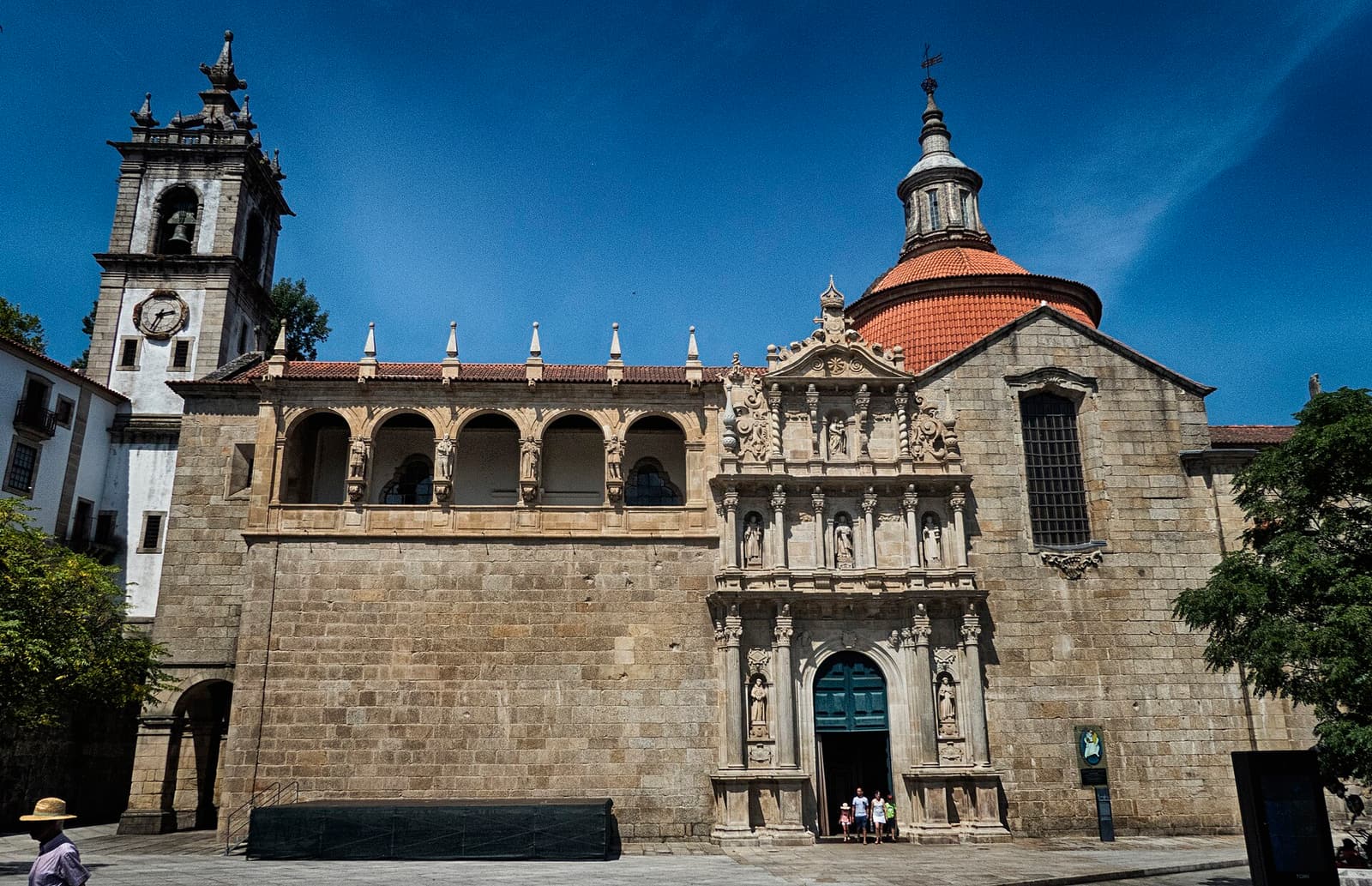
The Church and Convent of São Gonçalo in Amarante: a Renaissance and Baroque complex above the Tâmega, with the Balcony of the Kings and the tomb of São Gonçalo.
- Location
- Amarante, Porto
- Built
- 1543–1600
- Style
- Renascimento, Maneirismo e Barroco
On the banks of the river Tâmega, in the town of Amarante, the complex of the Church and Convent of São Gonçalo is one of the most recognisable landmarks in northern Portugal. Its silhouette — a compact granite façade, an azulejo-clad dome and the famous sculptural balcony facing the bridge — has lodged itself in the region’s collective imagination, where the patron saint is venerated as a protector of marriages and the local patron.
A royal foundation and a medieval saint
The decision to raise the monastery fell to King João III and Queen Catherine of Austria, in 1540, on a site where, according to tradition, a hermitage founded in the thirteenth century by São Gonçalo of Amarante had once stood. A Dominican beatus, Gonçalo is said to have lived as a hermit beside the Tâmega, and the memory of his popular devotion led the crown to entrust the new convent to the Order of Preachers. Work began in 1543 and the essential fabric of the building was complete before 1600, by then under the reign of the Philips.
The long duration of the works — almost six decades — made São Gonçalo a rare showcase, within a single building, of the transition from the Renaissance to Mannerism and then to the Baroque.
A façade that tells the story of Portuguese art
The lateral front, facing the river and the town of Amarante, is the most celebrated part of the complex. It is structured as a great portal-altarpiece of three superimposed registers: the lower one in Renaissance grammar; the middle one already Mannerist; and the upper one Baroque. Above it opens the so-called Balcony of the Kings, a gallery with statues of João III, Sebastião, Henrique and Philip II of Spain — the monarchs who reigned during the building of the church. This dynastic sequence carved in stone, begun in 1683, is at once ornament and political document, asserting royal continuity over the conventual patronage.
The interior, with a single nave and a barrel vault, holds in the right transept the saint’s tomb, the object of centuries-old pilgrimage. Also of note is the pipe organ built in 1766 by the Galician organ-builder of Braga, Francisco António Solha, subject to a complete restoration finished around 2010.
The cloister, the convent and its modern fate
Adjoining the church extends the cloister, raised between 1586 and 1606, with a central fountain attributed to Mateus Lopes — a serene space that contrasts with the exuberance of the riverside façade. With the dissolution of the religious orders in 1834, the Dominican convent was suppressed and its quarters changed function over time. Today the church is the town’s parish church and part of the former monastery houses the Amadeo de Souza-Cardoso Municipal Museum, dedicated to the modernist painter born in the region.
The Church and cloister of São Gonçalo have been classified as a National Monument since 1910. The complex belongs to a network of northern religious architecture that ranges from the Romanesque austerity of the Church of São Martinho de Mouros to the Benedictine monumentality of the Monastery of Pombeiro, passing through the idioms of Portuguese Renaissance painting and, later, the Joanine Baroque that renewed so many of the country’s interiors. At São Gonçalo, all these currents seem to coexist, layered by the patient hand of generations of stonemasons on the banks of the Tâmega.
Frequently asked questions
- When was the Church of São Gonçalo in Amarante built?
- Construction began in 1543, following a decision taken in 1540 by King João III and Queen Catherine of Austria, and most of the complex was completed before 1600. Later campaigns, such as those on the portal and the Balcony of the Kings, continued into the seventeenth century.
- Where is the tomb of São Gonçalo?
- The tomb of São Gonçalo of Amarante lies in a chapel to the right of the high altar. Popular tradition credits him with matchmaking powers, and devotees customarily touch or kiss the tomb chest.
- Does the church still belong to the Dominican friars?
- No. The Dominican convent was dissolved following the suppression of the religious orders in 1834. Today the church serves as the parish church of Amarante, and part of the conventual quarters houses the Amadeo de Souza-Cardoso Municipal Museum.
Sources
Keep exploring
Heritage nearby
More places to discover from here. Approximate straight-line distances, within 50 km.