Monuments
Monastery of Santa Maria de Pombeiro
The Monastery of Santa Maria de Pombeiro in Felgueiras is a Benedictine Romanesque house with Baroque facade and gilded woodwork, a National Monument on the…
- Location
- Felgueiras, Porto
- Built
- Séc. XII (igreja românica); 1719–1722 (fachada barroca)
- Style
- Românico e Barroco
The Monastery of Santa Maria de Pombeiro rises in the parish of Pombeiro de Ribavizela, in the municipality of Felgueiras, on a plateau of the Sousa Valley that once intersected some of the main medieval routes between the Douro and Minho regions. A Benedictine house with a long memory, it combines in a single structure a 12th-century Romanesque church and an exuberant 18th-century Baroque intervention, now standing as one of the highlights of the Romanesque Route. It was classified as a National Monument in 1910.
From medieval origins to Benedictine immunity
The monastic community of Pombeiro has been documented since 853, though tradition associates the foundation of the monastery at its current site with the mid-11th century. The decisive impulse came from the powerful Sousa family: Egas Gomes de Sousa generously endowed the house in 1102, and a few years later, in 1112, Queen Teresa granted it a charter of immunity, ensuring jurisdictional autonomy over a vast territory. Under the Order of Saint Benedict, Pombeiro became one of the most influential religious and economic centers in the region, controlling lands, churches, and rights extending far beyond parish boundaries.
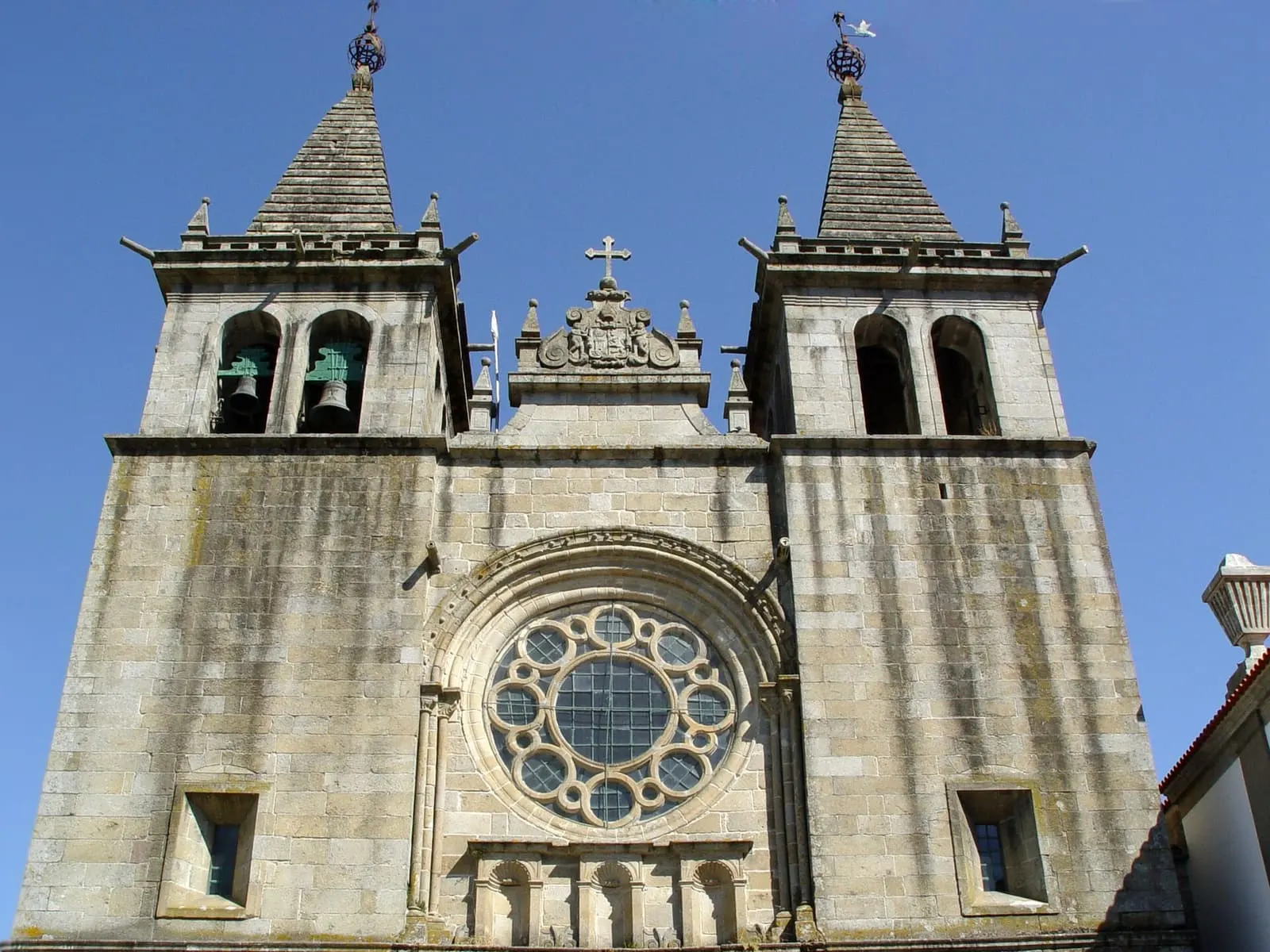
The frank juxtaposition of the Romanesque portal and Baroque facade makes Pombeiro a stone textbook: in a single glance, one reads the long duration of Portuguese monastic architecture.
The Romanesque church
From the medieval campaign, the church survives predominantly, with its three-nave plan terminating in eastern apses. The most notable element is the axial portal of the facade, organized with archivolts resting on columns whose capitals display some of the most expressive examples of Romanesque sculpture in the Sousa Valley, populated with vegetal and zoomorphic motifs. These solutions belong to the so-called nationalized Romanesque style that flourished in the Sousa and Tâmega basins, sharing a common grammar with neighboring houses like the Monastery of Paço de Sousa and fitting within the evolution of Romanesque architecture in Portugal.
The great Baroque workshop
It was in the Early Modern period that the monastery acquired the monumental appearance that impresses visitors today. The facade towers were erected starting in 1629, and between 1719 and 1722, under the direction of Friar Bento da Ascenção, the wall section between them was extended and redesigned in Baroque language, with niches for statues of Our Lady, Saint Benedict, and Saint Scholastica. The interior followed this transformation: the chancel, upper choir, and an extensive gilded woodwork program completely renewed the liturgical space.
The most celebrated woodwork is attributed to Friar José de Santo António Ferreira Vilaça, who between 1770 and 1777 executed in Rococo style some of the altarpieces and carved furniture, among the finest ensembles in northern Portugal. The pipe organ, attributed to the workshop of Francisco António Solha and completed around 1783, completes this decorative program, representative of the pinnacle of Baroque architecture in Portugal applied to great monastic complexes.
Decline and memory
The modern history of the monastery was marked by violence: during the second French invasion in 1809, Soult’s troops burned part of the building. With the dissolution of religious orders in 1834, the community dispersed, and the complex suffered looting and partial demolitions, losing much of its conventual dependencies. The church, however, remained in parish use and survives today as the greatest testimony of Benedictine art between the Sousa and Tâmega rivers—a monument where nine centuries of faith and stone remain legible on the same facade.
Frequently asked questions
- Where is the Monastery of Pombeiro located?
- It is situated in the parish of Pombeiro de Ribavizela, in the municipality of Felgueiras, Porto district, integrated into the Romanesque Route of the Sousa Valley.
- Which religious order occupied the monastery?
- It was a house of the Order of Saint Benedict (Benedictines), documented since 853 and granted a charter of immunity in the early 12th century.
- Why does it have a Baroque facade over a Romanesque church?
- The church is Romanesque from the 12th century, but between 1719 and 1722 the facade was extended and redesigned in Baroque style with niches and new ornamentation, preserving the medieval structure behind it.
Sources
Keep exploring
Heritage nearby
More places to discover from here. Approximate straight-line distances, within 50 km.