Places
Ponte de Lima
Ponte de Lima, in the district of Viana do Castelo, claims the title of Portugal's oldest town, with its Roman and medieval bridge over the Lima River.
- Location
- Ponte de Lima, Viana do Castelo
- Built
- 1125 (foral)
On the banks of the Lima River, in the heart of Alto Minho, the town of Ponte de Lima proudly bears a singular title: Portugal’s oldest town. The claim rests on the charter granted on 4 March 1125 by Countess D. Teresa of León, mother of D. Afonso Henriques, who “made a town of the place of Ponte”. Although other charters predate it chronologically — Viseu and Porto in 1123, Sernancelhe in 1124 — tradition reserves for Ponte de Lima the status of first chartered royal town in what would become the kingdom.
The bridge that named the town
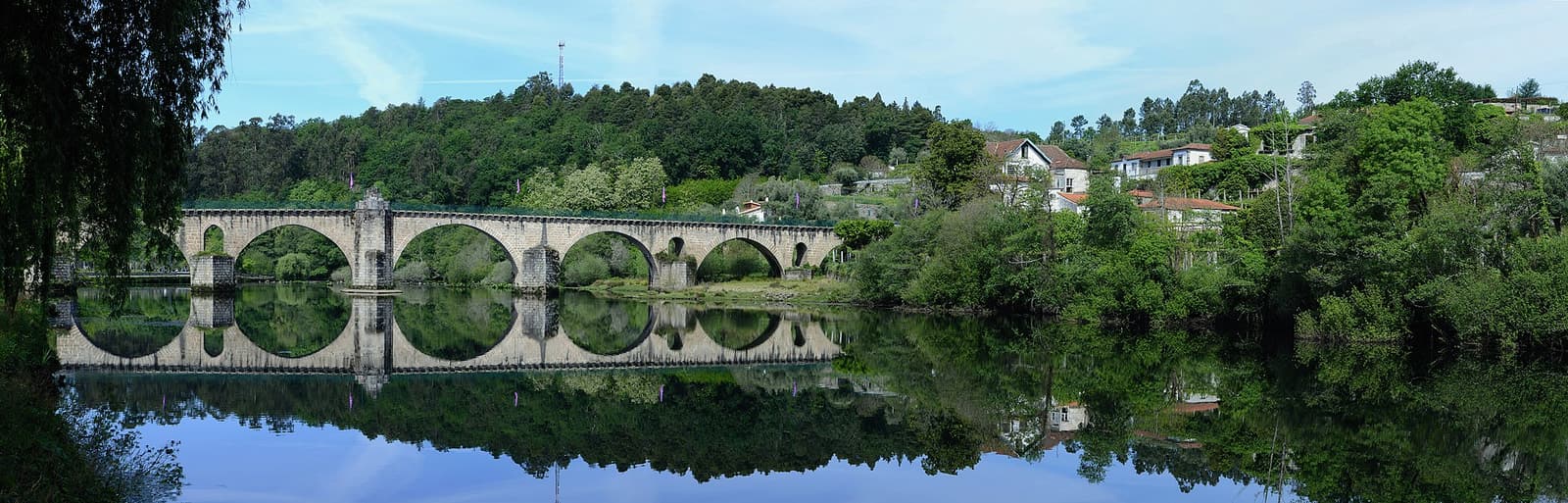
The place takes its name from the crossing itself. The bridge over the Lima River is, in fact, two bridges layered by history. The oldest dates to the 1st century, built when Via XIX of the Antonine Itinerary was opened, the Roman military road linking Bracara Augusta to Asturica Augusta, that is, Braga to Astorga, crossing Minho en route to Galicia. Remnants of this structure remain on the right bank: the characteristic cushioned masonry arches of Roman bridges, wider and more austere.
The dominant section, however, is medieval. Rebuilt in Gothic style with pointed arches, prismatic cutwaters upstream, and carefully dressed stonework, the structure became part of the town’s defensive system and was even fortified with towers. It stands as a prime example among Portuguese medieval bridges, classified as a National Monument since 1910.
The bridge is not just a monument: it is the raison d’être of the place. Without it there would be no crossing, without crossing no town, and without town none of the history Ponte de Lima has told for nine centuries.
A historic centre of stone and granite
Walled by initiative of D. Pedro I in the 14th century, the town preserved part of its enclosure, including surviving towers like the Cadeia Velha. But it’s the housing that most impresses: Ponte de Lima boasts one of Portugal’s largest collections of manor houses and Baroque mansions, arranged along streets and squares descending to Largo de Camões and its Renaissance fountain from 1603. The Monastery of Refoios, founded in the 12th century, completes a heritage that weaves medieval, Renaissance and Baroque elements into an urban fabric of remarkable coherence.
The town belongs to the district of Viana do Castelo, at the country’s northwestern edge, and today stands as one of the most distinctive points in Minho’s Norte, land of green wine and landscapes flooded by the Lima.
Path of pilgrims and fairs
Across the bridge have passed, through the centuries, armies, merchants and pilgrims. Ponte de Lima is a stage on the Central Portuguese Way to Santiago, and the crossing of the Lima still marks the rhythm of those bound for Compostela. The town maintains vibrant rooted festivities, with the Feiras Novas animating the calendar since 1826, and a gastronomy where arroz de sarrabulho holds pride of place. Between Roman memory, medieval fortification and Baroque opulence, Ponte de Lima remains one of the places where Portugal’s long historical duration is best read.
Frequently asked questions
- Why is Ponte de Lima considered Portugal's oldest town?
- The town received its charter on 4 March 1125, granted by Countess D. Teresa of León, mother of D. Afonso Henriques. Although other places have earlier charters, Ponte de Lima claims the title as the oldest to be officially granted town status by royal decree.
- Is the bridge over the Lima River Roman or medieval?
- It is both. The crossing preserves remnants of the 1st-century Roman bridge, connected to Via XIX linking Bracara Augusta (Braga) to Asturica Augusta (Astorga), and a Gothic-style medieval section built in the Late Middle Ages.
- In which district is Ponte de Lima located?
- Ponte de Lima belongs to the district of Viana do Castelo in Alto Minho, at the northwestern edge of mainland Portugal, by the Lima River.
Sources
Keep exploring
Heritage nearby
More places to discover from here. Approximate straight-line distances, within 50 km.