Monuments
The Fortress of Almeida
The Fortress of Almeida, a twelve-pointed star-shaped bastioned stronghold on the Beira frontier, is one of the finest examples of Vauban military architecture…
- Location
- Almeida, Guarda
- Built
- 1641–1762
- Style
- Arquitetura militar abaluartada (sistema Vauban)
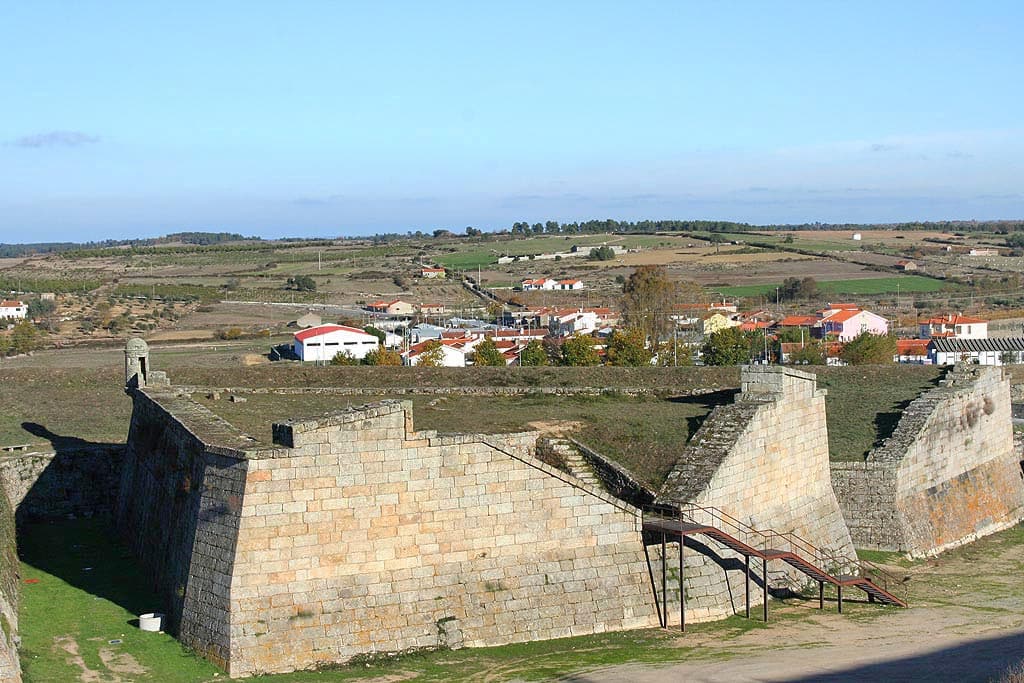
The Fortress of Almeida rises in the far north-east of the Beira Alta, in the district of Guarda, a few kilometres from the Spanish border. Seen from above, it traces on the ground a twelve-pointed star, perfect and regular, which makes it one of the most accomplished examples of bastioned fortification in Portugal. The town of Almeida lies entirely contained within the walled enclosure — not an isolated castle, but a fortress-town designed as a single defensive organism.
From the medieval wall to the bastioned star
Almeida was a contested stronghold from the Middle Ages, equipped with a castle and a wall, owing to its position guarding the valleys that lead into Castile. It was, however, the Restoration of Independence in 1640 that radically transformed the site. Facing the imminence of war with Spain, the Crown decided to convert the old town into a frontier bastion capable of resisting modern artillery. Work on the bastioned fortress began in 1641, under the direction of the governor of arms of the Beira, Álvaro de Abranches, and continued for more than a century, with decisive interventions during the Seven Years’ War and the military reorganisation promoted by the Count of Lippe in the 1760s.
The result is a coherent system of six bastions — São Pedro, da Bandeira, Nossa Senhora das Brotas, Santa Bárbara, São João de Deus and São Francisco — linked by curtain walls and protected by six advanced ravelins, dry moats and covered ways. Every angle of the complex was conceived so that no face of the wall would be left without the flanking fire of a neighbouring bastion.
In a bastioned fortress there are no walls to defend walls: each projection exists to sweep the base of the next. It is this relentless geometry that gives Almeida its star-like appearance.
A key to the Beira frontier
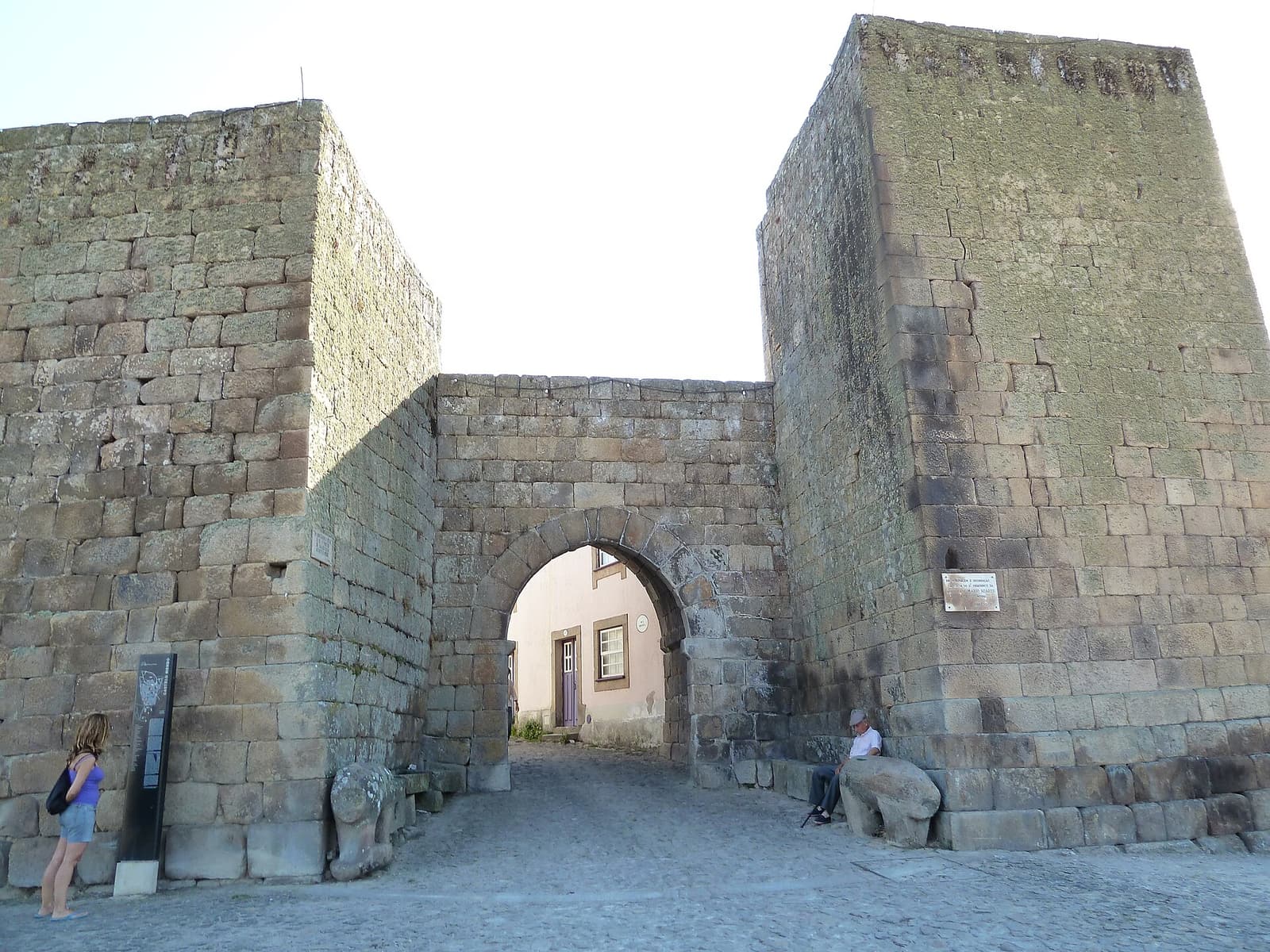
By virtue of its location and robustness, Almeida became one of the principal military keys of the north-eastern frontier, a role it shared with the neighbouring stronghold of Castelo Rodrigo and with the wider system of bastioned fortresses erected along the Luso-Spanish frontier. Entry into the stronghold is still made today through monumental gates in vaulted tunnels — the Portas de São Francisco and the Portas de Santo António — crossing two successive lines of wall that clearly illustrate the defensive depth of the complex.
The most dramatic episode of its history occurred during the Peninsular War. Taken by Napoleonic troops, Almeida was besieged in 1810 by Masséna’s army. During the bombardment, a spark struck the main magazine: the explosion razed the old medieval castle and the parish church, caused hundreds of deaths and forced the immediate surrender of the stronghold. The ruins of the castle, still visible inside, are the most eloquent testimony of that disaster.
Heritage and World Heritage candidacy
Classified as a National Monument in 1928, the Fortress of Almeida lost its military functions in the early twentieth century, but preserved intact its extraordinary urban and defensive integrity. Today it is part of the network of the Historic Villages of Portugal and is one of the central components of the indicative list of the bastioned fortifications of the frontier submitted to UNESCO, alongside strongholds such as the frontier garrison of Elvas, already inscribed on the World Heritage List. For those travelling along the Beira frontier, Almeida offers the rare possibility of walking over the bastions and reading, in the terrain itself, the logic of early modern siege warfare.
Frequently asked questions
- Why does the fortress of Almeida have a star shape?
- The twelve-pointed star plan results from the bastioned layout: six projecting bastions and six outer ravelins eliminate dead angles and allow the crossfire of flanking fire, the central principle of modern fortification codified by Vauban.
- What destroyed the medieval castle of Almeida?
- During the French siege of 1810, in the Peninsular War, the explosion of the main magazine razed the old medieval castle and the parish church, causing hundreds of deaths and precipitating the surrender of the stronghold.
- Is Almeida still an inhabited fortress?
- Yes. The historic town of Almeida still occupies the interior of the walled enclosure, making it one of the few Portuguese settlements entirely contained within a functioning bastioned fortress as an urban centre.
Sources
Keep exploring
Heritage nearby
More places to discover from here. Approximate straight-line distances, within 50 km.