Monuments
Fort of São João Baptista das Berlengas
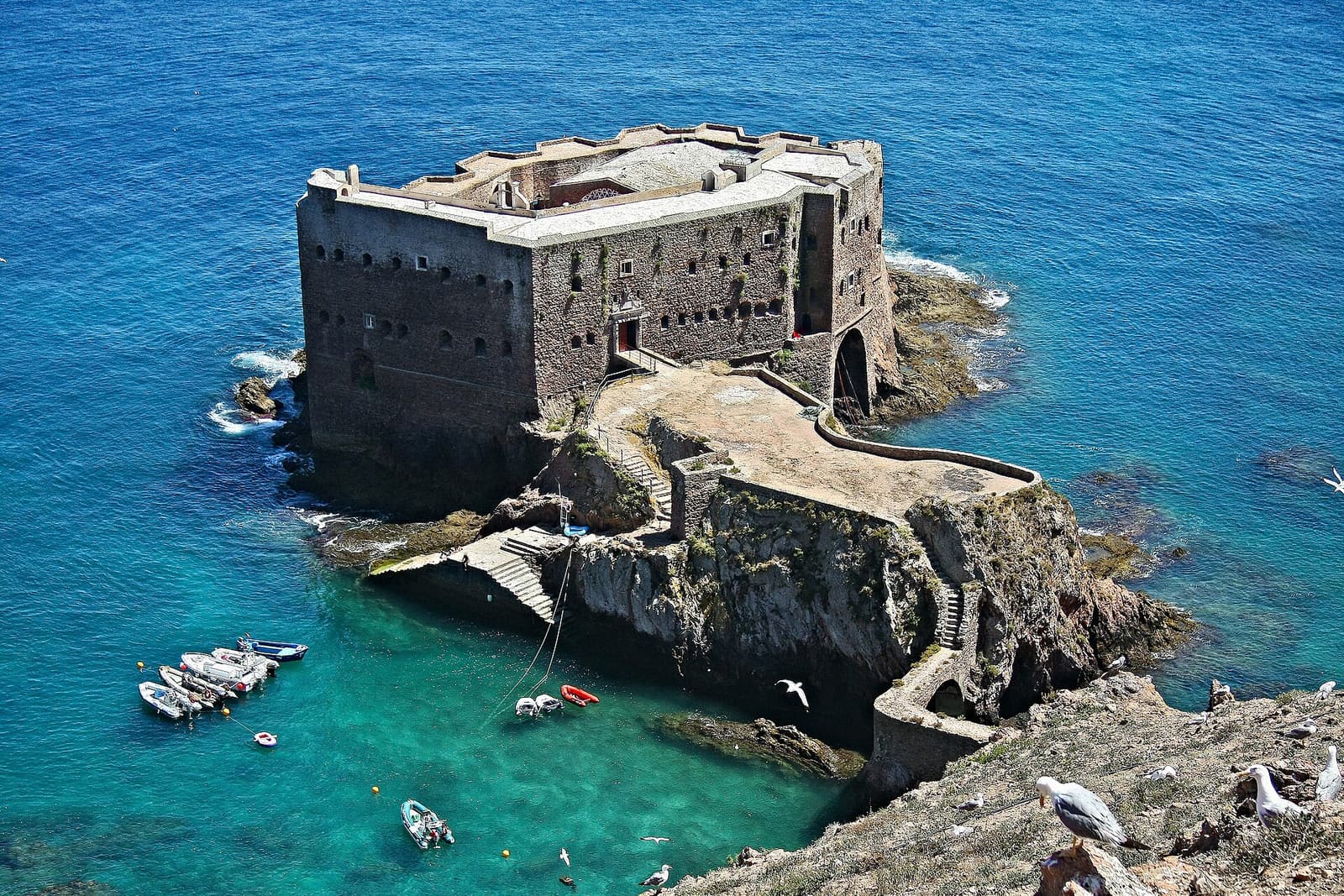
Seventeenth-century Fort of São João Baptista, on the island of Berlenga Grande off Peniche, a maritime fortress and National Monument since 1938.
- Location
- Peniche, Leiria
- Built
- 1651–1656
- Style
- Arquitetura militar seiscentista
The Fort of São João Baptista das Berlengas rises on a small rocky islet next to Berlenga Grande, the largest island of the Berlengas archipelago, which lies off Peniche in the district of Leiria. Set on an outcrop battered by the Atlantic and linked to the island by a narrow stone bridge, it is one of the most singular examples of Portuguese maritime military architecture and has been classified as a National Monument since 1938.
From monastery to fortress
The site was occupied before the fortification was built. Around 1513, under the patronage of Queen Leonor, monks of the Order of Saint Jerome settled on the island, founding a monastery whose mission included aiding navigation and rescuing the victims of the frequent shipwrecks along that coast. The isolation, the harshness of the climate and the exposure to corsair attacks made monastic life difficult, and the community ultimately abandoned the site over the course of the sixteenth century.
During the Restoration War (1640–1668), King João IV’s Council of War recognised the strategic value of Berlenga as an advanced coastal watch post. In 1651 it was decided to demolish the ruins of the monastery and reuse its stone in building a new fortress, completed around 1656. Still under construction, in 1655 the structure withstood a first attack by corsair vessels.
Siege and decline
The fort’s most celebrated military episode took place in 1666, when a far superior Spanish fleet laid siege to the garrison. Despite the enormous disparity of forces, the defenders held out for several days before surrendering, a feat that entered the nation’s heroic memory. The fortress would again play an active role during the Portuguese Civil War (1828–1834), then in Miguelist hands, serving as a base for the Liberals in the assault on the nearby Fortress of Peniche.
As armaments evolved throughout the nineteenth century, the fort lost its military relevance and was decommissioned of its artillery in 1847, going on to serve as a support for fishing. Its polygonal plan, with seaward faces pierced by gun embrasures and casemates set against the landward side, clearly illustrates the type of coastal fortification that protected the Atlantic seaboard, belonging to the world of Portuguese coastal forts and to the great family of castles and defensive structures of the country.
Restoration and present-day uses
In the mid-twentieth century, the fort was partially restored and adapted into accommodation, operating as a simple guesthouse for visitors to the island. Berlenga Grande is today part of a nature reserve and has been recognised as a Biosphere Reserve by UNESCO, combining the protection of built heritage with the conservation of a marine and ornithological ecosystem of great value. Access is by boat from Peniche, on seasonal services, and the ensemble formed by the island, the islet and the fort is one of the most striking sights of the western Portuguese coast.
Frequently asked questions
- Where is the Fort of São João Baptista das Berlengas?
- It stands on a rocky islet next to Berlenga Grande, in the Berlengas archipelago off Peniche (district of Leiria), connected to the island by a narrow bridge.
- When was the fort built?
- It was ordered built by King João IV during the Restoration War, with works carried out between 1651 and 1656, on the ruins of a former Hieronymite monastery.
- Is the fort classified as a National Monument?
- Yes, it has been classified as a National Monument since 1938.
Sources
Keep exploring
Heritage nearby
More places to discover from here. Approximate straight-line distances, within 50 km.