Monuments
Sanctuary of Our Lady of Remedies (Lamego)
Rococo sanctuary in Lamego, on Santo Estêvão Hill, renowned for its monumental blue-and-white tiled staircase and September pilgrimage.
- Location
- Lamego, Viseu
- Built
- 1750–1905
- Style
- Barroco e Rococó
At the summit of Santo Estêvão Hill, dominating the episcopal city of Lamego, rises the Sanctuary of Our Lady of Remedies — one of the most scenographic devotional ensembles of Portuguese Baroque and Rococo. More than just a church, it is a program of religious staging that combines architecture, sculpture, water, and tiles along a hillside, guiding pilgrims step by step from urban bustle to the temple’s forecourt.
From medieval origins to the Rococo temple
Devotion on this hillock is ancient. A chapel dedicated to Saint Stephen once stood here, documented in the mid-14th century, which gave the hill its name. Threatened with ruin, it was demolished in 1568, making way for a new temple through episcopal initiative. The dedication eventually changed to Our Lady of Remedies, and under this patronage the foundation stone of the sanctuary we know today was laid in 1750. Construction dragged on for over a century and a half, with the facade and interior works extending into the early 20th century.
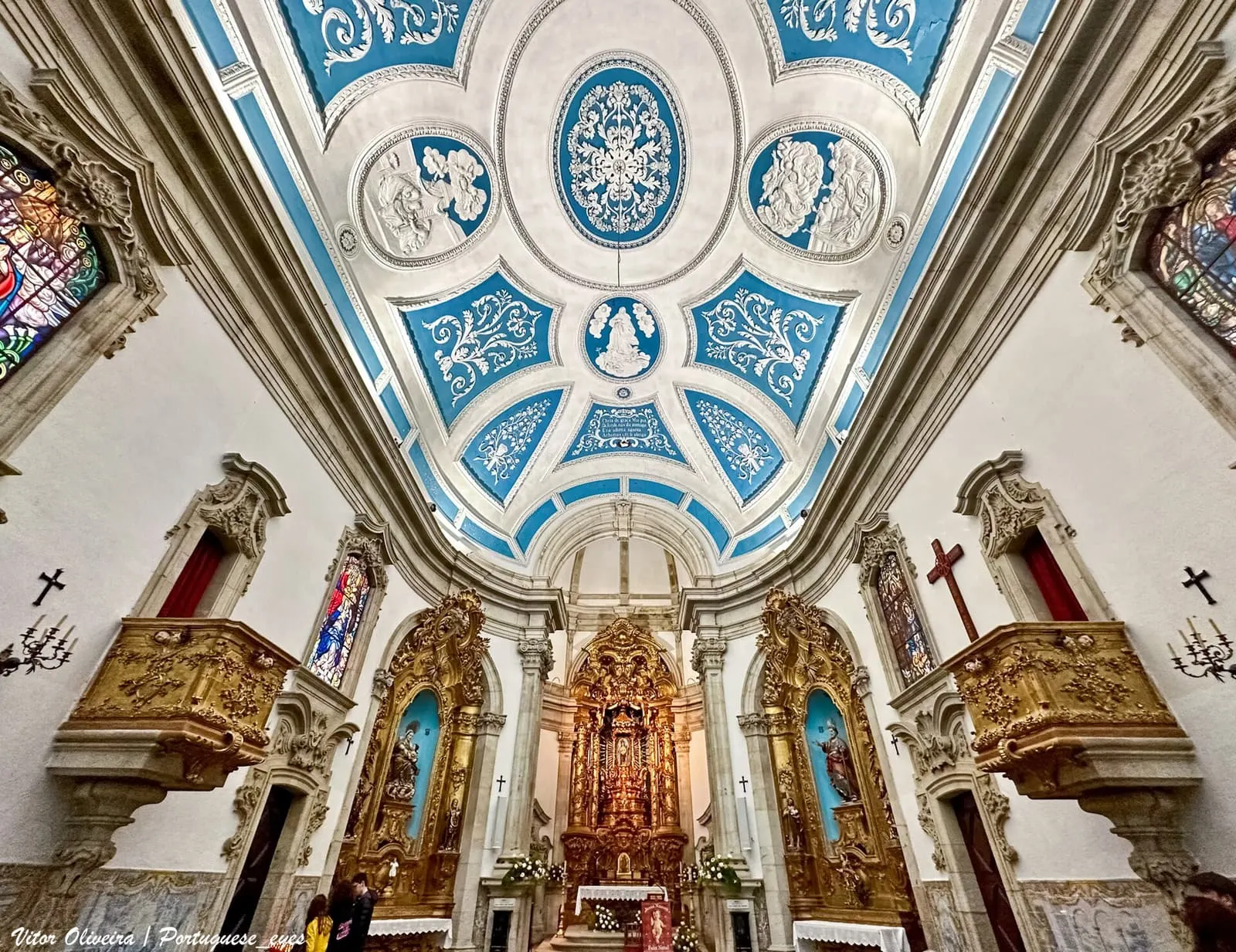
The church features a Latin cross plan and a balanced facade flanked by two bell towers with bulbous spires, characteristic of the Trás-os-Montes and Douro regions. Inside, gilded woodwork and decoration blend Rococo taste with Neoclassical elements; the main altar venerates a wooden image of Our Lady of Remedies, with stained-glass windows depicting Marian scenes.
The staircase: a theater of stone and water
However, what made the sanctuary famous is not the church but its approach. Designed in the second half of the 18th century and completed in the 20th century, the staircase conquers the hillside with approximately 700 steps organized across nine landings, in a play of converging and diverging flights that multiplies viewpoints. Granite stone dialogues with blue-and-white tiles covering walls and fountains, while the route is punctuated by urns, obelisks, statues, and fountains of clear symbolic meaning.
The staircase isn’t just for climbing: it’s a visual narrative that spiritually prepares those who traverse it, transforming the effort of ascent into a devotional journey.
The highlight of this setting is the Kings’ Courtyard, a terrace populated with figures evoking biblical kings that concludes the climb before the forecourt. This solution belongs to the same family as the great Marian staircases of the North, inevitably inviting comparison with the Sanctuary of Bom Jesus do Monte in Braga, with which it shares the logic of devotional theatricalization and which fits within Rococo in Portugal.
Pilgrimage, landscape, and classification
The sanctuary hosts one of the largest religious festivals in Northern Portugal. The Our Lady of Remedies celebrations occur in early September, peaking on the 8th with the imposing Triumph procession, traditionally pulled by oxen teams. The pilgrimage attracts thousands and integrates into the long tradition of sanctuaries and pilgrimage sites dotting the Portuguese territory.
Its elevated position grants the ensemble remarkable landscape value, with sweeping views over Lamego and the valley, a short distance from the Alto Douro Wine Region, a UNESCO World Heritage Site. The monument is classified as a Property of Public Interest and stands, alongside Lamego Cathedral, as one of the identity markers of this ancient Douro city.
Frequently asked questions
- How many steps does the Sanctuary of Remedies staircase have?
- The monumental staircase ascends Santo Estêvão Hill with approximately 700 steps, distributed across nine landings and adorned with fountains, statues, obelisks, and blue-and-white tile panels.
- When does the Our Lady of Remedies pilgrimage take place?
- The festival, one of the largest pilgrimages in Northern Portugal, occurs in early September, culminating on the 8th with the famous Triumph procession, traditionally pulled by oxen teams.
- Where is the Sanctuary of Our Lady of Remedies located?
- It stands on Santo Estêvão Hill, overlooking the city of Lamego in Viseu District, connected to the historic center by the staircase that forms its scenic axis.
Sources
Keep exploring
Heritage nearby
More places to discover from here. Approximate straight-line distances, within 50 km.