Monuments
Faro Cathedral
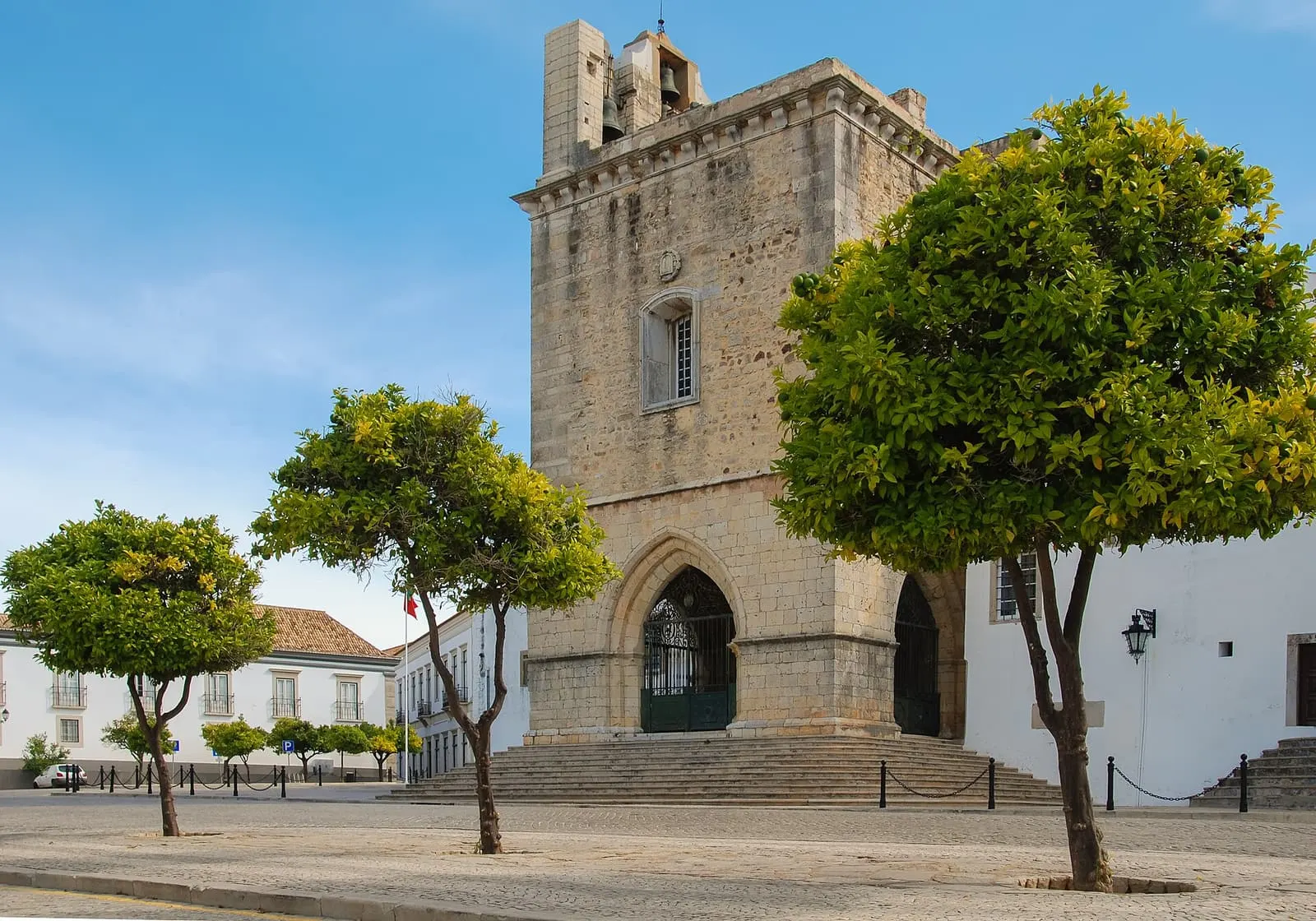
Faro Cathedral, a medieval cathedral built in the Algarve's old town quarter atop an ancient mosque, featuring Gothic façade and a celebrated Baroque organ…
- Location
- Faro, Faro
- Built
- 1251 (séc. XIII); ampliações até séc. XVIII
- Style
- Gótico, maneirista e barroco
In the heart of vila-adentro, the oldest walled nucleus of Faro, stands the Cathedral, a building that encapsulates nearly eight centuries of Algarve history. Situated at Largo da Sé, one of the highest points in the old town, it marks Faro’s transition into a bishopric seat and the symbolic center of a Christianized Algarve after the Reconquista.
From origins to Christian foundation
Construction of the Christian temple began in 1251, just years after Afonso III took Faro from the Moors, completing Portugal’s continental Reconquista. Tradition claims the church was built over a mosque and, earlier still, a Paleochristian basilica – a plausible succession of worship sites, though unconfirmed archaeologically. The initial structure was modest and soon proved inadequate: it was expanded from 1321 under King Dinis and substantially remodeled throughout the 15th century.
From this medieval period remain the façade’s most expressive elements: the sturdy bell tower, main arched portal, and transept chapels – Gothic traces that survived later tribulations.
Cathedral of the Algarve
The building’s pivotal moment came in 1577 when the Algarve’s episcopal see transferred from Silves to Faro. The former Church of Santa Maria thus became a cathedral, reflecting the region’s political and economic center shifting to this riverside city by the Ria Formosa.
Its new status didn’t spare it severe trials. In 1596, during the Earl of Essex’s English forces’ sacking of Faro, the temple was burned and ruined. Subsequent damage came from the 1722 earthquakes and especially the great 1755 earthquake, necessitating repeated reconstruction campaigns.
Faro Cathedral isn’t a single-style monument but a palimpsest: each catastrophe left it more marked by its era’s architecture, and this stratification makes it so eloquent today.
An interior of many periods
These reconstructions created the building’s composite character, where medieval Gothic, Mannerist estilo chão, and Baroque exuberance coexist. The longitudinal floor plan divides into three naves separated by round arches on Doric columns, extending into a chancel and side chapels.
The interior features extensive 17th-18th century blue-and-white azulejo panels covering walls and chapels with hagiographic scenes and ornamental motifs. The most celebrated piece is the early 18th-century Baroque organ, decorated with chinoiserie paintings from circa 1751 – a rarity among Portugal’s historic organs where European chinoiserie taste infiltrated liturgical furnishings.
From the visitor-accessible tower unfolds views of Ria Formosa and the old town’s rooftops, framing the cathedral within the lagoon landscape defining this stretch of the Algarve coast. As part of Portugal’s cathedrals, Faro Cathedral was classified as a Public Interest Monument in 1955, recognizing its heritage value as the city’s foremost religious monument.
Frequently asked questions
- Was Faro Cathedral built over a mosque?
- Tradition holds that the cathedral was erected over an Islamic mosque and, prior to that, over a Paleochristian temple. Christian construction began in 1251, shortly after Afonso III's conquest of Faro, but direct superimposition over the mosque hasn't been confirmed by archaeological evidence.
- When did Faro become the seat of the Algarve's bishopric?
- The transfer of the episcopal see from Silves to Faro occurred in 1577, elevating the Church of Santa Maria to the status of Algarve's cathedral.
- What's special about Faro Cathedral's organ?
- It's an early 18th-century Baroque organ, notable for its mid-1700s chinoiserie painted decorations – one of the most unique specimens of Portugal's historic organs.
Sources
Keep exploring
Heritage nearby
More places to discover from here. Approximate straight-line distances, within 50 km.