Archäologie
Pedra Formosa and Castro Bathhouses
The sauna-bathhouses of the Castro culture and their decorated 'Pedra Formosa' stones, Iron Age furnace monuments in the northwestern Iberian Peninsula.
- Lage
- Briteiros, Braga
- Errichtet
- séculos V a.C. – I d.C.
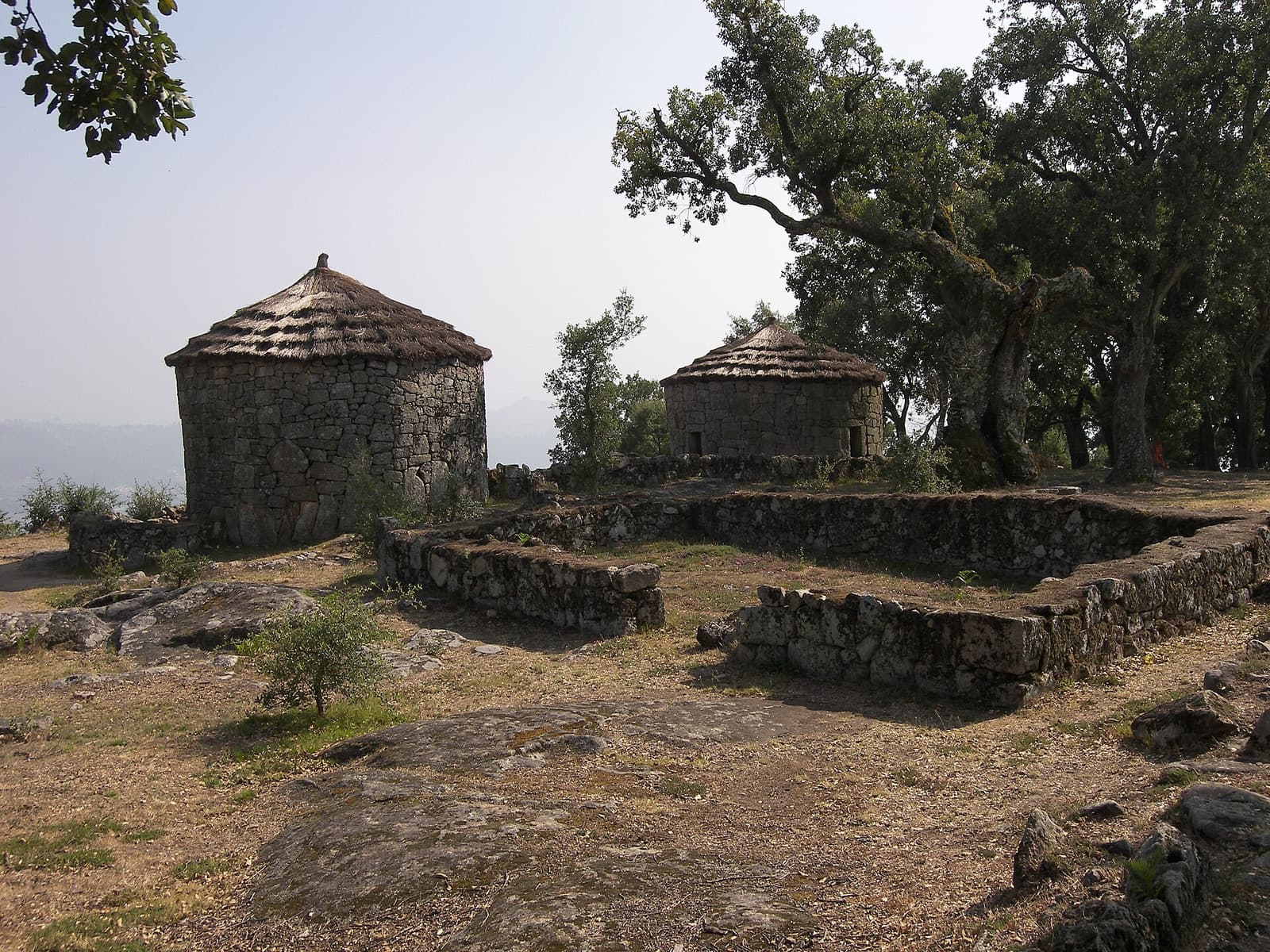
Among the most unique testimonies of the Castro culture in the northwestern Iberian Peninsula are the so-called sauna-bathhouses, or furnace monuments, and their remarkable Pedras Formosas. Built during the Iron Age, roughly between the 5th century BCE and the beginning of the Roman era, these structures were designed for steam and water baths, predating the thermal practices later popularized by the Romans by centuries. Today, around thirty examples are known, scattered across the territory stretching from the Douro River to Galicia, making them one of the most coherent and enigmatic architectural expressions of Castro communities.
The Architecture of the Bathhouse
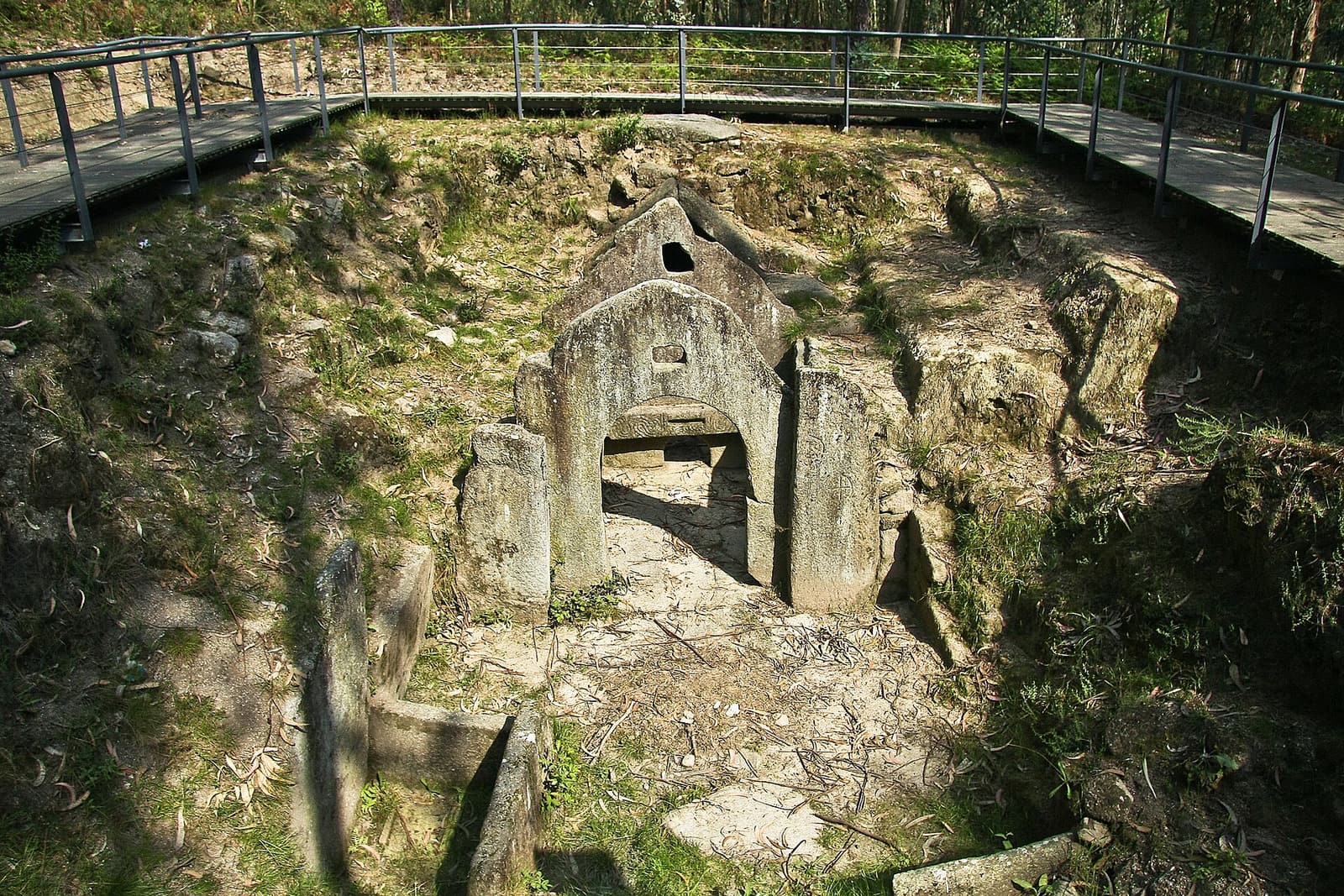
A Castro bathhouse typically consists of successive compartments arranged in a linear layout. An atrium or vestibule, sometimes equipped with a water tank, was used for cold baths; this was followed by a transitional anteroom and, at the far end, the steam chamber, heated by a circular furnace with a false dome, partially buried, where wood and scorching stones were burned. The separation between the hot chamber and the preceding spaces was marked by a large vertical monolith—the Pedra Formosa—pierced by a low, door-like opening that required those entering to stoop to access the innermost part of the building.
The narrow passage of the Pedra Formosa was not merely a construction detail: it marked the threshold between the ordinary world and a space of transformation, suggesting that the bath had as much to do with ritual as with hygiene.
The Decoration and Its Symbolism
What sets the Pedra Formosa apart from a simple slab is its bas-relief decoration. Geometric motifs—triangles, concentric circles, cords, ropes, and net-like compositions—unfold across the granite surface, organizing the facade into registers and framing the central opening. The meaning of these decorative programs remains debated, but their association with water, fire, and steam has led researchers to link them to water deities and the idea of purification and healing. The sacred nature of these places is one of the most discussed hypotheses in archaeology today, though no definitive consensus exists.
The Main Examples
The most emblematic example comes from Citânia de Briteiros in Guimarães: a granite block about three meters wide and over two meters tall, weighing approximately five tons, now preserved at the Museum of Castro Culture in Briteiros. It was discoveries like this that Francisco Martins Sarmento, in the last quarter of the 19th century, used to lay the foundations for the study of these monuments. The Citânia de Sanfins in Paços de Ferreira also features a bathhouse notable for its construction technique, and Castro das Eiras in Vila Nova de Famalicão, identified by Sarmento in 1880, includes a similar complex.
Further south, in Tongóbriga (Marco de Canaveses), a bathhouse with a Pedra Formosa was excavated, later buried under the construction of Roman baths—illustrating the continuity and overlap of bathing practices between the Castro and Roman worlds. This coexistence highlights the place of these structures in the long history of Iberian thermalism and their significance for understanding pre-Roman societies in Portuguese archaeology.
Häufige Fragen
- What is a Pedra Formosa?
- It is a stone monolith, usually granite and decorated with bas-relief carvings, which separated the compartments of a Castro bathhouse and provided access, through a small opening, to the hot steam and bathing chamber.
- What were Castro bathhouses used for?
- They were steam and water bath structures, similar to saunas, used by Iron Age communities in the northwestern Iberian Peninsula, possibly in purification rituals linked to water worship.
- Where can the most famous Pedra Formosa be seen?
- The most renowned Pedra Formosa comes from Citânia de Briteiros in Guimarães and is now displayed at the Museum of Castro Culture in Briteiros.
Quellen
Weiter entdecken
Kulturerbe in der Nähe
Weitere Orte in der Umgebung entdecken. Ungefähre Entfernungen als Luftlinie, im Umkreis von 50 km.