Monuments
Charola of the Convent of Christ
The Charola of the Convent of Christ, in Tomar, is the twelfth-century Templar rotunda, an oratory of centralised plan and the original nucleus of the…
- Location
- Tomar, Santarém
- Built
- c. 1160–1250
- Style
- Romanesque and late Romanesque, with Manueline reconfiguration
Within the walled perimeter of the castle of Tomar, in the district of Santarém, rises the Charola, the rotunda church that constitutes the original nucleus of the Convent of Christ. It is one of the rarest and most emblematic churches of centralised plan in medieval Europe, conceived by the Knights Templar as a private oratory and, by all indications, with probable sepulchral functions. It was from this octagonal body that, over almost five centuries, the whole of the remaining monumental complex developed.
The Templar rotunda
The Charola was raised in the second half of the twelfth century, in the context of the foundation of the castle by Gualdim Pais, master of the Order of the Temple, from 1160 onwards. The construction proceeded in successive campaigns, crossing the threshold between the Romanesque and the Gothic, extending until the middle of the thirteenth century. The result is a building of remarkable ingenuity: a polygonal ambulatory, with sixteen faces on the exterior, encloses a central octagonal body, the so-called charola-mor, linked to the surrounding gallery by arches.
The circular plan was not arbitrary. It evoked the great rotundas of the East — the Rotunda of the Holy Sepulchre in Jerusalem and the Dome of the Rock, then identified with the Temple of Solomon — models that the religious-military orders sought to reproduce as a symbolic affirmation of their mission. Over the central octagon rests a vault of crossed ogives, while the ambulatory is covered by a barrel vault.
The sixteenth-century pictorial programme
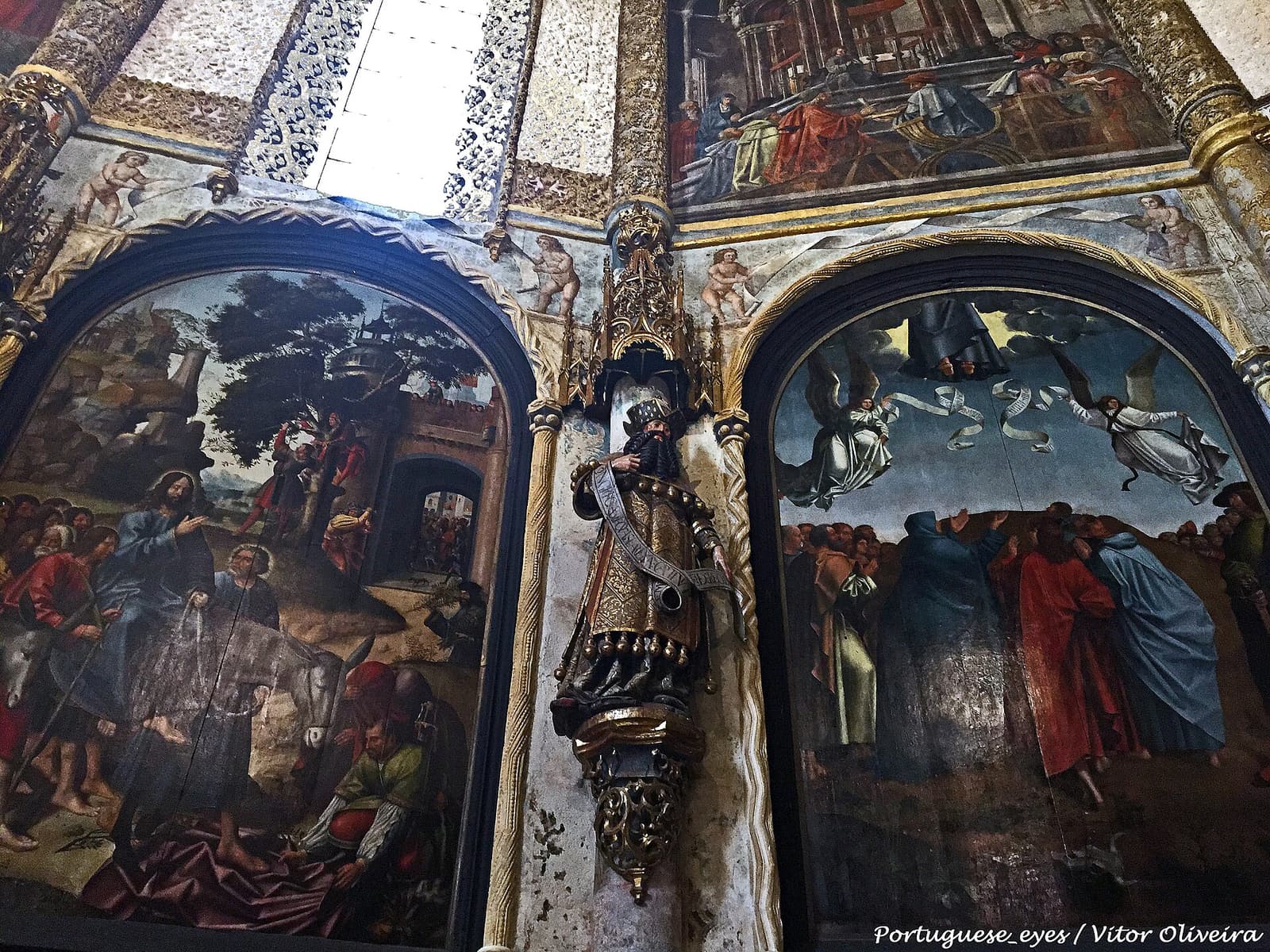
The appearance admired today in the interior is owed, in large measure, to the profound reconfiguration that took place in the sixteenth century. Under King Manuel I, the architect João de Castilho opened, around 1515, a triumphal arch that reoriented the access and linked the old Templar rotunda to a new nave, transforming the Charola into the chancel of a Manueline church. This intervention brought with it one of the richest decorative programmes of its time.
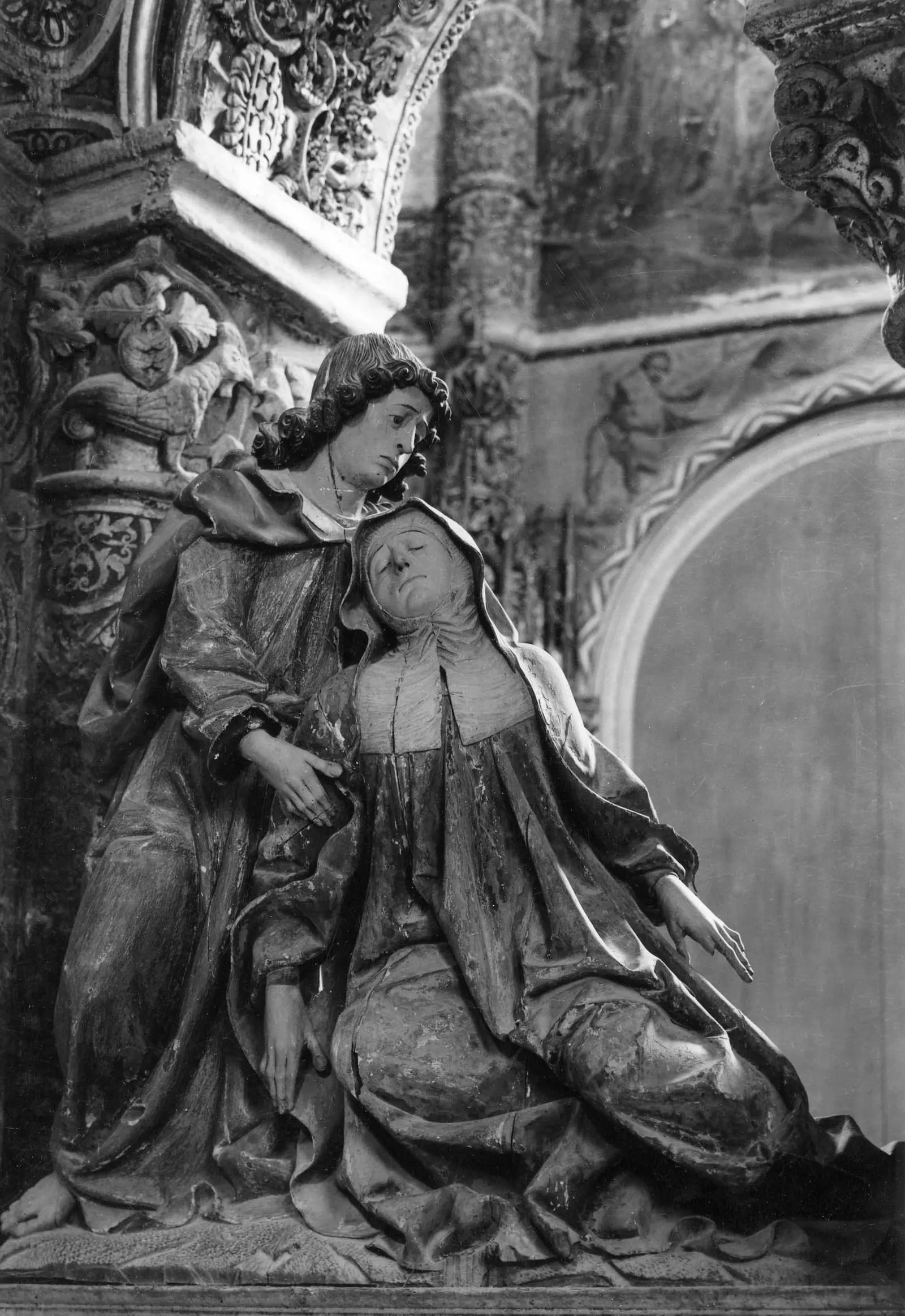
The walls and the supports received a vast ensemble of paintings, sculptures and gilded woodwork that confer on the space a rare scenographic character. The direction of the great panels painted with scenes of the Life and Passion of Christ is attributed to Jorge Afonso; the wooden statuary falls to Olivier de Gand; and to Fernão Anes the mural paintings with the instruments of the Passion, on the central drum. The vaults of the ambulatory were covered with fresco motifs — ribs, interlaced ropes, tree trunks, animals — in an ensemble of extraordinary visual density.
Significance and classification
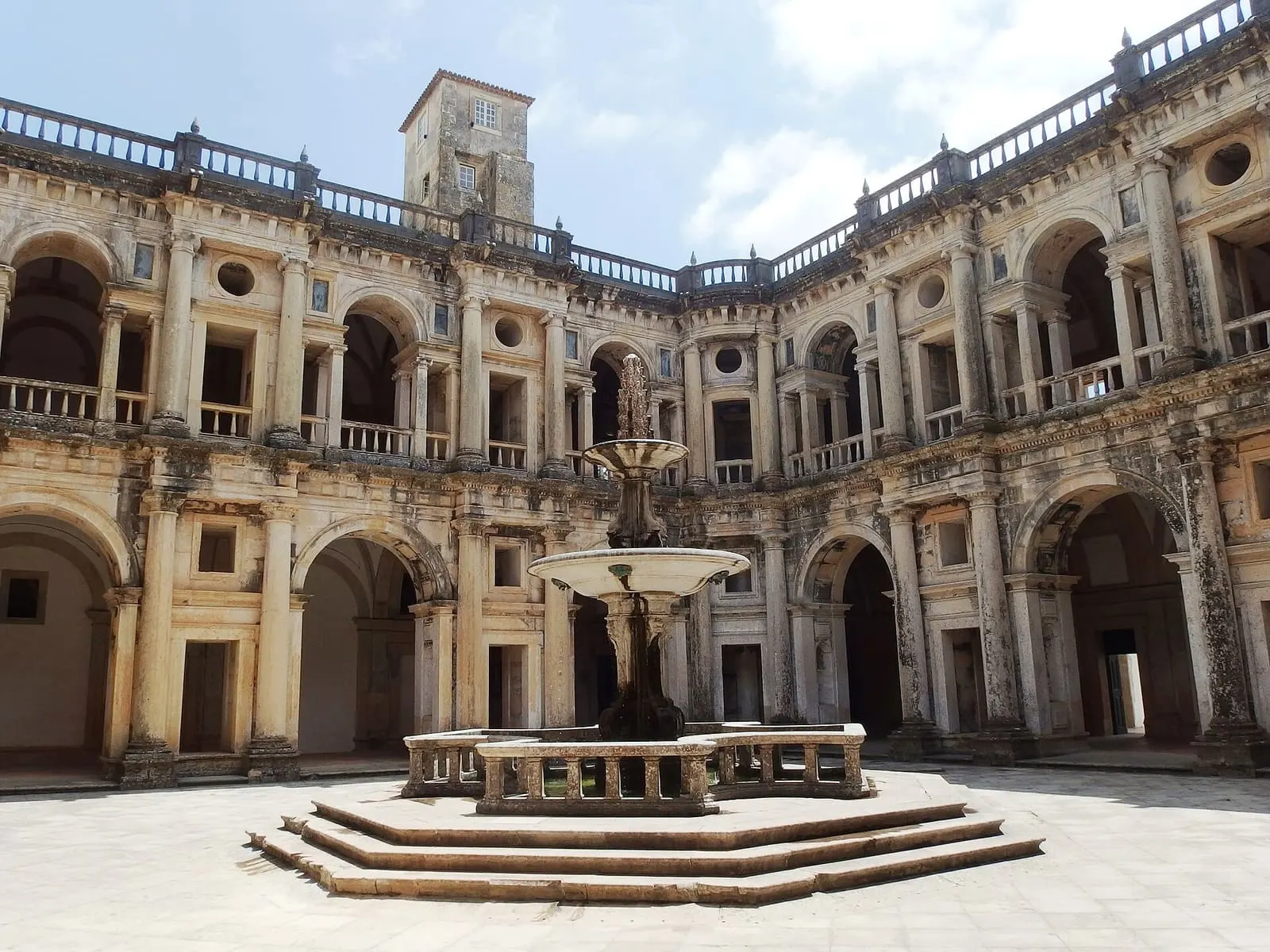
The Charola condenses, in a single space, the passage from the fortified austerity of the Templars to the splendour of the Order of Christ in the age of the Discoveries. This stratification places it among the foremost examples of Portuguese architecture, alongside monuments such as the Monastery of Batalha, and it dialogues directly with the later Renaissance campaigns, visible in the Cloister of João III.
The Convent of Christ was classified as a National Monument in 1910 and inscribed on the UNESCO World Heritage list in 1983. The Charola, as the oldest and most singular piece of the complex, sustains much of the outstanding universal value recognised by the inscription, being an unparalleled testimony of the encounter between architecture, devotion and the memory of the military orders in Portugal.
Frequently asked questions
- What is the Charola of the Convent of Christ?
- It is the Templar rotunda church of Tomar, an oratory of centralised plan raised in the second half of the twelfth century. It forms the original nucleus of the Convent of Christ, around which the whole of the remaining complex grew.
- Who commissioned the construction of the Charola?
- It was built by the Knights Templar, in the context of the foundation of the castle by Gualdim Pais from 1160 onwards, during the reign of King Afonso Henriques.
- Why does the Charola have a circular plan?
- The centralised plan evokes the rotundas of the East, in particular the Holy Sepulchre in Jerusalem and the Dome of the Rock, then identified with the Temple of Solomon, models dear to the religious-military orders.
Sources
Keep exploring
Heritage nearby
More places to discover from here. Approximate straight-line distances, within 50 km.