Monuments
Igreja da Conceição Velha (Lisbon)
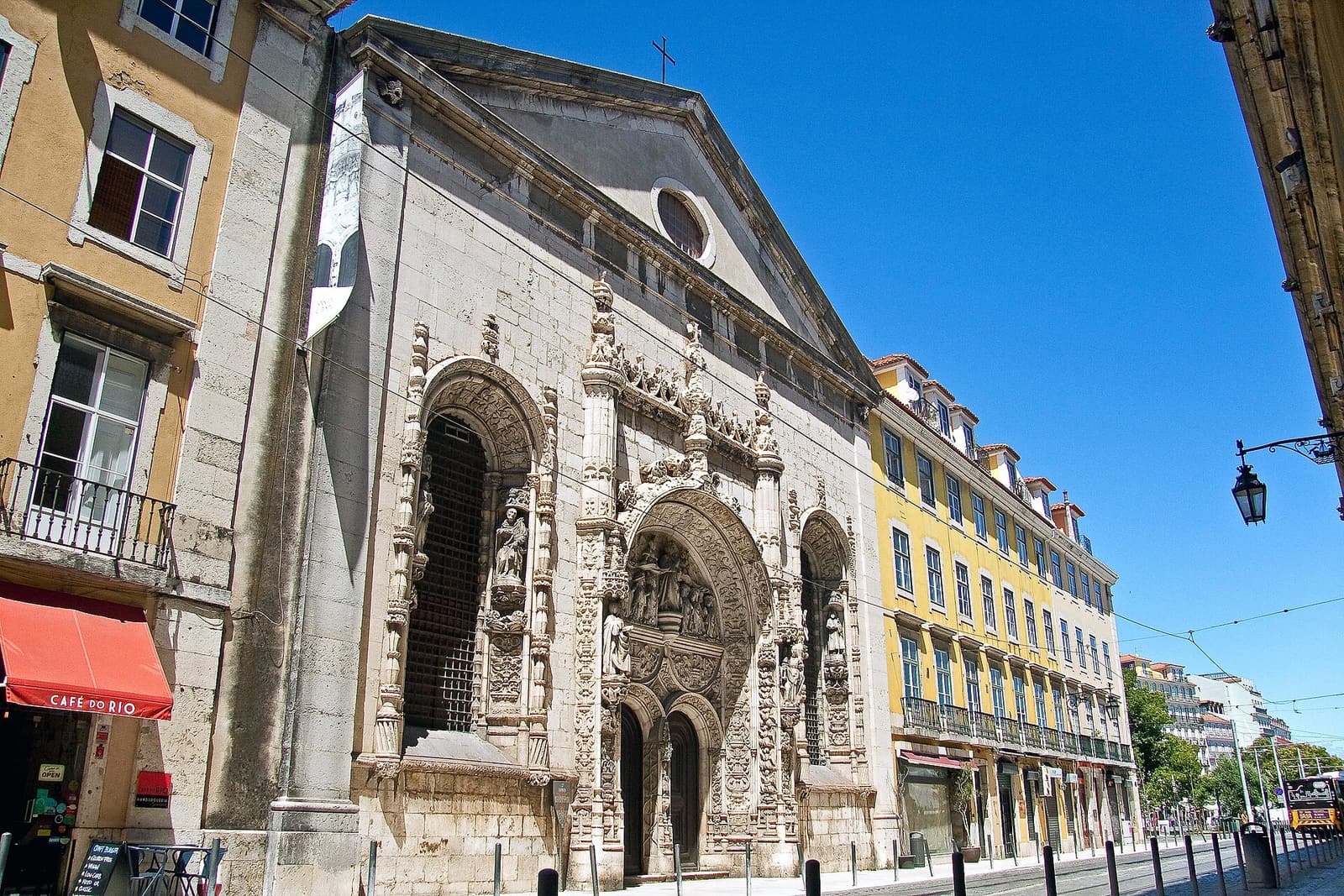
Igreja da Conceição Velha, in Lisbon's Baixa district: the remarkable Manueline portal that survived the 1755 earthquake and the former seat of the royal…
- Location
- Lisboa, Lisboa
- Built
- 1534
- Style
- Manuelino e pombalino
The Igreja da Conceição Velha rises on Rua da Alfândega, in the very mercantile heart of Lisbon’s Baixa, a few steps from the Praça do Comércio and the Casa dos Bicos. Its façade, dominated by a Manueline portal of exceptional richness, is one of the most surprising survivals of the Lisbon that predates the 1755 earthquake — an intact fragment of a splendour that the quake largely erased.
From the Misericórdia to the earthquake
The church that stood here before the catastrophe was the Igreja de Nossa Senhora da Misericórdia, seat of the kingdom’s first Santa Casa, founded in 1498 under the patronage of Queen Leonor of Viseu. Commissioned by Manuel I and completed in the reign of João III, in 1534, with a design attributed to the master João de Castilho — the same who directed the works at the Jerónimos Monastery — it was regarded as the second-largest Manueline church in Lisbon, second only to the Belém complex.
The earthquake of 1 November 1755 and the fire that followed it reduced the church to ruins. Like so many other buildings in the city, it fell victim to the same force that ruined the Carmo Convent, whose ruined nave remains to this day as a memorial to the disaster.
The surviving portal
Of the old building, the south side portal survived almost miraculously, together with two sixteenth-century windows and some carved elements. These were carefully reused in the reconstruction, going on to form the main façade of the new church. The portal unfolds in successive arches densely populated with motifs from the Manueline vocabulary, crowned by a tympanum depicting Our Lady of Mercy: her mantle, held up by two angels, shelters beneath its protection King Manuel I, Queen Leonor and various figures of the court and the Church.
The Conceição Velha is less a building than a memory grafted onto another: the Manueline skin of a vanished church, set into a Pombaline body rebuilt from scratch.
The work of rebuilding was promoted by José I and entrusted to the architect Francisco António Ferreira, known as Cangalhas. The result is a church of dual identity, in which the sixteenth-century façade deliberately contrasts with the sober Pombaline interior, raised according to the rational criteria that guided the reconstruction of the Baixa.
Significance and classification
The name “Velha” (Old) distinguishes this church from the Conceição Nova, and underscores the antiquity of the worship maintained here. More than an isolated monument, the Conceição Velha forms part of the small and precious group of Manueline testimonies that escaped the earthquake, alongside the Jerónimos and the Belém Tower — essential references for understanding the art of Manuel I’s reign, distinct from the language of the city’s great medieval cathedrals.
The church was classified as a National Monument in 1910, in the first great inventory of Portuguese heritage, and remains in use for worship. Recent conservation work has restored legibility to the sculpture of the portal, ensuring the continuity of one of the most expressive episodes of civil and religious Manueline art in the capital.
Frequently asked questions
- Why is the Igreja da Conceição Velha important?
- It preserves one of the most remarkable Manueline portals in Lisbon, a rare survivor of the 1755 earthquake, and stands on the site of the former church of the Misericórdia, once the second-largest Manueline church in the city after the Jerónimos.
- Is the Manueline portal original?
- Yes. The side portal and some sixteenth-century elements withstood the earthquake of 1755 and were reintegrated into the Pombaline reconstruction, retaining the original sculpture of the tympanum.
- Where is the Igreja da Conceição Velha located?
- On Rua da Alfândega, in Lisbon's Baixa, between the Praça do Comércio and the Casa dos Bicos, in the parish of Santa Maria Maior.
Sources
Keep exploring
Heritage nearby
More places to discover from here. Approximate straight-line distances, within 50 km.