Monuments
Church of Jesus (Setúbal)
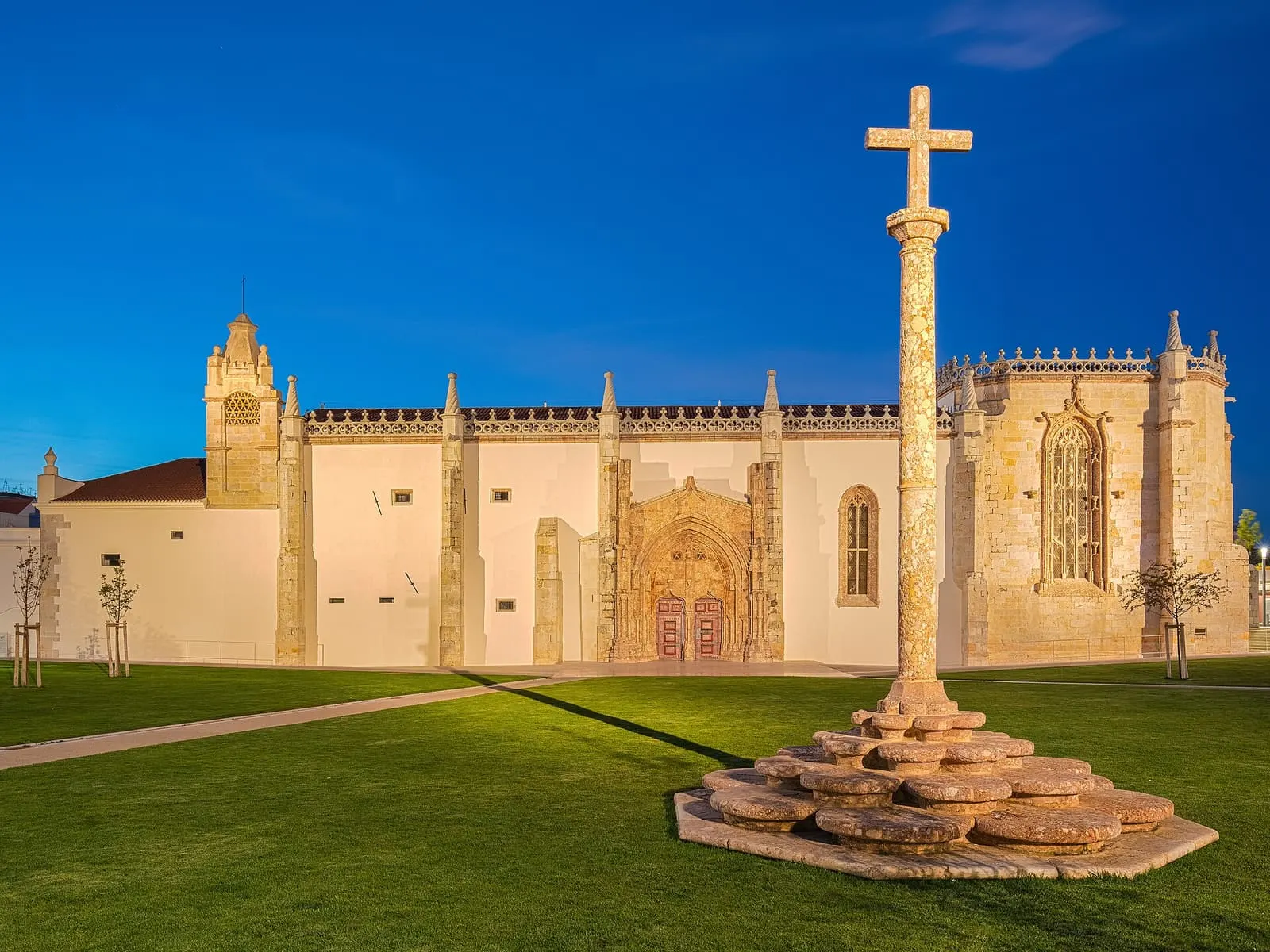
The Church of Jesus in Setúbal, a work by Diogo de Boitaca begun in 1490, is considered the inaugural landmark of the Manueline style in Portugal.
- Location
- Setúbal, Setúbal
- Built
- 1490–1495
- Style
- Manueline
The Church of Jesus in Setúbal occupies a singular place in the history of Portuguese architecture: it is generally pointed to as the first work of the Manueline style, predating by more than a decade the monuments that would come to enshrine it. Raised in what was then a prosperous fishing town on the Sado, it already announces, around 1490, the language that would mark the reign of Manuel I.
Foundation and construction
The initiative came from Justa Rodrigues Pereira, wet nurse of Manuel I, who ordered the building of a convent of Poor Clares dedicated to Jesus. The first stone was laid on 17 August 1490, and the church was completed around 1495. Direction of the work fell to Diogo de Boitaca, a master probably of French origin who would go on to sign the works of the Jerónimos Monastery in Belém, and whose workshop would prove decisive in the spread of the new decorative grammar.
Tradition holds that John II, present at the laying of the first stone, considered the planned dimensions cramped, prompting an adjustment of the plan on the ground itself. The episode, true or not, attests to the royal importance attached to the undertaking from the outset.
The invention of a language
What makes the Church of Jesus so remarkable is the anticipation of solutions that would be thought of as later. The temple is one of the first — and the most daring — essays of the hall church (from the German Hallenkirche) in Portugal: three naves of equal height, without a marked transept, merging into a single broad and luminous space. This effect of a unified hall breaks with the traditional Gothic hierarchy and opens the way to Manueline monumentality.
The twisted columns of the Church of Jesus look like ropes of stone wrung out to hold up the heaven of the vault: it is the Manueline before it knew itself to be so.
The six columns dividing the naves are carved from Arrábida breccia, a breccia marble in tones of pink and grey quarried in the neighbouring mountain range. Twisted into a helix, they resemble bundles of petrified rope — a motif that echoes the maritime taste of the age and that would reappear, refined, in the great royal workshops. The ribbed vaults that bear down upon these piers complete an interior of rare coherence.
From convent to museum
With the convent suppressed in the wake of the extinction of the religious orders in the nineteenth century, the complex lost its monastic function but kept the church. The church was classified as a National Monument in 1910, in the Republic’s first great heritage inventory. Today the former conventual quarters house the Setúbal Museum, holding a remarkable collection of sixteenth-century panels, while the church remains the symbolic heart of the complex. For the broader monastic context, see the Convent of Jesus of Setúbal and the city that surrounds it, Setúbal.
Modest in scale but pioneering in conception, the Church of Jesus is a major document for understanding the Manueline style: here, before Belém, the fusion was tried between the late Gothic and the decorative exuberance that would give identity to an entire age.
Frequently asked questions
- Why is the Church of Jesus considered the beginning of the Manueline style?
- Begun in 1490 under the direction of Diogo de Boitaca, it predates the Jerónimos Monastery and the Belém Tower, trying out for the first time the twisted columns, ribbed vaults and hall-church plan that would come to define the Manueline.
- What are the twisted columns of Arrábida breccia?
- They are helical piers carved from a breccia marble, in pinkish and greyish tones, quarried in the Serra da Arrábida. They support the church's vaults and constitute its most celebrated plastic feature.
- Can the Church of Jesus be visited?
- Yes. The church is part of the complex of the former Convent of Jesus, which houses the Setúbal Museum, one of the city's principal heritage centres.
Sources
Keep exploring
Heritage nearby
More places to discover from here. Approximate straight-line distances, within 50 km.