Monuments
Church of Santa Maria de Belém
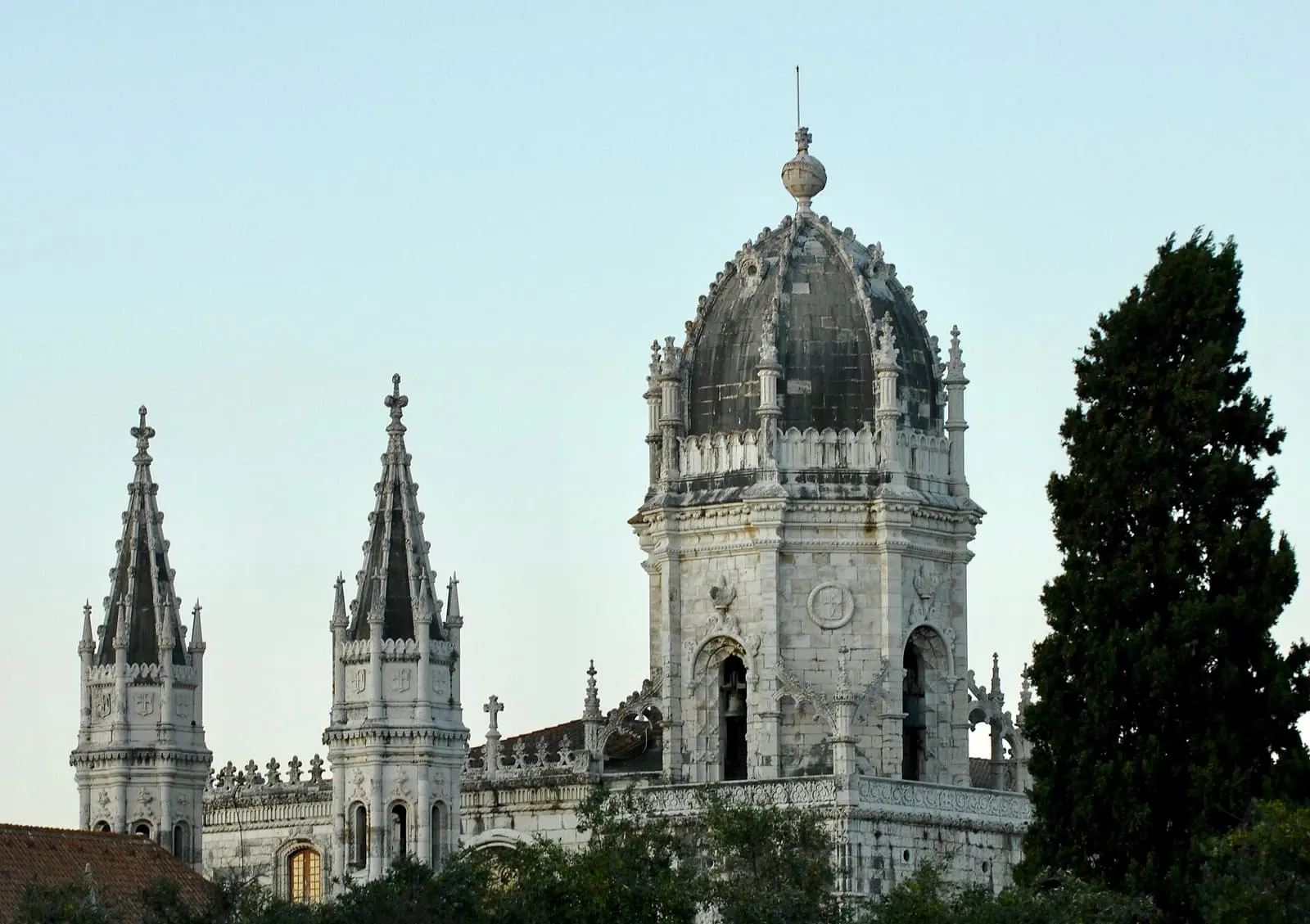
The Church of Santa Maria de Belém, the Manueline church of the Jerónimos Monastery in Lisbon, holding the tombs of Vasco da Gama and Camões and the pantheon…
- Location
- Lisboa, Lisboa
- Built
- 1501–1601
- Style
- Manuelino
The Church of Santa Maria de Belém is the church of the Jerónimos Monastery, built in the riverside district of Belém in Lisbon on the initiative of King Manuel I. Commissioned beside the spot from which Vasco da Gama’s fleet had set sail for India, the church became the most emblematic monument of the Manueline style and one of the most symbolically charged spaces in Portuguese national memory.
History and construction
Work began on 6 January 1501, following an earlier hermitage dedicated to Santa Maria de Belém and linked to the devotion of seafarers. Funding came largely from the revenues of overseas trade, which made possible an undertaking of exceptional scale that continued throughout the sixteenth century.
The direction of the works passed through a succession of masters. Diogo de Boitaca laid out the initial design; from 1517, João de Castilho took over the coordination, giving the ensemble the decorative exuberance that characterises the Manueline phase. Working in a Renaissance idiom, Diogo de Torralva and Jerónimo de Ruão also intervened, the latter responsible for the chancel, completed at the end of the century. The sculptor Nicolau Chanterene executed the western portal.
Architecture and art
The interior is a hall-church: the three naves rise to the same height, giving the space a rare sense of unity and breadth. The vast ribbed vault rests on just six octagonal piers, finely carved with plant motifs, ropework and heraldic elements. The light entering through the high windows reinforces the reading of the church as a forest of stone, a recurring image in the appreciation of the Manueline.
The south portal, lavishly worked by João de Castilho, and the axial western portal, with Chanterene’s Nativity, are among the high points of the architectural sculpture of the period. Within the whole, the church dialogues with other contemporary works such as the nearby Belém Tower, also commissioned by Manuel I.
Pantheon and significance
The church took on from early on the role of royal pantheon of the House of Aviz. In the arms of the transept stand the tombs of Manuel I and Queen Maria, and of John III and Catherine, borne by carved elephants. In the lower choir, beneath the gallery, the Neo-Manueline tombs of Vasco da Gama and Luís de Camões were installed in the nineteenth century, turning the church into a space of homage to the great names of overseas expansion and of letters. In the chapter house rests the historian Alexandre Herculano, and in the cloister there is a cenotaph of Fernando Pessoa.
Classified as a National Monument since 1907, the church, together with the monastery, has been inscribed on UNESCO’s World Heritage List since 1983, alongside the Belém Tower. It remains a place of active worship, retaining the dual condition of parish church and major monument of Portuguese heritage.
Frequently asked questions
- Who is buried in the Church of Santa Maria de Belém?
- In the lower choir, beside the south portal, are the tombs of Vasco da Gama and Luís de Camões, made in the nineteenth century. In the arms of the transept rest the kings Manuel I and John III and their respective queens, along with other members of the House of Aviz.
- What is the architectural style of the church?
- It is one of the greatest examples of the Manueline style, with a hall-church plan (the three naves at the same height) covered by a ribbed vault resting on six richly decorated piers.
- Can the church be visited free of charge?
- Yes. The church remains in use for worship and access to the body of the church is free, unlike the cloister and the other parts of the monastery, which require a separate ticket.
Sources
Keep exploring
Heritage nearby
More places to discover from here. Approximate straight-line distances, within 50 km.