Places
Monsanto
Monsanto, the historic village of Idanha-a-Nova perched among granite boulders, with its Templar castle and houses fused into the stone of the Beira Baixa.
- Location
- Monsanto, Castelo Branco
- Built
- século XII
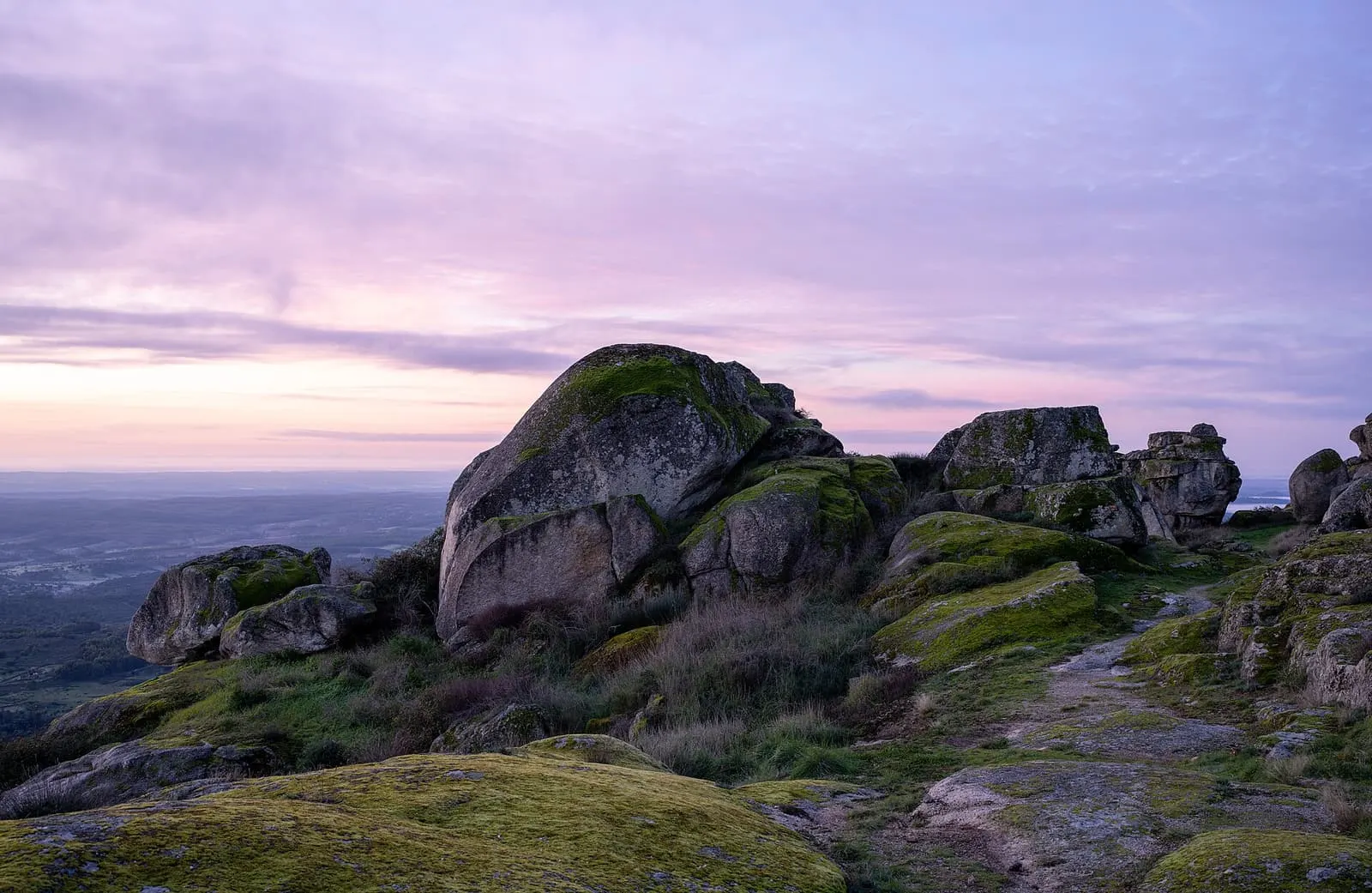
Perched on the southern slope of a granite hill rising to around 758 metres, Monsanto is perhaps the most singular of the villages of the Beira Baixa. Here, in the municipality of Idanha-a-Nova, district of Castelo Branco, the houses do not merely sit upon the rock: they fuse with it. Colossal boulders serve as wall, as roof and as floor, and the narrow streets wind around blocks of granite that no human hand could move. The result is a landscape in which it is hard to tell where nature ends and the work of man begins.
A settlement fused into the stone
The name Monsanto — “holy mount” — suggests an occupation far older than the founding of Portugal. Lusitanian and Roman remains attest that the hill was settled and fortified at various times, benefiting from its commanding position over the border plain and the valley of the Ponsul. It was, however, in the Middle Ages that the village acquired the appearance that still defines it today.
After the Christian reconquest, Monsanto was donated in 1165 to the Order of the Temple. It fell to the master Gualdim Pais, a central figure in the fortification of the frontier, to order the building atop the hill of the castle that crowns the village. The charter granted in 1174 confirmed the military importance of the place, later reinforced by new royal privileges and by its elevation to town status in the reign of D. Manuel I. The castle of Monsanto, today a dramatic ruin among the crags, preserves the memory of that frontier disputed between Portugal and Castile.
In Monsanto vernacular architecture did not conquer the stone: it learned to live with it, fitting houses, pens and ovens into the gaps left by the boulders.
The “most Portuguese village in Portugal”
The episode that made Monsanto famous in the national imagination took place in 1938, when the settlement won the contest for “the most Portuguese village in Portugal”, promoted by the Estado Novo. The trophy — a silver cockerel designed by Abel Pereira da Silva — stands today atop the Torre de Lucano, and the title consecrated Monsanto as a symbol of an authentic and unchanging rural Portugal. That fame partly explains its preservation: spared from disorderly expansion, the village retained its layout and traditional materials.
In 1995, Monsanto joined the network of the Historic Villages of Portugal, a programme that brought together twelve settlements of the country’s central interior united by monumental heritage and by the granite and schist landscape. The classification brought rehabilitation campaigns and a new touristic vitality, without erasing the austere character that distinguishes Monsanto from its counterparts.
Living traditions and nearby heritage
Intangible culture is an essential part of local identity. The Festa das Cruzes, or Festival of the Castle, is celebrated on 3 May: the women climb the walls to cast flowers and sing to the sound of the adufe, evoking a legendary resistance to a siege. Associated with the festival are the marafonas, faceless cloth dolls, regarded as protectors of the home and linked to ancient fertility rites. This percussive sound connects to the wider world of the adufe and the music of the Beira Baixa.
A few kilometres away, the Roman and Visigothic village of Idanha-a-Velha — the ancient Egitânia — completes the historical itinerary of the Terras de Idanha, while, further north, Sortelha offers another magnificent example of a fortified settlement embedded in the granite. Together, these villages make up one of the most memory-laden territories of the Portuguese interior, where stone is at once shelter, defence and landscape.
Frequently asked questions
- Why is Monsanto known as 'the most Portuguese village in Portugal'?
- In 1938, as part of the Estado Novo celebrations, Monsanto won the contest for 'the most Portuguese village in Portugal', receiving as a trophy the Silver Cockerel, designed by Abel Pereira da Silva, now kept in the Torre de Lucano.
- Where is Monsanto and what is its landscape like?
- Monsanto lies in the municipality of Idanha-a-Nova, in the district of Castelo Branco, in the Beira Baixa. Its houses rise on the slope of a granite hill of around 758 metres in altitude, set among enormous boulders.
- Who built Monsanto castle?
- After the Christian conquest, Monsanto was donated in 1165 to the Order of the Temple. The castle at the top of the hill was built at the command of Gualdim Pais, master of the Templars, and the village received its charter in 1174.
Sources
Keep exploring
Heritage nearby
More places to discover from here. Approximate straight-line distances, within 50 km.