Monuments
Arouca Monastery
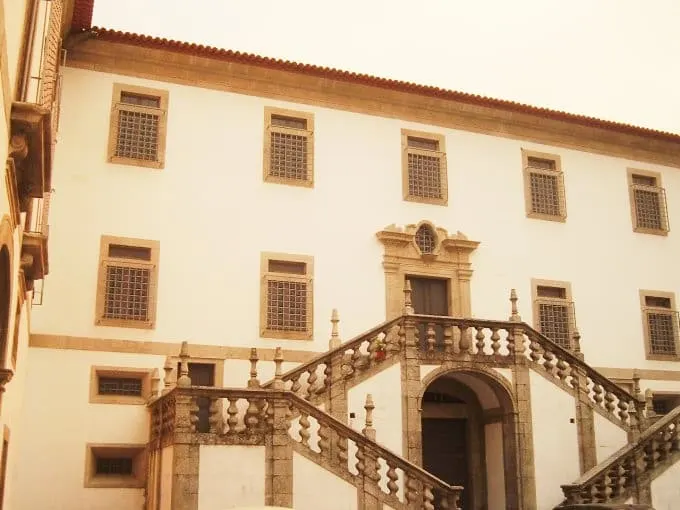
The Arouca Monastery, a Cistercian nunnery associated with Blessed Mafalda in Arouca, Aveiro district, featuring remarkable choir stalls and Baroque gilded…
- Location
- Arouca, Aveiro
- Built
- Século X (reconstrução c. 1700–1789)
- Style
- Maneirista e Barroco
The Arouca Monastery, or Monastery of Santa Maria de Arouca, stands in the center of the town of Arouca in Aveiro district, nestled in a mountain valley now part of the Arouca Geopark. Its origins date to the first half of the 10th century, when a small religious community settled there under the patronage of Saint Benedict of Nursia. Over more than a millennium, the abbey witnessed Portugal’s major monastic transformations and has been classified as a National Monument since 1910.
From foundation to Cistercian reform
The monastic house underwent a decisive turn in the early 13th century. Around 1217, Mafalda (c. 1195–1256) – daughter of King Sancho I and granddaughter of Afonso Henriques, briefly Queen of Castile through an annulled marriage – retired to Arouca. She is associated with the community’s adoption of the Cistercian reform, formalized in 1226, which converted the former Benedictine monastery into a Cistercian nunnery. Mafalda devoted her final years to religious life and governing the house; upon her death in 1256, she was buried in Arouca, and her veneration grew over centuries, culminating in beatification in 1792.
The monastery’s fate became so intertwined with the memory of its royal patroness that even today the town venerates her as its patron saint, and the urn containing her remains remains one of the building’s devotional focal points.
Joining the Cistercian order connected Arouca to an extensive network of reformed houses, of which the Alcobaça Monastery was the Portuguese head. Like other Portuguese monasteries, Arouca’s community organized its life around silence, labor, and choral prayer.
Baroque reconstruction
The complex seen today largely results from extensive renovations begun in the late 17th century and continuing throughout the 18th, marked by a 1725 fire that required rebuilding much of the premises. This phase gave the church, cloister, and spacious convent wings their Mannerist and Baroque appearance, designed for a large community.
Inside, the nuns’ choir stands out – low and separated from the nave by an arch, following a layout also seen at Lorvão and Cós. It preserves remarkable jacaranda choir stalls with over a hundred seats, crafted around 1725 by Lisbon masters, their gilded woodcarved backs featuring paintings of scenes from Blessed Mafalda’s life and Cistercian saints. The profusion of gilded woodcarving covering the choir and church body exemplifies the Joanine Baroque style then dominant in northern Portugal.
The organ and Museum of Sacred Art
Around 1741 saw the installation of a large pipe organ placed between the public church and the nuns’ choir. Built by a Valladolid organ maker, with over a thousand pipes and more than twenty stops, experts consider it one of the most important instruments of the Iberian organ school.
After religious orders were dissolved and monastic life ended, part of the monastery’s movable heritage was gathered into the Museum of Sacred Art, regarded as one of the richest of its kind on the Iberian Peninsula. It holds goldsmith work, vestments, sculpture, painting, liturgical manuscripts, and furniture – testaments to the long continuity of a community that for over eight centuries made Arouca one of northern Portugal’s great monastic centers.
Frequently asked questions
- Who was Blessed Mafalda and what was her connection to Arouca?
- Mafalda (c. 1195–1256), daughter of King Sancho I, retired to the monastery from 1217. She is credited with the community's adoption of the Cistercian Order, and her body remains entombed in the church. She was beatified in 1792.
- When did the monastery adopt the Cistercian rule?
- The originally Benedictine community adopted the Cistercian reform in 1226, becoming a Cistercian nunnery.
- What can visitors see at Arouca Monastery today?
- The Baroque church with its gilded woodcarvings and nuns' choir, the choir stalls, the renowned 18th-century pipe organ, and the Museum of Sacred Art – one of the richest on the Iberian Peninsula.
Sources
Keep exploring
Heritage nearby
More places to discover from here. Approximate straight-line distances, within 50 km.