Monuments
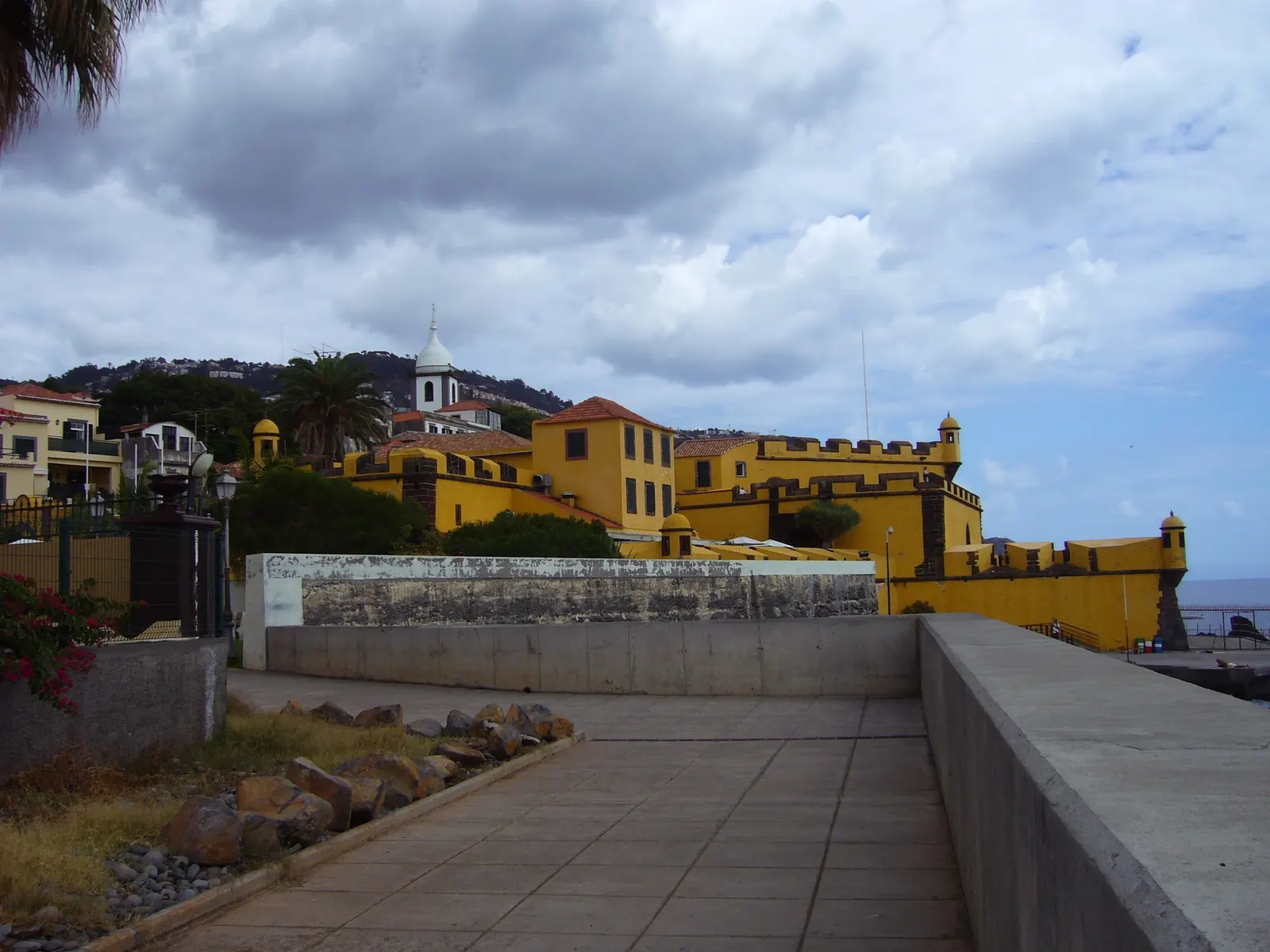
São Tiago Fortress, Funchal
Explore São Tiago Fortress in Funchal: its seventeenth-century origins, coastal defences, former contemporary art museum and official visitor information.
- Location
- Funchal, Madeira
- Built
- c. 1614–1637; enlarged in 1767
- Style
- Seventeenth- and eighteenth-century military architecture
São Tiago Fortress, also known as Forte de Santiago, stands on the waterfront of Funchal’s Old Town. It offers a way to understand the defence of the bay and the later conversion of military buildings in Madeira to cultural uses. The fortress and the museums associated with it have distinct histories, which are useful to separate when planning a visit.
Defending the eastern waterfront
The coastal position made the fortress part of Funchal’s protection against corsair attacks. The Regional Directorate for Culture dates the beginning of construction to around 1614, the year inscribed on the original gateway. Royal master builder Jerónimo Jorge directed the early works; after his death in 1617, his son Bartolomeu João continued them. The first phase is thought to have been completed in 1637.
A further building campaign took place in the eighteenth century under the engineer Tossi Columbina. Its date, 1767, appears on the later gateway. These inscriptions offer a useful way to distinguish successive phases, rather than treating the entire structure as the product of one year. From the surrounding waterfront, consider how the building’s position connects the sea, the shoreline and the town it defended.
Barracks, refuge and museum
Different military units occupied the fortress, including British troops in the early nineteenth century. It also provided shelter for families left homeless by the 1803 flood in Funchal. Its significance therefore extends beyond coastal warfare to the city’s social history and experience of disaster.
The fortress was transferred to Madeira’s autonomous regional government in 1992. A contemporary art museum opened there that year and remained until October 2015, when its collection moved to Casa das Mudas in Calheta. Visitors seeking that collection should consult MUDAS — Madeira’s Museum of Contemporary Art, rather than expect to find it inside the fortress.
Heritage protection and archaeology
Madeira’s official list of classified properties records the building as Forte de Santiago, DGEMN code 220304019, in Santa Maria Maior parish. It identifies the fort as a monument of Public Interest, under Decree No. 30 762 of 26 September 1940.
The Regional Directorate for Culture describes plans to use the fortress for archaeological research, conservation and interpretation, including material recovered from São Filipe Fort. This connects the building with the excavated history of Funchal. A museum project does not, however, establish that its galleries or other spaces are currently open.
Planning a visit
The address is Rua do Portão de São Tiago, 9060-250 Funchal. On 2 October 2026, the Regional Directorate for Culture’s page stated that the fortress was temporarily closed, while access to Restaurante do Forte remained available. Consult that page for the monument’s opening arrangements, accessible areas and any access requirements. Restaurant access should not be taken as confirmation that the whole fortress can be visited.
Continue exploring through Funchal Cathedral and the wider subject of coastal forts. Their different purposes help explain the buildings, sea routes and defensive systems of an Atlantic city.
Photograph by Coeli, 2009 — original and public-domain dedication.
Frequently asked questions
- Where is São Tiago Fortress?
- It stands on Rua do Portão de São Tiago in Funchal’s Old Town, in the parish of Santa Maria Maior on Madeira. The fortress overlooks the eastern side of the bay.
- Does it still house the contemporary art museum?
- No. The museum occupied the fortress from 1992 to 2015. Its collection moved to MUDAS in Calheta in October 2015.
- Can I visit the interior?
- When checked on 2 October 2026, the Regional Directorate for Culture listed the fortress as temporarily closed, with access to Restaurante do Forte remaining available. Check the official page before planning an interior visit.
- What is its heritage designation?
- Madeira’s official register lists Forte de Santiago as a monument of Public Interest under Decree No. 30 762 of 26 September 1940.
Sources
Keep exploring
Heritage nearby
More places to discover from here. Approximate straight-line distances, within 50 km.