Monuments
Carmo and Carmelitas Churches (Porto)
The Carmo and Carmelitas Churches in Porto, a pair of twin temples separated by the narrowest house in the city and clad in azulejo tilework.
- Location
- Porto, Porto
- Built
- 1619–1768
- Style
- Maneirismo, Barroco e Rococó
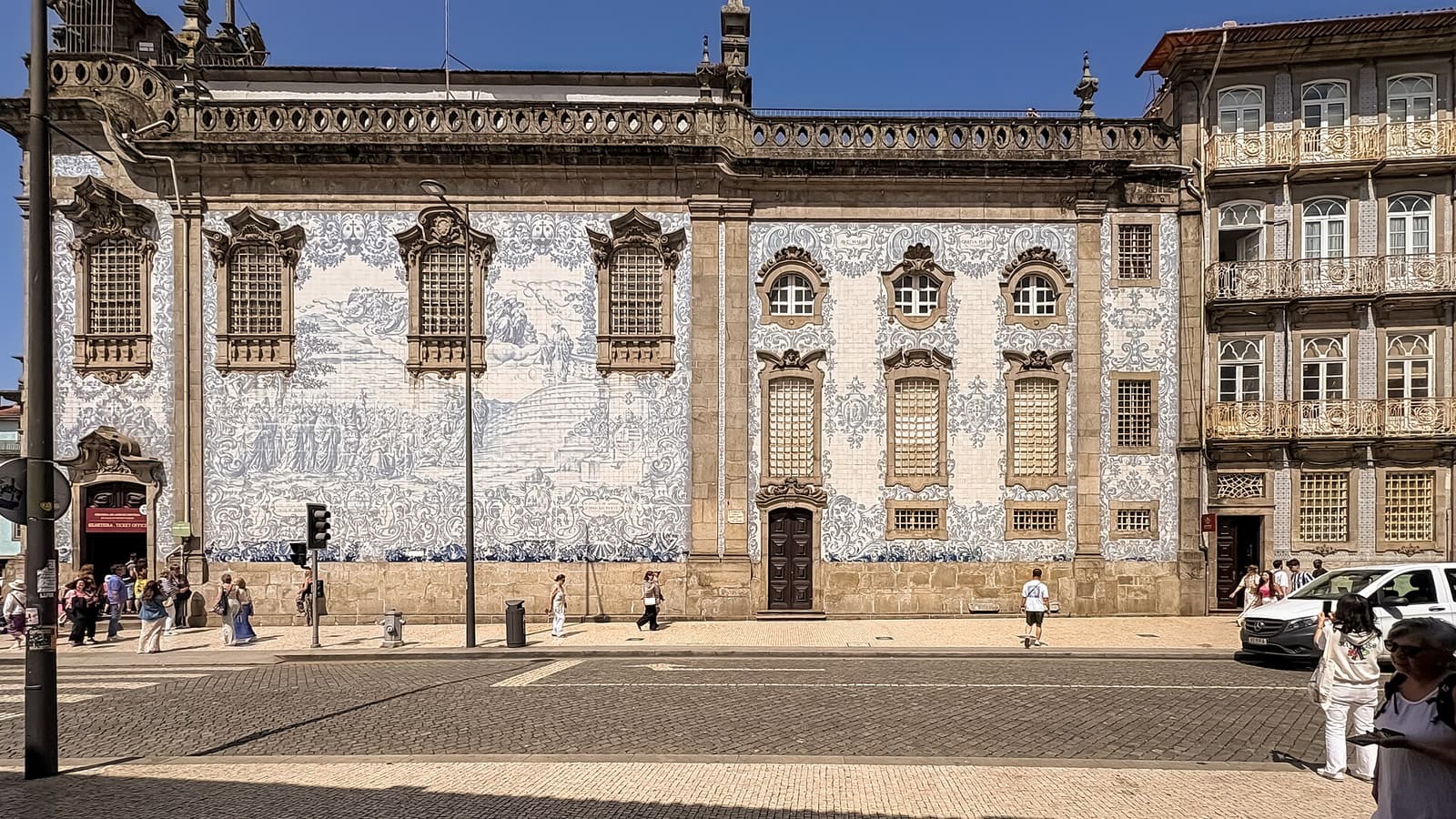
Few images of Porto are as widely reproduced as that of the ensemble formed by the Carmelitas and Carmo Churches, at the meeting of Rua do Carmo with Praça de Carlos Alberto and Rua de Cedofeita. From afar, the eye reads a single imposing Baroque façade; up close, one realises that these are two distinct temples, separated by the narrowest house in the city — the celebrated Casa Escondida — and clad in one of the most spectacular tile panels in all of Porto.
Two temples, two centuries
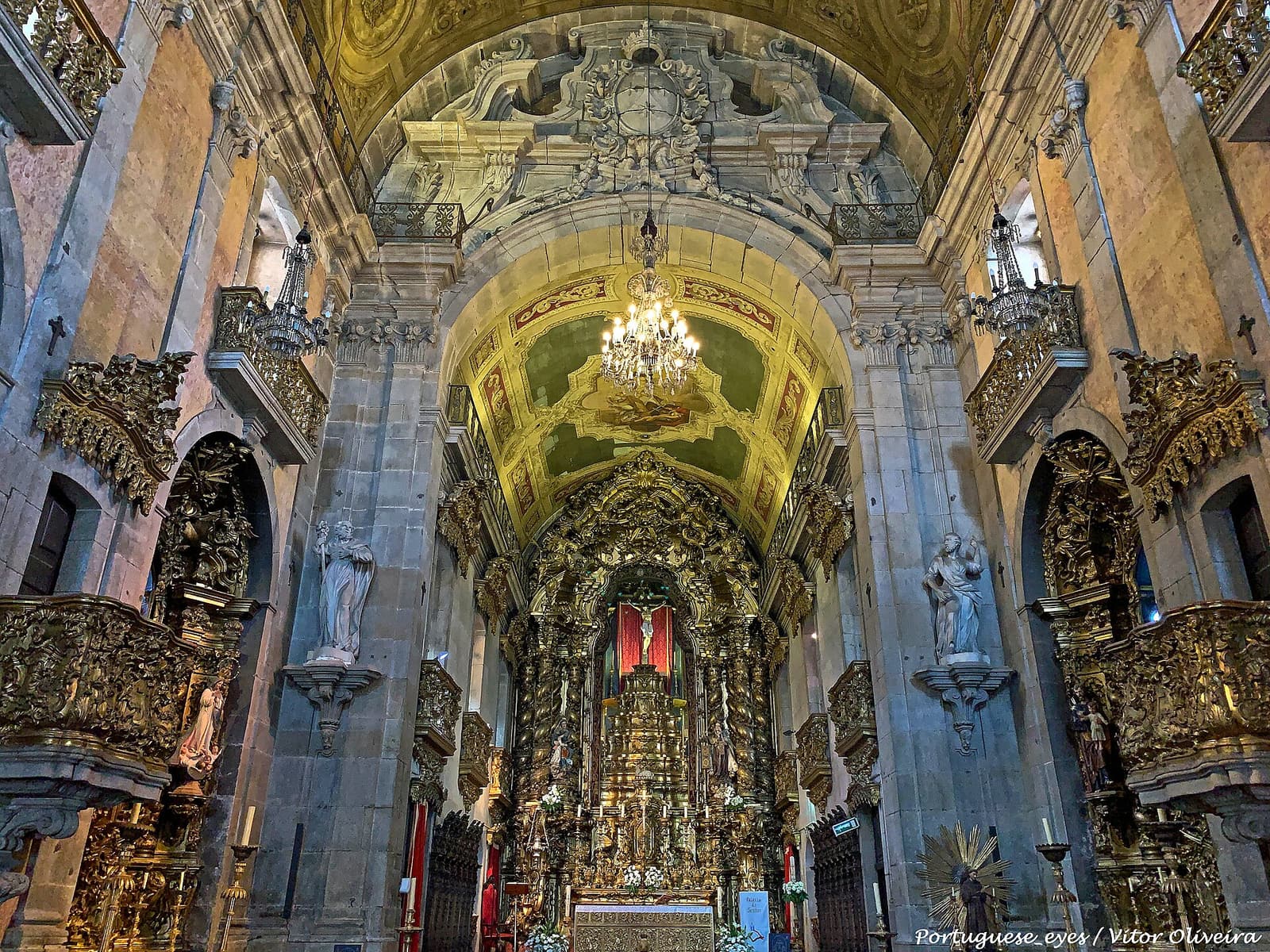
The story begins with the Discalced Carmelites, authorised to settle in Porto in 1616. The foundation stone of their church was laid in 1619 and the temple was completed around 1628, with the decorative campaign extending into the middle of the century. The Carmelitas Church is a scholarly example of a Mannerist façade — three entrance arches and a triangular pediment — which houses inside a remarkable heritage of Baroque and Rococo carved woodwork, with the high altarpiece as its highlight.
More than a century later, it was the turn of the Third Order of Our Lady of Mount Carmel. On land granted in 1752, the Carmo Church was raised between 1756 and 1768, designed by the architect José de Figueiredo Seixas, a disciple of Nicolau Nasoni. It is one of the masterpieces of Portuguese Rococo: a lively façade, a portal flanked by statues of the prophets Elijah and Elisha, and a wealth of gilded woodwork that rivals that of the neighbouring Church of São Francisco.
The proximity of the two temples is neither chance nor a mere urban accident: the Casa Escondida was born precisely to circumvent the prohibition on two churches sharing a common wall.
The Casa Escondida
Between the two façades is inserted an exceedingly narrow dwelling, little more than a metre and a half wide, which for decades went unnoticed by those climbing the street. Its function was legal before it was residential: with a common wall ruled out, this buffer house guaranteed the legal separation required between the two religious buildings. Inhabited until the 20th century, it is today a much-sought curiosity, an example of the ingenuity with which the city resolved a regulatory constraint.
The great tile panel
The element that most fixes itself in the visitor’s memory is, however, later than the two churches. The side façade of the Carmo Church, facing Praça de Carlos Alberto, is entirely covered by a vast blue-and-white panel narrating scenes connected to the founding of the Carmelite Order and to Mount Carmel. Conceived by Silvestre Silvestri and painted by Carlos Branco, it was executed in 1912 at a factory in Vila Nova de Gaia. This monumental façade azulejo solution, characteristic of the turn of the century, transformed a blind wall into one of the most photographed visual billboards in the city.
Significance and classification
The ensemble lies in the heart of historic Porto, a few steps from the Clérigos Tower and within the fabric that makes up the Historic Centre of Porto, listed as World Heritage. On 3 May 2013, the two churches were jointly classified as a National Monument, a recognition that underscores not only the artistic value of each temple — the 17th-century Mannerism and the 18th-century Rococo — but also the singularity of the architectural dialogue they establish, mediated by a house a metre and a half wide.
Frequently asked questions
- Why is there a narrow house between the two churches?
- The Casa Escondida (Hidden House), little more than a metre and a half wide, physically separates the two churches because the law forbade two temples from sharing a common wall. For a long time it served as a dwelling and is regarded as one of the narrowest houses in Porto.
- Are the two churches the same building?
- No. They are independent, adjoining temples: the Carmelitas Church, Mannerist and dating from the 17th century, and the Carmo Church, Rococo and dating from the 18th century. Seen from a distance they appear to be a single monumental façade.
- When was the tile panel on the side façade painted?
- The great blue-and-white panel on the side façade of the Carmo Church was conceived by Silvestre Silvestri and painted by Carlos Branco in 1912, in Vila Nova de Gaia.
Sources
Keep exploring
Heritage nearby
More places to discover from here. Approximate straight-line distances, within 50 km.