Archaeology
Alcalar Monuments
Alcalar Monuments (Portimão): Chalcolithic settlement and megalithic necropolis from the 3rd millennium BC. National Monument; Museum interpretation centre.
- Location
- Alcalar, Mexilhoeira Grande, Portimão, Faro
- Built
- desde o III milénio a.C.
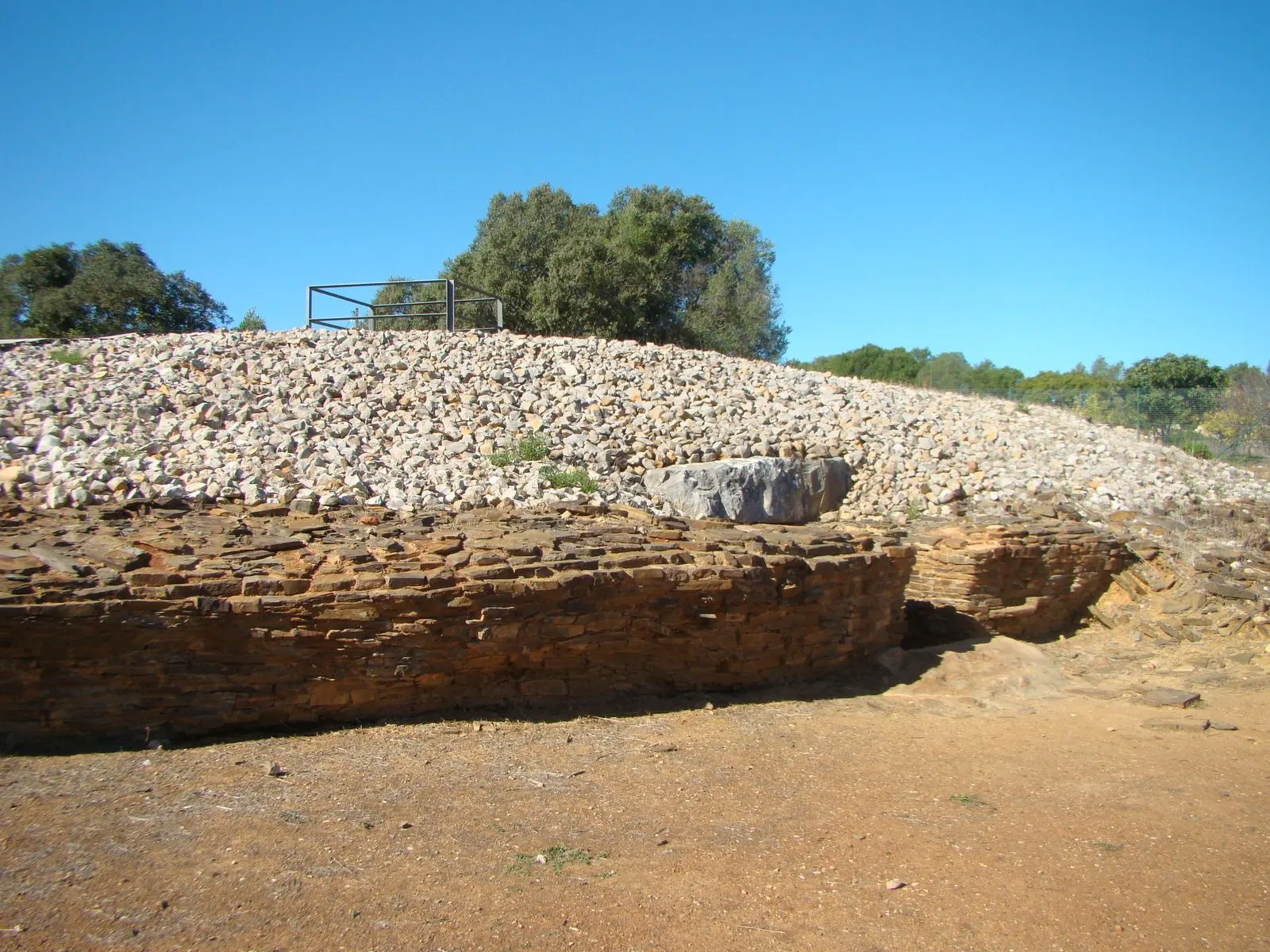
The Alcalar Monuments are a megalithic necropolis and the Chalcolithic settlement that surrounded it, on a promontory overlooking the Ribeira da Torre, in the parish of Mexilhoeira Grande, municipality of Portimão. It lies about five kilometres from Mexilhoeira Grande, between the Alvor estuary and the foothills of the Serra de Monchique. It forms part of prehistoric Algarve and has an interpretation centre managed by the Museum of Portimão.
A settlement and its necropolis
According to the record of the Património Cultural, I.P., the territory of Alcalar has harboured, since the 3rd millennium BC, a settlement of more than ten hectares. It was first studied in 1880. Its position commanded a transitional zone between the mountains and the sea, with varied resources: fishing and shellfish gathering in the estuary, fresh water, land for cereals and vegetables, hunting, and raw materials for building and making artefacts. The Museum of Portimão describes a village defended by walls, trenches and embankments, with dwellings and, alongside them, the megalithic tombs.
The tombs
The necropolis brings together some two dozen barrow tombs, grouped in small clusters distinguished by the variety of their architectural solutions. The record describes an evolution ranging from a tholos with a crypt capped by a corbelled false dome, through dolmens built with large sandstone orthostats, to a hypogeum cut into the rock for collective burial. The record’s images show Monument No. 7, with corridor, crypt and lateral niches, and the crypts of the Monte Canelas hypogeum, with collective burial. The official bibliography includes a study and rehabilitation of Monument No. 7 (Elena Morán and Rui Parreira, 2004). The general framework for these monuments is found in megalithism and in Portuguese megalithic art; the cultural context, in the Chalcolithic, which includes fortified settlements such as Castro do Zambujal.
Classification
The Alcalar Monuments are a National Monument. The initial core was classified by the Decree of 16 June 1910 (Diário do Governo No. 136, of 23 June 1910). The classification was extended by Decree No. 1/2016, published in the Diário da República, 1st series, No. 48, of 9 March 2016. The special protection zone was fixed by Ordinance No. 129/2023, of 20 March (Diário da República, 2nd series, No. 56). The site is not part of any UNESCO inscription.
Preparing the visit
The Reception and Interpretation Centre of the Megalithic Monuments of Alcalar is the point of entry. The record of the Património Cultural notes that the building, constructed from scratch, serves to improve interpretation and regulate visitor flows. The Museum of Portimão states that two of the funerary monuments are open to the public; it does not specify which.
As of consultation on 5 November 2026, from 1 September to 31 July the published hours were Tuesday to Saturday, 10:00–13:00 and 14:00–16:30 (last entry 15 minutes before closing), closed on Mondays, Sundays and national holidays. In August, the hours were 10:00–13:00 and 14:00–18:00 from Tuesday to Saturday, and 10:00–14:00 on Sundays and holidays. The published tickets were: standard, €2.00; combined with the Museum of Portimão, €4.00; over-65s and young people aged 16 to 25, €1.00. The museum indicated free admission for residents of national territory on Saturdays (and, in August, on Sundays and holidays). The centre’s telephone number is +351 282 248 594. Please confirm opening hours and prices on the Museum of Portimão page, as they may change.
Photograph: Bextrel, 8 November 2017, Centro de Alcalar 2017 - Monumento 7.jpg, licence CC BY-SA 4.0, resized and compressed for the web, composition unaltered.
Frequently asked questions
- What are the Alcalar Monuments?
- A megalithic necropolis of some two dozen barrow tombs, associated with a Chalcolithic settlement of over 10 hectares, in the parish of Mexilhoeira Grande, municipality of Portimão.
- When can they be visited?
- As of consultation on 5 November 2026, the Museum of Portimão published, from 1 September to 31 July, opening hours from Tuesday to Saturday, 10:00–13:00 and 14:00–16:30, closed on Mondays, Sundays and national holidays.
- How much does admission cost?
- At the same consultation, the standard ticket cost €2.00 and the combined ticket with the Museum of Portimão cost €4.00. The museum also indicated free admission on Saturdays for residents of national territory.
- Are the Alcalar Monuments a National Monument?
- Yes. The initial core was classified by the Decree of 16 June 1910, and the classification was extended by Decree No. 1/2016, of 9 March.
Sources
- Património Cultural, I.P. — Monumentos de Alcalar (70254)
- Património Cultural, I.P. — Atlas do Património Classificado (NINV 2860)
- Museu de Portimão — Centro de Acolhimento e Interpretação dos Monumentos Megalíticos de Alcalar
- Museu de Portimão — Visitar: Centro de Acolhimento e Interpretação de Alcalar (horário e preçário)
- Wikidata — Monumentos de Alcalar (Q1747799)
Keep exploring
Heritage nearby
More places to discover from here. Approximate straight-line distances, within 50 km.