Monuments
Walls of Lagos
Medieval walls and the bastioned Cerca Nova of the 16th and 17th centuries define Lagos; see bastions like Porta da Vila. National Monument since 1924.
- Location
- Lagos, Faro
- Built
- Cerca medieval (séc. XIII–XIV); Cerca Nova (séc. XVI – 1.ª metade do séc. XVII)
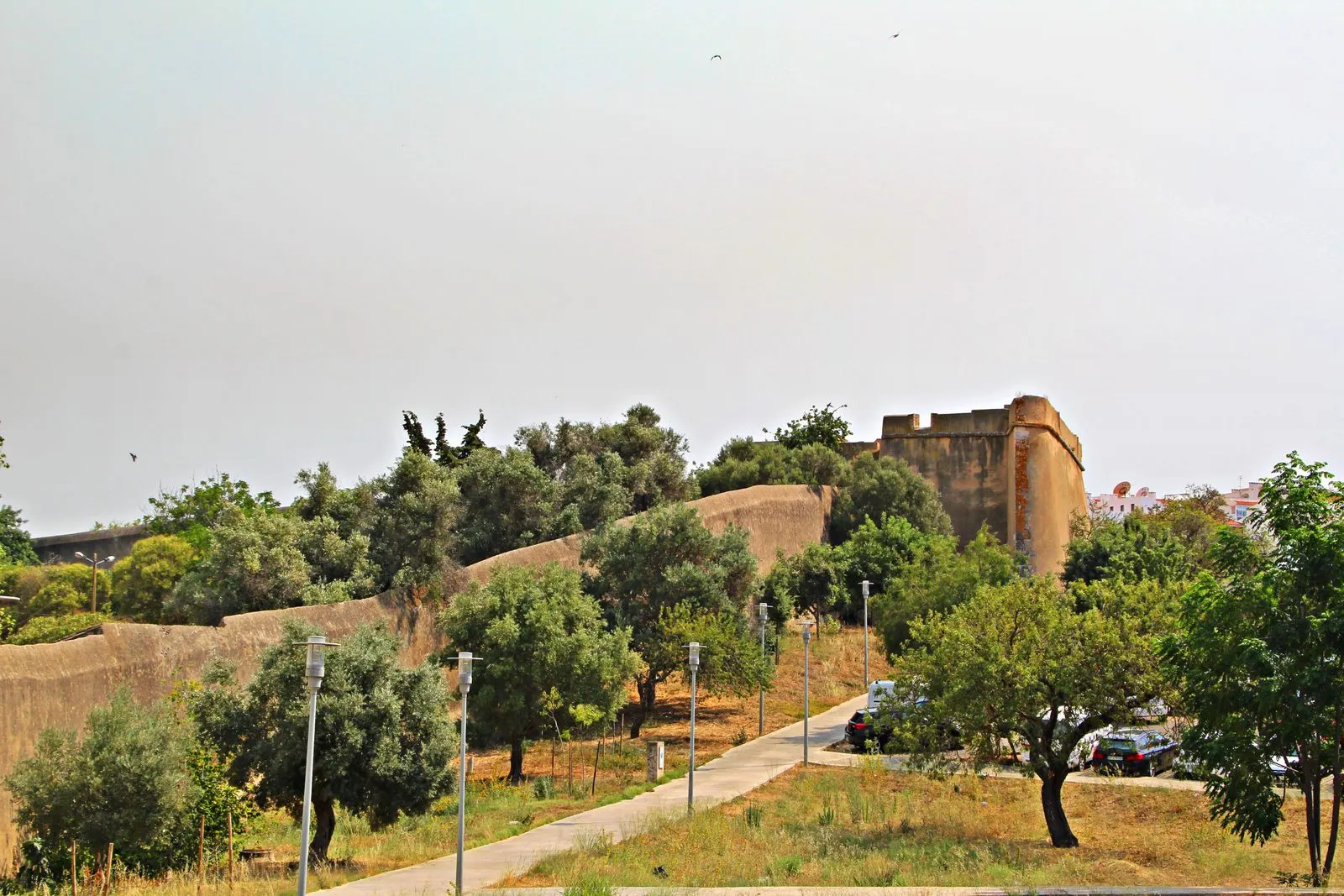
Anyone arriving at Lagos along the waterfront finds, between gardens and the Avenida dos Descobrimentos, long stretches of wall with towers and bastions. These are the remains of two enclosures. The medieval enceinte enclosed the small town beside the river. The bastioned Cerca Nova was built between the 16th and 17th centuries and extended the perimeter to include the districts that had grown outside the gates. The ensemble is classified as a National Monument under the name Walls and Towers of Lagos. For the wider context of these structures, see city walls and enceintes.
From the Islamic fortress to the medieval enceinte
The national Heritage Register (Património Cultural, I.P.) notes that when the Algarve’s Barlavento was finally conquered, in 1253, Lagos already had a castle with an Islamic past. It was a point of coastal defence and one of the approaches to the capital, Silves. No material trace of this primitive stronghold has been identified to date: the works of the following centuries destroyed and replaced it.
The works of the first kings are also poorly documented. The register states that they began in the reign of King Afonso III and that, according to more or less reliable reports, continued under Afonso IV and Fernando. The Municipality of Lagos says the so-called Cerca Velha was completed in the 14th century. It enclosed an orthogonally planned town, with a “straight street” and cross-streets, corresponding to the city’s original core, known as Viladentro.
At the most fortified point of the medieval enceinte stands the Governors’ Castle, also called the Castle of Lagos. The municipality dates the present building to the second half of the 15th century. After 1581 it was adapted as the residence of the governors of the Algarve; the national register places these works in 1621. Damaged by the 1755 earthquake, it was ceded to the Misericórdia in 1850 and adapted as a hospital from 1885. In 1960, during works for the 500th anniversary of the death of Prince Henry the Navigator, the Avenida dos Descobrimentos was opened, the Bairro da Ribeira and part of the castle were demolished.
The Cerca Nova and the bastions
The extension of the walls is recounted somewhat differently by the two official sources. The national register attributes to King Manuel I the most ambitious military project of the stronghold, with a second enceinte and four bastions facing the sea and the river. In 1556, King John III is said to have ordered the completion of his father’s works, but with a different priority: the western wall. According to the register, this gave the fortress ten more bastions and made it “the first fully bastioned wall in national territory”. The municipality, for its part, says the overall plan of the Cerca Nova was drawn up in the first half of the 16th century, driven by John III, and completed in the first half of the 17th century. An anonymous plan of 1554–1555, attributed to Miguel de Arruda, is according to the municipality the oldest drawing of the fortifications and the design of this second enceinte.
The Cerca Nova came to include the city’s two parishes, Santa Maria and São Sebastião. The municipality lists its bastions, many with two names:
- Porta da Vila or Santa Maria da Graça, the first of the Cerca Nova, at the southeast angle, polygonal in plan and with three orejões. The national register notes its recent adaptation as an astronomical observatory.
- Coronheiro or Santo António, Gafaria or Nossa Senhora da Conceição and Paiol or Santo Amaro, named after neighbouring churches and hermitages.
- Jogo da Bola or São Francisco, square in plan, on the northern section.
- Freiras, Alcaria or São Nicolau, square, at the southwest angle. The register describes the Alcaria as the most prominent on the western side, linked to the walls by a ramp and protected by two large orejões.
- Porta dos Quartos, on the western section, named after the barracks for soldiers built in 1695.
The bastions of São Manuel, Postigo and Porta de Portugal no longer exist. The city’s expansion towards the river erased them, and some survive only in street names.
Drake, the Philips and the Estado Novo
The walls did not prevent the attack of Francis Drake in 1587, during the war between Spain and England. The national register recounts that Philip I subsequently ordered the stronghold rebuilt and modernised, in a lengthy campaign. In the following centuries, as the city declined in relative importance, works were limited to consolidating the structures and reinforcing the coast with small forts.
In the 20th century, Lagos was one of the stages for the centenary commemorations organised by the Estado Novo, linked to Prince Henry the Navigator. The national register notes that the walls were then restored and freed of the buildings that had been attached to them.
Classification
The Walls and Towers of Lagos are a National Monument under Decree No. 9 842, published in the Diário do Governo, I Série, No. 137, of 20 June 1924. The same decree classified the Church of Santo António and the Church of São Sebastião. A first special protection zone was set by ordinance published in 1962. It was replaced by the Ordinance of 30 October 1969, published in the Diário do Governo, II Série, No. 275, of 24 November 1969, which establishes a zone common to the two churches and the walls.
The Fort of Ponta da Bandeira, at the entrance to the harbour, is a separate property, classified individually as a Property of Public Interest. The walls are not part of any UNESCO inscription.
Preparing a visit
The walls are integrated into the urban fabric and are walked along the waterfront and through the streets of the historic centre. At the Arco de São Gonçalo, beside the former Portas do Mar, a 1940s oratory commemorates the city’s patron, whom tradition places as born in a house on this spot. When consulted on 5 November 2026, we found no published ticket, opening hours or conditions for access to the top of the bastions from the municipality. Confirm on the municipal page on the walls.
To continue, see the Church of Santo António, within the enceinte, and the Fortress of Sagres, at the tip of Barlavento. Other bastioned fortifications in the country are listed in bastioned fortresses, and the regional itinerary in Algarve.
Photograph by Hovallef, 7 August 2018. Original on Wikimedia Commons, under CC BY-SA 4.0; resized and compressed for the web, without altering the composition.
Frequently asked questions
- When were the walls of Lagos built?
- There are two enclosures. The medieval enceinte, or Cerca Velha, was completed in the 14th century, according to the municipality. The bastioned Cerca Nova was planned in the first half of the 16th century, driven by King John III, and completed in the first half of the 17th century.
- Which bastions still exist?
- The municipality identifies, among others, the bastions of Porta da Vila (or Santa Maria da Graça), Coronheiro, Gafaria, Paiol, Jogo da Bola (or São Francisco), Freiras (or Alcaria) and Porta dos Quartos. Those of São Manuel, Postigo and Porta de Portugal no longer exist.
- Are the walls listed?
- Yes. The Walls and Towers of Lagos are a National Monument under Decree No. 9 842 of 20 June 1924, the same decree that classified the churches of Santo António and São Sebastião. The special protection zone was set by ordinance of 30 October 1969.
- Is a ticket needed to see the walls?
- We found no indication of a ticket. The sections and bastions are integrated into the urban fabric and can be seen from the streets, gardens and the Avenida dos Descobrimentos. Confirm any access to the top of the bastions with the Municipality of Lagos.
Sources
- Património Cultural, I.P. — Muralhas e torreões de Lagos (70535)
- Património Cultural, I.P. — Atlas do Património Classificado, Muralhas e Torreões de Lagos (NINV 2841)
- Diário do Governo — Decreto n.º 9 842, de 20 de junho de 1924
- Município de Lagos — Muralhas
- Município de Lagos — Castelo dos Governadores
- Município de Lagos — Arco de São Gonçalo
- Wikidata — Muralhas e torreões de Lagos (Q5049781)
Keep exploring
Heritage nearby
More places to discover from here. Approximate straight-line distances, within 50 km.