Resources
Dr. Anastácio Gonçalves House-Museum
Casa-Museu Dr. Anastácio Gonçalves occupies Casa Malhoa by Norte Júnior, Valmor Prize 1905, with Chinese porcelain, Portuguese painting and furniture.
- Location
- Lisboa, Lisboa
- Built
- 1904–1905
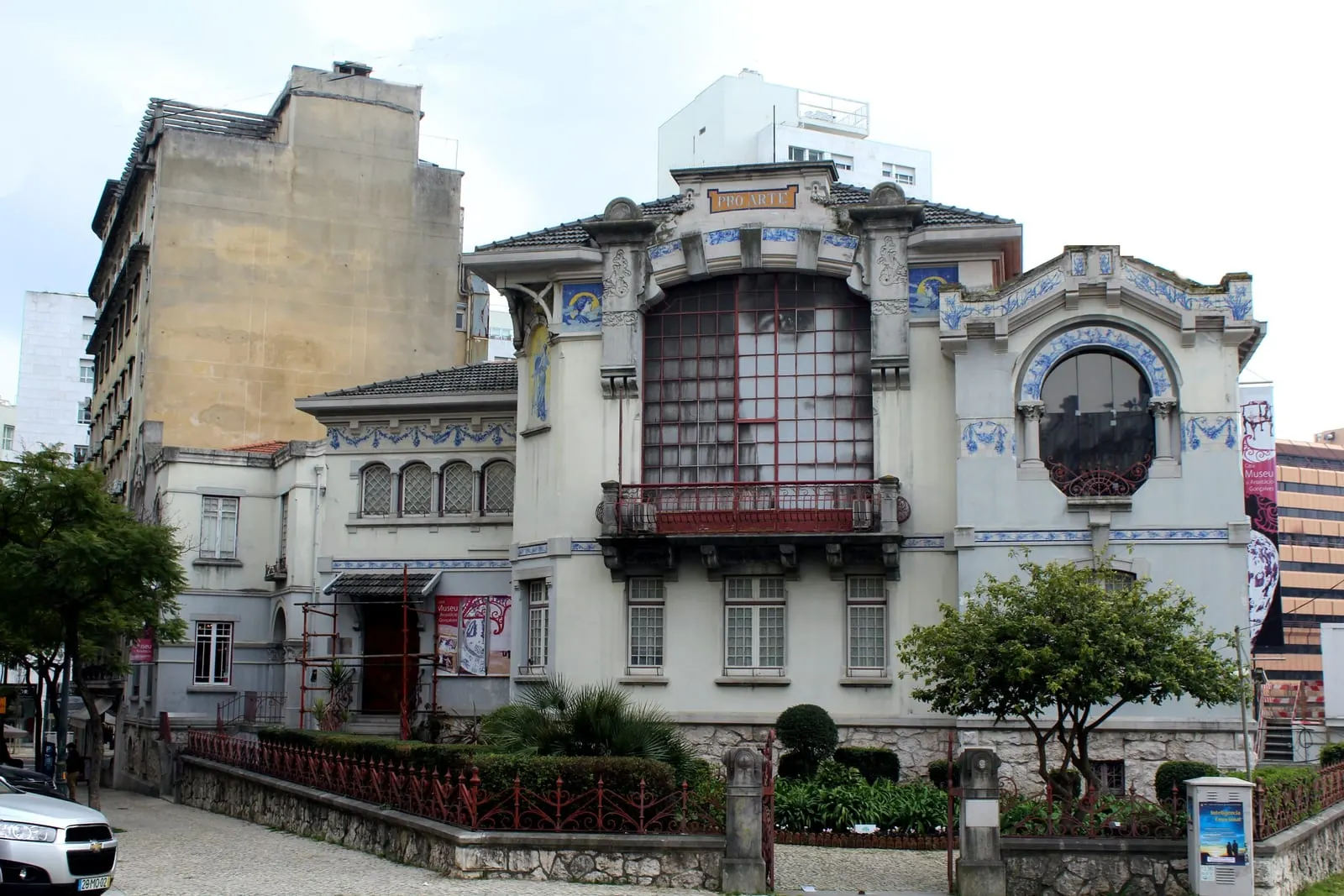
The Casa-Museu Dr. Anastácio Gonçalves occupies the former Casa Malhoa, on the corner of Avenida 5 de Outubro and Rua Pinheiro Chagas, in the Avenidas Novas district of Lisbon. The visit brings together two histories. The first is that of the house-studio the painter José Malhoa had built at the beginning of the twentieth century, distinguished with the Valmor Prize. The second is that of the collection of an ophthalmologist who lived there and bequeathed it to the State. The result is a domestic museum, on the scale of a town house, with some 3,000 works.
The house of the painter José Malhoa
The design is by the architect Manuel Joaquim Norte Júnior and dates from March 1904. It was entrusted to the builder Frederico Augusto Ribeiro. Museus e Monumentos de Portugal dates the building to 1904–1905 and presents it as the first artist’s house in the capital. Malhoa intended it as a residence and studio, and the work was at one point called the “Lar-Oficina Pro-Arte”. As early as November 1904, the design was altered to include a basement.
According to Museus e Monumentos de Portugal, the house received the Valmor Prize in 1905. The register of the Património Cultural, I.P. notes that the prize is marked by an azulejo panel on the west façade.
Architecture: eclecticism with Art Nouveau
The national register describes a detached house surrounded by walled gardens. The irregular plan results from the intersection of three bodies with a central block, where a broad bay window with a lowered arched balcony opens. The solutions for plan and height, including chamfered walls, responded to a request from Malhoa: every room was to receive direct sunlight.
The house is not a “pure” example of Art Nouveau. The register reads it as a work of late nineteenth-century eclecticism, in which decorative Art Nouveau motifs coming from Paris intersect with the model of the so-called Portuguese house. On the façade, observe:
- the azulejo friezes by José António Jorge Pinto, free interpretations of drawings by Malhoa and António Ramalho, which replaced fresco paintings by João Eloy Amaral;
- the two azulejo panels with female figures flanking the main bay window, and the ceramic motto above it, which gave the house its name;
- the panel alluding to Painting, on the chamfered wall;
- the figurative Art Nouveau stained-glass window on the south body;
- the sculpture by António Augusto da Costa Mota (nephew) and the wrought iron designed by Norte Júnior and executed by the locksmith Vicente Joaquim Esteves.
To see how these coverings fit within the azulejo production of the period, continue to azulejo Art Nouveau and modern.
The collector and the museum
After the death of Malhoa’s wife, the house was put up for sale. Between 1919 and 1932 it had two owners, until it was bought in 1932 by the ophthalmologist António Anastácio Gonçalves (1889–1965). He lived there and organised his collection. By will, he bequeathed the house and its contents to the State so that a museum could be created there. The bequest was incorporated in 1969 and the museum opened to the public in 1980.
In 1996, to a design by the architects Frederico and Pedro George, the house was joined to an adjoining residence on Rua Pinheiro Chagas, the former Casa António Pinto da Fonseca Mota, dating from 1908, also by Norte Júnior. The extension added a reception area, a shop and a space for temporary exhibitions. The Casa-Museu reopened in December 1997 in its present configuration.
The collections
The collection numbers some 3,000 works, organised in three main groups:
- nineteenth- and twentieth-century Portuguese painting;
- Chinese porcelain;
- furniture, Portuguese and foreign.
There are also groups of civil and sacred goldsmiths’ work, European painting, Portuguese sculpture, European ceramics, textiles, numismatics, medals, glass, and Swiss and French pocket watches. The Casa-Museu also holds a documentary archive and drawings, watercolours and small objects that belonged to the painter Silva Porto.
Classification and management
The building is classified as a Property of Public Interest under Decree No. 28/82, of 26 February 1982, with the designation “Casa Malhoa, actualmente Casa-Museu Dr. Anastácio Gonçalves”. The Casa-Museu is the first museum on the list in Annex II of Decree-Law No. 79/2023, among the museums managed by Museus e Monumentos de Portugal. It has no connection with the World Heritage List.
Planning the visit
The entrance is at Avenida 5 de Outubro, 6-8, 1050-055 Lisbon. When consulted on 5 November 2026, the official page indicated:
- opening Tuesday to Sunday, 10:00 to 18:00, with last entry at 17:00;
- standard ticket €5.00;
- closed on 1 January, Easter Sunday, 1 May, 13 June and 25 December, with possible changes on public holidays.
Visits are always guided, in groups of up to 10 people, lasting approximately 45 minutes. Organised groups require advance booking. Please confirm opening hours, visit times and prices on the Museus e Monumentos de Portugal page or by telephone on +351 213 540 823.
Photograph by Dguendel, dated 25 January 2017. Original on Wikimedia Commons, under CC BY 4.0; resized and compressed for the web, without altering the composition.

Frequently asked questions
- Why is it also called the Casa Malhoa?
- Because it was commissioned by the painter José Malhoa as a house and studio, to a design by Norte Júnior dated 1904. The physician Anastácio Gonçalves bought it in 1932 and bequeathed it to the State so that a museum could be created there.
- Which collections can be seen?
- Some 3,000 works assembled by António Anastácio Gonçalves, organised in three main groups: nineteenth- and twentieth-century Portuguese painting, Chinese porcelain, and Portuguese and foreign furniture. There is also goldsmiths' work, European painting, sculpture, ceramics, textiles, numismatics, glass and pocket watches.
- Did the house receive the Valmor Prize?
- Yes. According to Museus e Monumentos de Portugal, the Casa Malhoa received the Valmor Prize in 1905. An azulejo panel on the west façade commemorates the award.
- Is the building listed?
- Yes. The Casa Malhoa, now the Casa-Museu Dr. Anastácio Gonçalves, is a Property of Public Interest under Decree No. 28/82, of 26 February 1982.
Sources
- Museus e Monumentos de Portugal — Casa-Museu Dr. Anastácio Gonçalves
- Património Cultural, I.P. — Casa Malhoa, actualmente Casa-Museu Dr. Anastácio Gonçalves (72353)
- Património Cultural, I.P. — Atlas do Património Classificado e em Vias de Classificação (NINV 3219)
- Diário da República — Decreto n.º 28/82, de 26 de fevereiro
- Diário da República — Decreto-Lei n.º 79/2023, de 4 de setembro (anexo II)
- Ordem dos Advogados — Museus e Monumentos de Portugal, E.P.E. (texto do Decreto-Lei n.º 79/2023)
- Wikidata — Casa-Museu Dr. Anastácio Gonçalves (Q5047773)
Resources for research
Find the sources. Follow the story.
Guides to researching buildings, exploring museum collections and understanding heritage protection.
SIPA
Get to know the architectural inventory, building records and documentary archive.
Read the guideMuseum collectionsMatrizNet
Explore the museum catalogue and records of works, materials, authorship and provenance.
Read the guideHeritage protectionHeritage classification
Understand cultural property categories and the levels of national, public and municipal interest.
Read the guide