Monuments
Church of Santo Amaro (Beja)
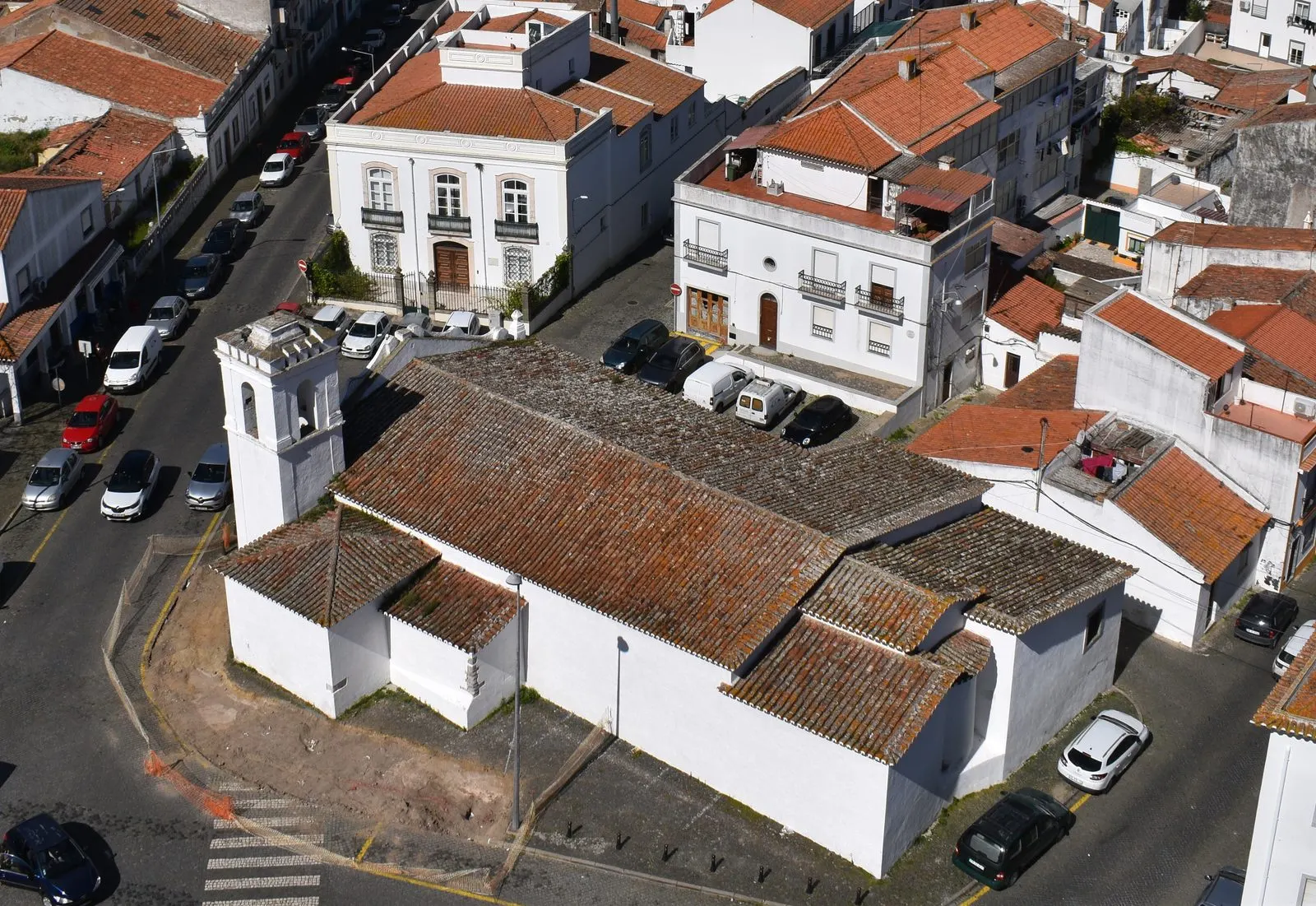
Church of Santo Amaro, in Beja: a High Medieval church, a National Monument since 1936, which houses the Visigothic Nucleus of the Queen D. Leonor Museum.
- Location
- Beja, Beja
- Built
- origem alto-medieval (datação discutida); remodelações dos séculos XV–XVI
The Church of Santo Amaro, on Largo de Santo Amaro, in Beja, is a small whitewashed church that holds the country’s best-known collection of Visigothic art. It operates as the Visigothic Nucleus of the Queen D. Leonor Museum, formerly the Regional Museum of Beja. The building is at once a museum object and a problem of dating: for decades it was treated as a Paleo-Christian or Visigothic church, and the most recent research proposes a later origin.
One church, several datings
The classification decree of 1936 describes the church as an «initial construction of the pre-Romanesque period», «a precious example among us and very rare everywhere» which, although heavily mutilated, retains enough of the original construction to justify its classification. The text adds that, with the necessary works, it would be possible to find buried materials that might help reintegrate it.
Today the question is less simple. The municipality of Beja writes that many authors associated the church with a Paleo-Christian foundation, but that more recent studies date it to the 10th century, in the midst of the Islamic period, as a work of the Mozarabic community of Beja. The present configuration results from several remodellings, above all in the 15th and 16th centuries. For the reader, the practical consequence is that the church may be presented as a High Medieval building of disputed dating, rather than as a securely Visigothic church; the exhibited collection covers, according to the museum, the 4th to 7th centuries.
The Visigothic Nucleus
According to the official page of Museus e Monumentos de Portugal, the nucleus opened in 1981, after more than forty years of persistence by specialists and residents. Already in 1949 Abel Viana had argued that the church should house the city’s Visigothic museum. The museological project sought to restore the interior and display the pieces in dialogue with the space of the former Paleo-Christian basilica.
Most of the pieces come from Beja and its region, above all architectural elements taken from religious buildings. The route begins in the Late Roman world of the 4th and 5th centuries and moves on to the Visigothic period of the 6th and 7th centuries, when architecture gradually transforms. Among the goldsmiths’ works mentioned are jewels and a warrior’s sword found in a Beja tomb at the beginning of the 20th century. To place this collection within the national whole, see Visigothic Art and Architecture in Portugal; for the wider Iberian pre-Romanesque context, see the page on Asturian and pre-Romanesque art.
Classification
The national register identifies the church as a National Monument (NINV 70911), with the alternative designations Capela de Santo Amaro, Capela de Santa Maria da Graça and Núcleo Visigótico do Museu Rainha D. Leonor. The instrument is Decree No. 27 398 of 26 December 1936 (Diário do Governo, I series, No. 302), which classifies «a igreja de Santo Amaro, do Beja» as a national monument. The Atlas also indicates Decree No. 22 743 of 27 June 1933, which we have not consulted. The indicated administration is Museus e Monumentos de Portugal, E.P.E.
Visiting
When consulted on 5 November 2026, the Museus e Monumentos de Portugal page indicated that the nucleus has been closed to the public since 24 March 2026. The municipality of Beja’s page also shows a notice of temporary closure and refers to works at the Regional Museum. The usual opening hours, when open, were Tuesday to Sunday, 10:00–12:30 and 14:00–17:30, with closures on Mondays, 1 January, Easter Sunday, 1 May, the municipal holiday (Ascension Thursday) and 25 December; admission was free.
The address is Largo de Santo Amaro, 7800-263 Beja. To confirm the reopening, consult the nucleus page or contact the museum at [email protected]. The Roman Arch and the Castle of Beja are nearby and can be seen from the outside on the same route; the managing institutions are described in Museus e Monumentos de Portugal.
Photograph by Bextrel, dated 8 March 2020. Original on Wikimedia Commons, under CC BY-SA 4.0; resized and compressed for the web, without altering the composition.
Frequently asked questions
- Is the Church of Santo Amaro a Visigothic church?
- For a long time it was presented as a Paleo-Christian or Visigothic church. The municipality of Beja notes that more recent studies date it to the 10th century, during the Islamic period, and attribute it to the Mozarabic community. The dating remains under debate.
- Which museum operates in the church?
- The Visigothic Nucleus of the Queen D. Leonor Museum, formerly known as the Regional Museum of Beja. The museum's main nucleus is located in the former Convent of the Conceição.
- Can I visit at the moment?
- When consulted on 5 November 2026, the Museus e Monumentos de Portugal page indicated that the nucleus has been closed to the public since 24 March 2026. Please confirm the reopening before travelling.
- Is it classified?
- Yes, as a National Monument, by Decree No. 27 398 of 26 December 1936. The Heritage Atlas also refers to Decree No. 22 743 of 27 June 1933.
Sources
- Património Cultural, I.P. — Atlas do Património Classificado: Igreja de Santo Amaro (NINV 70911)
- Diário do Governo — Decreto n.º 27 398, de 26 de dezembro de 1936 (I Série, n.º 302)
- Município de Beja — Igreja de Santo Amaro / Núcleo Visigótico do Museu Regional de Beja
- Museus e Monumentos de Portugal — Igreja de Santo Amaro, Núcleo Visigótico do Museu Rainha D. Leonor
- Município de Beja — História da Cidade
- Wikidata — Igreja de Santo Amaro (Q2138420)
Keep exploring
Heritage nearby
More places to discover from here. Approximate straight-line distances, within 50 km.