Archaeology
Roman Arch of Beja
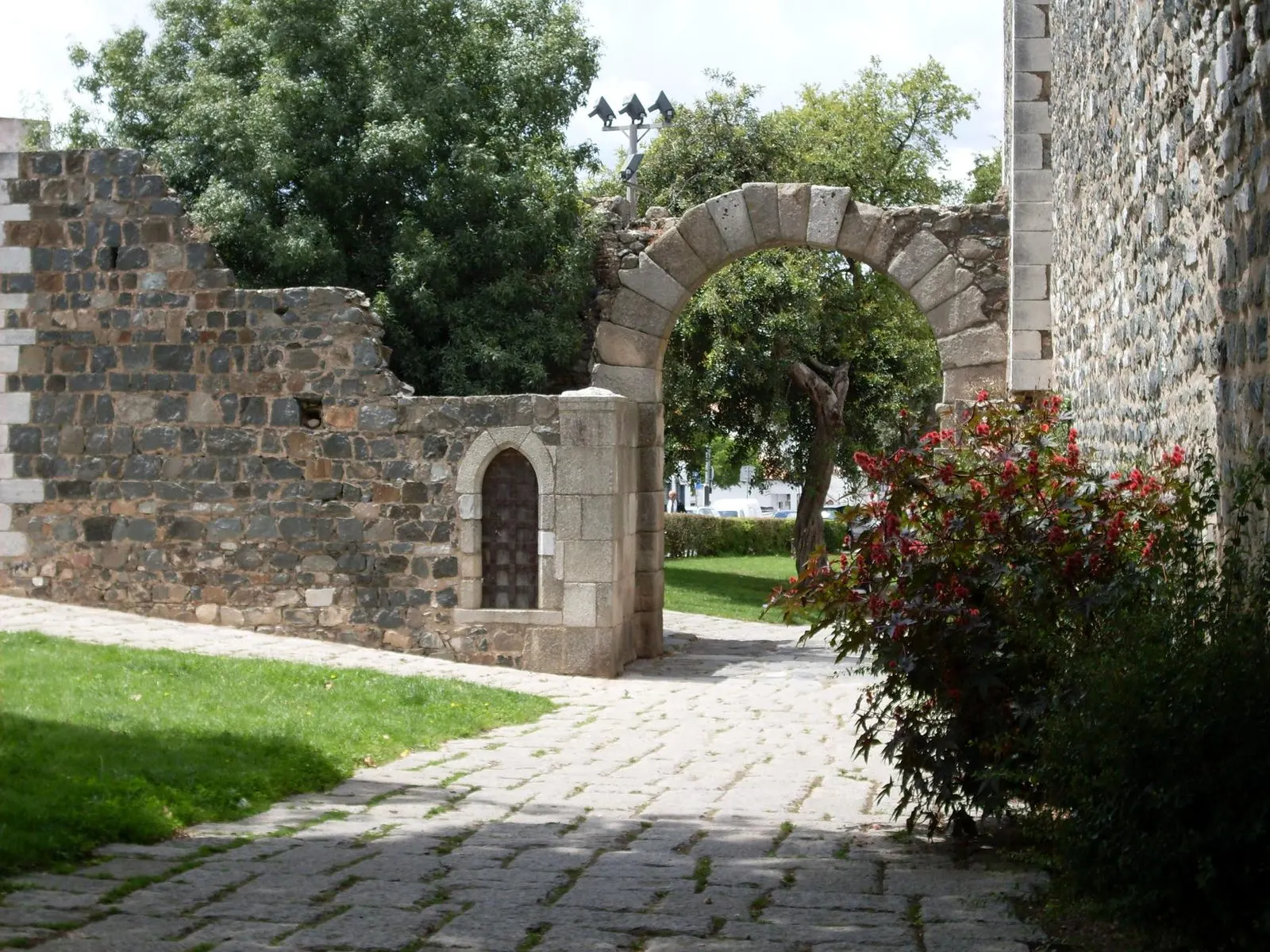
Roman Arch of Beja, or Évora Gate: a gate in the Roman walls of Pax Iulia, dated to the 3rd–4th centuries, rebuilt in 1938, National Monument since 1910.
- Location
- Beja, Beja
- Built
- séculos III–IV (reconstruído em 1938)
The Roman Arch of Beja, also called the Évora Gate, is a round-arched stone gate that opens between stretches of wall beside the castle of Beja. It is the most visible remnant of Pax Iulia, the Roman city from which Beja developed, and one of the few elements that allow us to imagine the city’s defensive perimeter at the time.
From Pax Iulia to the modern town
The city’s history page, published by the municipality, attributes the foundation of Pax Iulia to Julius Caesar or Augustus, without fixing a date. It is known that it was the capital of the conventus Pacensis, one of the three administrative districts of Lusitania, alongside those of Scallabis (Santarém) and Emerita (Mérida), and that it held the status of civitas and colonia. The forum was located near the present Praça da República, with a probable temple to the imperial cult; other public buildings, such as a theatre, amphitheatre, circus and baths, are mentioned, but their locations remain hypothetical.
After Rome, the city remained an administrative centre and episcopal see in the Visigothic period. The Islamic occupation introduced a radial urban layout in place of the Roman orthogonal grid, and the city lost importance from the 11th century onwards. Part of what is seen today in the walls rests on older layouts, as noted on the page for the Castle of Beja.
An arch with a turbulent history
The municipality indicates that some authors date the construction of the arch to the 3rd–4th centuries AD, when it formed part of the Roman walls and functioned as one of the city’s entrance gates. Today it stands outside the medieval castle’s citadel, leaning against the wall.
The building’s history is not linear. The same municipal page states that the arch was demolished in the 16th century and rebuilt in 1938, using the surviving remains, integrated into buildings that have since been demolished. Other published accounts place the demolition later, at the end of the 19th century; we have not found a document that resolves the discrepancy, so the exact chronology of the demolition should be treated as unconfirmed. What the municipal source and on-site observation allow us to affirm is that the present arch is, for the most part, a 20th-century reconstruction.
Classification
The national heritage register identifies the Arco romano de Beja (NINV 2112), also designated the Évora Gate, as a National Monument, by the Decree of 16 June 1910, published in the Diário do Governo no. 136, of 23 June 1910. It is the same instrument that classified many other monuments and archaeological sites in the country. We consulted the Atlas do Património register, not the full text of the decree; the register does not indicate a special protection zone.
Reading the arch in the context of Beja
To understand the Roman city, it is worth linking the arch to other points in the historic centre: the Castle of Beja, the area of the former forum, and the Church of Santo Amaro, which holds the city’s Visigothic collection. The broader picture is covered in Roman and pre-Roman Portugal and in Roman Portugal: archaeology; for a comparison with another city in the Alentejo, see the Walls of Évora, whose ancient enclosure also dates back to the late Roman period.
Visiting
The arch stands outdoors, in the castle’s surroundings, and is viewed from the outside. When consulted on 5 November 2026, the municipal page dedicated to the monument did not list opening hours or an address, only the coordinates 38.01708 N, 7.86550 W. Ask at the Beja tourist office or consult the municipal portal for the route context and for the castle’s opening hours, which follow their own rules.
Photograph by LFino, dated 20 May 2009. Original on Wikimedia Commons, under CC BY-SA 3.0; resized and compressed for the web, without altering the composition.
Frequently asked questions
- Is the Roman Arch of Beja the same as the Évora Gate?
- Yes. The national heritage register uses "Arco romano de Beja" and gives "Porta de Évora" as another designation; the municipality of Beja presents it as "Portas de Évora / Arco Romano".
- What is the date of the arch?
- The municipality notes that some authors date it to the 3rd–4th centuries AD, when it formed part of the Roman walls and served as one of the city's gates. The structure seen today was rebuilt in 1938.
- Is it classified?
- Yes, as a National Monument, by Decree of 16 June 1910, published in the Diário do Governo no. 136, of 23 June 1910.
- Can I visit the arch?
- It stands outdoors, beside the castle walls, in the historic centre of Beja. The municipal page does not give opening hours or access conditions.
Sources
Keep exploring
Heritage nearby
More places to discover from here. Approximate straight-line distances, within 50 km.