Monuments
Walls of Viseu
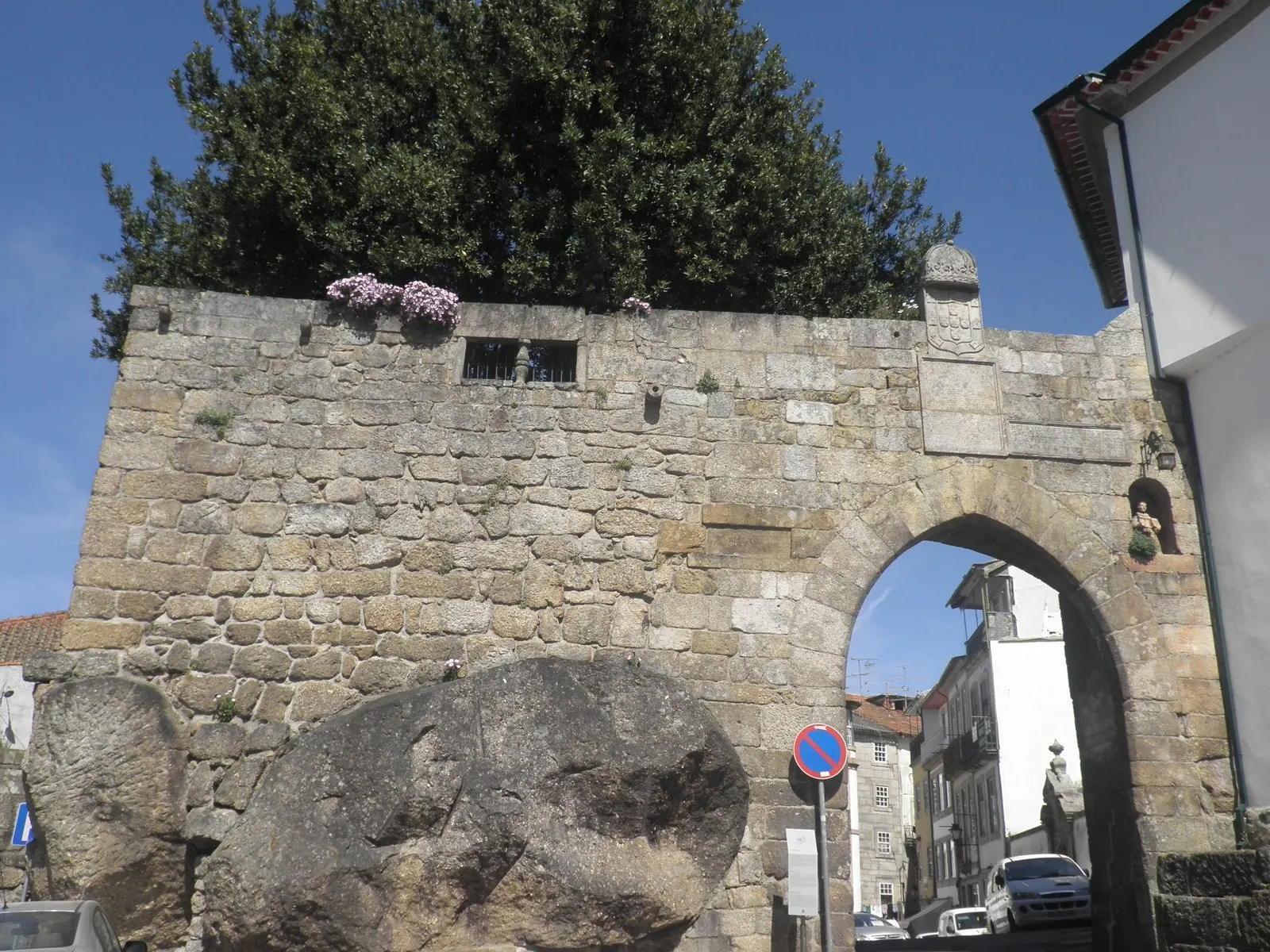
Viseu's ancient walls and gates, a 15th-century wall from King Afonso V's reign, with Porta do Soar and Porta dos Cavaleiros. National Monument since 1915.
- Location
- Viseu, Viseu
- Built
- séc. XV (reinado de D. Afonso V)
In Viseu, the medieval wall no longer forms a continuous circuit, unlike in other cities. What remains are two monumental gates, the Porta do Soar and the Porta dos Cavaleiros, and some isolated stretches beside the cathedral and between houses in the historic centre. They are often hidden by later buildings. Even so, these remains are among the clearest witnesses to the city’s 15th-century past, and the State classified them as a National Monument in 1915.
Uncertain origins
The national register acknowledges that opinions on the origin of the walls vary widely, due to a lack of archaeological information. The existence of an early Roman wall has been generally accepted and was confirmed by excavations in the Largo de Santa Cristina. Its extent and perimeter, however, remain unknown. The early medieval enclosure is also uncertain. A defensive structure around the turn of the 12th century is often mentioned, but, according to the national register, certainty is lacking.
The 15th-century enclosure
What survives dates from the 15th century. The 1915 classification decree refers to the historical value of the city’s wall and old gates, “which date back to the 15th century”. The national register describes an enclosure built under the House of Avis, with a very irregular polygonal plan, adapted to the shape of the city that already existed. Later alterations have made the original line difficult to define. The remains are isolated sections with no connection between them, and they do not allow the complete circuit to be reconstructed.
According to the national register, of the seven original gates, two remain. Almost nothing survives of the original towers.
The Porta do Soar
The Porta do Soar, also called the Porta de São Francisco, is the most important surviving element. It has a pointed arch and a short stretch of wall attached to it. It was the city’s main thoroughfare. It was there that the builders placed the inscription dating the work to the reign of King Afonso V, together with a stone bearing the national coat of arms. Inside the gate, a small niche still holds the image of the patron saint. The national register notes that this feature was common at the main entrances of fortifications at the end of the Middle Ages.
Centuries later, the Solar dos Melos, one of Viseu’s most interesting Baroque mansions, was built beside the gate. The mansion was so prominent in the city that the gate also came to be known as the Arco dos Melos. The national register places it on Rua Nunes de Carvalho, in the historic centre where the Sé de Viseu and the Museu Nacional Grão Vasco are also located.
The Porta dos Cavaleiros and other remains
The Porta dos Cavaleiros stands on Rua dos Loureiros. The national register associates it with a stone plaque dated 1646, evidence that the wall was worked on in the early modern period. Photographs in the register show the gate near the São Francisco fountain and the Casa do Arco.
They also show other, less well-known remains: the section at the Sé, with walls to the north and south and the Varanda dos Cónegos, and remnants of the Porta da Senhora do Postigo, near Rua Silva Gaio. On the Largo de Santa Cristina stands a manor house, probably from the 17th century, whose foundations rest on a stretch of wall.
Dismantling
The history of the enclosure’s destruction is not fully clear. The national register indicates that dismantling may have begun as early as the 16th century, with the extension of the episcopal palace. In 1844, the Municipal Chamber ordered the demolition of the old gates. This was seen as a modernising decision, similar to those taken by other Portuguese municipalities in the 19th century. Throughout the early modern period, the wall was also gradually occupied and altered to make room for houses and manor houses.
Classification
The wall and old gates are a National Monument under Decree No. 2 165, signed on the 24th and published in the Diário do Governo, I series, no. 265, on 31 December 1915. The decree provided that the protection, defence and conservation of the monument be governed by the provisions of the decree-law of 26 May 1911. When consulted on 5 November 2026, the Atlas do Património Classificado showed no published special protection zone. Viseu is not part of any UNESCO inscription.
Visiting
The two gates and the preserved sections stand on public streets and squares in the historic centre, near the cathedral. When consulted on 5 November 2026, we found no official information on guided tours of the walls. For organised routes, contact Viseu’s municipal tourism office.
To place the visit in context, see the guide to Viseu, the Centro region and the typology of city walls and urban enclosures. The network of castles of Portugal brings together other medieval military works in the region.
Photograph by Alexa Pinto, 15 April 2011, submitted to Wiki Loves Monuments Portugal. Original on Wikimedia Commons, under CC BY-SA 3.0; resized and compressed for the web, without altering the composition.
Frequently asked questions
- When date the walls of Viseu?
- What survives dates from the 15th century. The classification decree states that the wall and the old gates date back to that century, and the national register notes that an inscription on the Porta do Soar dates the construction to the reign of King Afonso V.
- How many gates survive?
- According to the national register, two of the seven original gates remain: the Porta do Soar, also called São Francisco, and the Porta dos Cavaleiros.
- Why did most of the enclosure disappear?
- The national register indicates that dismantling began as early as the 16th century, with the extension of the episcopal palace, and that the Municipal Chamber ordered the demolition of the old gates in 1844. Houses and manor houses were later built on top of the wall.
- Is the wall classified?
- Yes. The city's wall and old gates are a National Monument under Decree No. 2 165, published in the Diário do Governo on 31 December 1915.
Sources
Keep exploring
Heritage nearby
More places to discover from here. Approximate straight-line distances, within 50 km.