Monuments
Walls of Évora
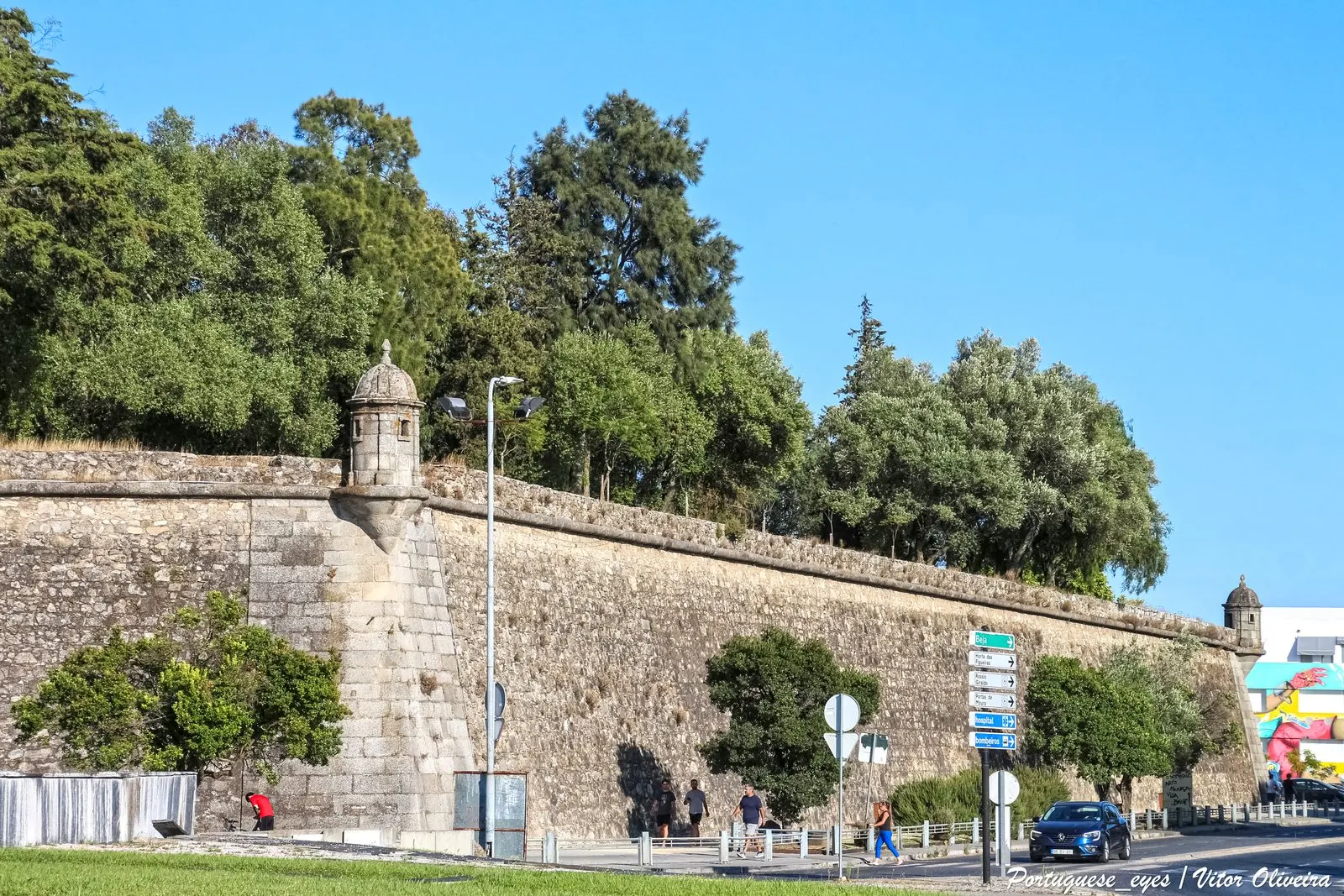
Walls of Évora: the ancient 3rd-century wall, the new medieval wall and 17th-century bulwarks, classified as National Monuments in 1910, 1922 and 1926.
- Location
- Évora, Évora
- Built
- séc. III (cerca antiga); séc. XIV (cerca nova); séc. XVII (baluartes)
Évora is one of the Portuguese cities where the evolution of a walled town can best be read. On the upper part, around the Sé and the Roman Temple, there are remains of an ancient enclosure from the 3rd century. Further down, a medieval new enclosure surrounds the districts that grew later. Outside it, the city was reinforced in the 17th century with bastions and moats adapted to artillery. The national register treats these three phases in three different records, classified on different dates.
The ancient enclosure
According to the national register, Évora’s first enclosure dates from the Roman period, more precisely the 3rd century. At that time, the area of the city was reduced, as was common in walls of this period, and parts of the city of the 1st and 2nd centuries were destroyed. The enclosure covered about 10 hectares and had a length of almost two thousand metres, around the highest part of the city, where the Sé de Évora stands today. The best-known witness of this phase is the Porta de D. Isabel, which the Atlas of Classified Heritage records as a Roman gate.
This enclosure is often called Romano-Gothic, but the national register shows caution. UNESCO says that, in the Visigothic period, the Christian city occupied the area enclosed by the Roman wall, which was then reformulated. The national register asks, however, which stretches can be attributed with certainty to Visigothic rule. The so-called Torre de Sisebuto, named after a Visigothic king, belongs more to legendary tradition than to proven dating. The same applies to the Islamic period, which ended in 1165, according to UNESCO. The national register places in this period the construction of a castle, today heavily altered and in ruins, but archaeological data confirming it are lacking.
The medieval new enclosure
As the city grew beyond the ancient enclosure, Évora received a second, much larger wall. The national register does not know the exact moment in the first dynasty when the decision was taken. It considers, however, that everything points to the reign of D. Afonso IV, who spent long periods in the city. Because the work was large, it dragged on and was only completed during the reign of D. Fernando. For this reason, some authors also call it the Fernandine enclosure.
The new enclosure retains its essential layout and has well-preserved stretches. Among the gates, the national register highlights the Porta de Avis, mentioned in 1353, and the gates of Alconchel, Mendo Estevens and Moinho de Vento. The stretches classified in 1922 include the towers and walls between the gates of Alconchel and Raimundo, and a tower next to the aqueduct. The national register includes these stretches in the protection zone of the Aqueduto da Água de Prata.
Bastions and moats of the 17th century
Artillery forced a rethinking of medieval defences. According to the national register, D. Manuel I ordered the construction of the Castelo Novo in 1518, to a design by Diogo de Arruda, completed seven years later. The great transformation came in the middle of the 17th century, after the Restoration. D. João IV commissioned Carlos Lassart, chief engineer of the kingdom, to examine the state of the fortress. For lack of funds, the works only began in the 1660s.
The national register attributes the design, “in all likelihood”, to Luís Serrão Pimentel. UNESCO refers to a Vauban-type wall built to plans by the French engineer Nicolas de Langres. The official sources do not agree, and it is not possible to settle the authorship with confidence.
The plan had two aims. The first was to reinforce the medieval circuit with moats and smaller bastions. The second was to defend the city at a distance, with a network of forts. This resulted in the bastions of Nossa Senhora de Machede, the first to be built, of the Apóstolos and of the Príncipe, and the forts of Santo António and Penedos. According to UNESCO, the historic centre kept its characteristics within this seventeenth-century wall, despite the growth of the city to the west, south and east. The road network built around the walls in the 20th century also helped preserve it.
Classification and World Heritage
Legal protection was granted in three steps, according to the Atlas of Classified Heritage:
- the stretches of the Roman and Arab enclosure were classified by the Decree of 16 June 1910 and by Decree No. 8 229, of 4 July 1922;
- the stretches of the medieval enclosure were classified by the same Decree No. 8 229, of 1922;
- the walls and moats were classified by Decree No. 11 773, published in the Diário do Governo on 25 June 1926. The decree considers as a National Monument “every part of the walls and moats of the city of Évora” that was not yet classified.
All three records carry the category of National Monument. The national register indicates that the walls and moats are covered by the Centro Histórico de Évora, inscribed on the World Heritage List in 1986. Under Law No. 107/2001, this also classifies them as a National Monument. The walls have no separate UNESCO inscription.
Visiting
The walls follow the perimeter of the historic centre, and the national register places the monument “along the entire route”. Gates, towers and wall sections can be seen from the streets and squares that surround the city. When consulted on 5 November 2026, we found no official information on guided visits or access to elevated stretches. Please confirm with the Câmara Municipal de Évora before planning a specific route.
Within the ancient enclosure stand the Roman Temple of Évora and the Sé. The typology is explained in city walls and urban enclosures, which gives Évora as an example of a city with an old and a new enclosure. To continue, see the region of Alentejo and the network of castles of Portugal.
Photograph by Vitor Oliveira, 24 July 2021, at the Baluarte do Príncipe; the author’s signature is part of the original image. Original on Wikimedia Commons, under CC BY-SA 2.0; resized and compressed for the web, without altering the composition.
Frequently asked questions
- How many enclosures did Évora have?
- Three overlapping systems: the ancient enclosure, dating from the 3rd century, around the highest part of the city; the new medieval enclosure, which the national register probably attributes to D. Afonso IV and records as completed during the reign of D. Fernando; and the 17th-century bastioned fortification, which reinforced the medieval circuit with bastions and moats.
- Is the ancient enclosure Roman or Visigothic?
- The national register dates the first enclosure to the 3rd century, in the Roman period. Note that it is often called Romano-Gothic, but there is no archaeological evidence allowing specific stretches to be attributed to the Visigothic period.
- How are the walls classified?
- In three stages. The stretches of the Roman and Arab enclosure were classified in 1910 and 1922, the stretches of the medieval enclosure in 1922, and Decree No. 11 773, published on 25 June 1926, classified as a National Monument all parts of the walls and moats that were not yet classified.
- Are the walls part of the World Heritage List?
- Yes. The national register indicates that they are covered by the Historic Centre of Évora, inscribed on the World Heritage List in 1986. They have no separate inscription.
Sources
- Património Cultural, I.P. — Muralhas e fossos da cidade de Évora (69777)
- Património Cultural, I.P. — Trechos da cerca romana e árabe das muralhas de Évora (69776)
- Património Cultural, I.P. — Trechos da cerca medieval das muralhas de Évora (69830)
- Património Cultural, I.P. — Atlas do Património Classificado (NINV 2739, 2740 e 2741)
- Diário do Governo — Decreto n.º 11 773, de 25 de junho de 1926
- Diário do Governo — Decreto n.º 8 229, de 4 de julho de 1922
- Diário do Governo — Decreto de 16 de junho de 1910
- UNESCO — Historic Centre of Évora
- Wikidata — Muralhas e fossos da cidade de Évora (Q39713732)
Keep exploring
Heritage nearby
More places to discover from here. Approximate straight-line distances, within 50 km.