Monuments
Houses and Palaces Classified in Évora
Évora's National Monuments: the former Counts of Basto Palace (Paço de São Miguel), the Casa da Sempre Noiva and the remains of the Paços de Évora.
- Location
- Évora, Évora
In addition to the Casa de Garcia de Resende, the municipality of Évora has three more domestic buildings classified as National Monuments: a palace in the city centre, a manor house in the countryside and the remains of a royal palace. The official record is accessible, in this guide, for only one of them; for the other two, what is stated comes from the Atlas of Classified Heritage and the decree.
Palace of the former Counts of Basto
The national register (NINV 2743) gives its alternative designations as Paço de São Miguel da Freiria and Palácio do Pátio de São Miguel, and places it in the parish of Évora (São Mamede, Sé, São Pedro e Santo Antão). It is a National Monument by Decree No. 8 218, published in the Diário do Governo No. 130, of 29 June 1922, which classifies, in the same text and in the district of Évora, the “Palácio dos antigos Condes de Basto”, the Convent of São Bento de Castris, the Porta de Avis and the Chafariz das portas de Moura. A note: the Atlas hyperlink to the diploma points to the 1910 decree; the diploma read is that of 1922, which is the one cited as the basis of the classification.
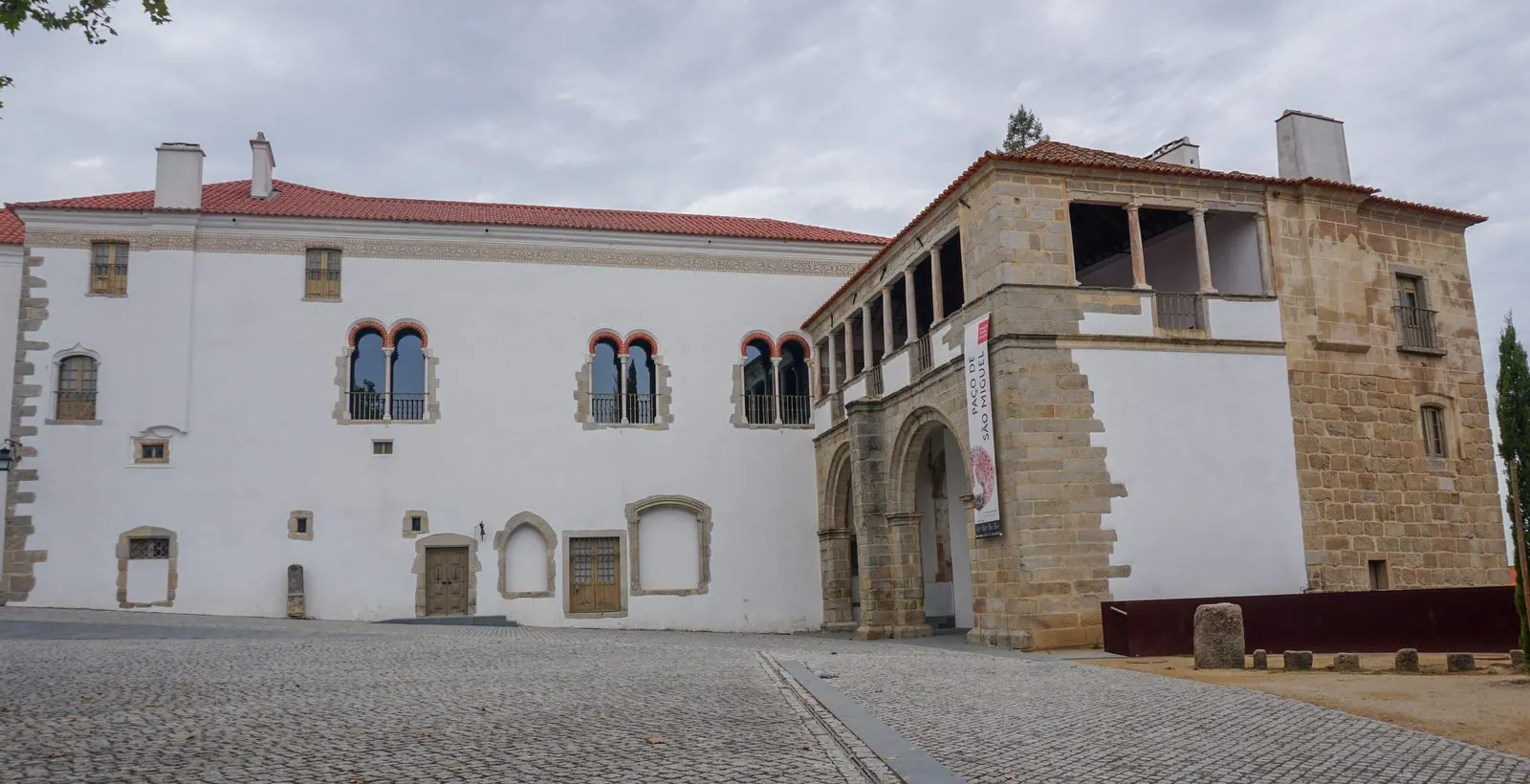
In the photograph illustrating this page, the whitewashed façade has three twin windows with cusped arches, and the dressed-stone wing on the right opens into an arcaded gallery; the panel covering it reads “Paço de São Miguel”. I was unable to read the descriptive record of the palace, so I do not give a construction date, owners or current use.
Casa da Sempre Noiva
Here there is official text. The record (NINV 2662, code 70189) describes a manor house at the Monte da Sempre Noiva, in the parish of Nossa Senhora da Graça do Divor, in the municipality of Évora. The 1910 decree mistakenly placed it in the municipality of Arraiolos; the register corrects this and notes that the estate lies about 4 km from that town. The register’s coordinates are 38.695442 N, 7.969043 W.
According to the register, the house was built at the turn of the fifteenth to the sixteenth century by D. Afonso de Portugal, Bishop of Évora, who had acquired the land by exchange from the bishopric, perhaps making use of an older building, possibly from the fourteenth century, centred on a two-storey tower. In 1531, the bishop’s natural daughter, D. Beatriz or Brites de Portugal, instituted the entail of the Herdade da Sempre Noiva, with her brother D. Francisco de Portugal, 1st Count of Vimioso, as administrator; hence the name Solar dos Vimiosos. The register defines the style as a “precious Mudéjar-Manueline declension of the late Gothic of the Alentejo”, at a time when the court was concentrated in Évora.
The plan is simple: a rectangular block that includes the two lower storeys of a three-storey tower, and an elongated wing, at an angle, with a small chapel and a two-storey vaulted porch on the main façade. The porch houses the staircase leading to the Manueline doorway of the noble floor. The chapel, with ribbed vaults, rises up to the residential floor of the tower, so that the religious services could be followed from there; the two upper storeys of the tower have star vaults. The exterior was greatly altered in the nineteenth century: a tower was demolished, the battlements and the cylindrical pinnacles of the chapel were removed, windows were mutilated, and the sgraffito friezes of the quoins were lost. The register also records traces of Roman occupation on the site. For the decorative vocabulary, see the Manueline style.
Paços de Évora (remains)
This is a different register entry from the Paço de São Miguel, although both are “paços”. The Atlas (NINV 2744) designates the property “Paços de Évora (restos)”, with the alternative names Palácio de D. Manuel, Palácio Real de São Francisco and Paço Real de Évora, and classifies it as a National Monument by the decree of 16 June 1910 (Diário do Governo No. 136, of 23 June). The qualifier “restos” (remains) suggests that what survived of the complex is what is classified, but I did not read the record that confirms this. I did not read the descriptive record, so I do not recount the history of the palace nor locate the remains; the royal and Franciscan context of the city can be seen at the Church of São Francisco, and the typology in royal palaces.
Taken together
The three buildings were classified at two moments, 1910 and 1922. They illustrate three functions of power in Évora: the royal palace, the urban residence of a titled house and the country house of a family tied to the bishopric and the court. For the general typology, see manor houses and seigneurial residences.
How to see them
When consulted on 5 November 2026, I did not find official opening hours for these buildings. Confirm access with the Municipality of Évora; the Casa da Sempre Noiva lies outside the city, on an estate, and there is no official information about visits.
Photograph by Vanbasten 23, of 16 September 2020. Original on Wikimedia Commons, under CC BY-SA 4.0; resized and compressed for the web, without altering the composition.

Frequently asked questions
- Are the Paço de São Miguel and the Paços de Évora the same building?
- No. The national register gives Paço de São Miguel da Freiria as an alternative name for the Palace of the former Counts of Basto. The "Paços de Évora (restos)" have a separate register entry and different designations: Palácio de D. Manuel, Palácio Real de São Francisco and Paço Real de Évora.
- Is the Casa da Sempre Noiva in Évora or in Arraiolos?
- In the municipality of Évora, in the parish of Nossa Senhora da Graça do Divor. The 1910 decree mistakenly placed it in Arraiolos, as the official register notes; it lies about 4 km from Arraiolos.
- What classification do they have?
- All three are National Monuments: the Palace of the Counts of Basto by Decree No. 8 218 of 29 June 1922; the Casa da Sempre Noiva and the Paços de Évora by the decree of 16 June 1910.
- Can they be visited?
- When consulted on 5 November 2026, I did not find official opening hours for the three. What can be seen from the street depends on access to each property; please confirm with the Municipality of Évora.
Sources
- Património Cultural, I.P. — Atlas do Património Classificado e em Vias de Classificação (NINV 2743, 2744 e 2662)
- Património Cultural, I.P. — Casa da «Sempre Noiva» (70189), consulta por arquivo web
- Diário do Governo, I série, n.º 130, de 29-06-1922 — Decreto n.º 8 218
- Diário do Governo, I série, n.º 136, de 23-06-1910 — Decreto de 16 de junho de 1910