Monuments
Listed Buildings of Upper and Lower Coimbra
Five National Monuments of Coimbra and Rua da Sofia, IIP: colleges, the Manga cloister, portals, the Almedina Arch and the relationship with UNESCO.
- Location
- Coimbra, Coimbra
Coimbra accumulates classifications from very different periods: some linked to the university that King John III established in the city in 1537, others to the medieval city wall, others to the great monastery of Santa Cruz. This guide brings together five little-known National Monuments, scattered across Upper and Lower Coimbra, and a sixth entry, Rua da Sofia, which is not a National Monument but whose relationship with UNESCO deserves an accurate explanation.
Colégio de São Jerónimo
The Atlas (NINV 271) classifies it as a National Monument by Decree no. 5/2002, published in the Diário da República, I série-B, no. 42, of 19 February 2002. The Archive of the University of Coimbra (AUC) summarises the history. Some Jeronymite friars were already in Coimbra in 1539, at the Convent of São Domingos; in 1549 the process of building their own house began, after they had acquired houses and land north of the castle. Installed in the royal palaces at the invitation of Friar Diogo de Murça, they had to leave in 1562, by order of Queen Catherine, for the Colégio de São Paulo. Work on the new building began in 1565, directed by Friar Diogo de Murça, and the friars moved in 1572 or 1573, with the building only partly constructed. The college fell into decline from 1584; the 1755 earthquake caused great damage and forced its abandonment. With the extinction of the religious orders, in 1834, the building passed in 1836 to the University, which housed various services there, among them the University Hospital, until 1986. According to the AUC, in 2010 it housed administrative and departmental services of the University.
Former Manga Cloister of the Monastery of Santa Cruz
The record (NINV 2546, code 69815) treats it as a garden: what remains of the central motif of the former Manga cloister, classified by Decree no. 23 967, of 5 June 1934. It covers about 1,400 m², organised around two axes centred on a raised templete, surrounded by a cruciform pool; eight columns of Ançã stone support the dome, and four cylindrical oratories, linked by small bridges, surround the ensemble, with box-hedged beds and orange trees. It is a Renaissance work, with a design attributed to João de Ruão, begun around 1533, when the stonework contracts were drawn up, and completed in 1534/35. The name, according to a chronicle of 1540 cited by the record, comes from the king having had it traced on the sleeve of his royal robe. The record notes interventions by the DGEMN from 1936, with the demolition of the workshops of the Escola Industrial de Avelar Brotero, and further works in 1955, 1957, 1994 and 1999–2000. It lies within what survives of the Monastery of Santa Cruz, which this page does not cover.
The record fills the fields «Abrangido em ZEP ou ZP» and «Outra classificação» with «Universidade de Coimbra — Alta e Sofia», but the Atlas does not include it in that set; I therefore do not state that it forms part of the inscribed property.
Portal of the Colégio de São Tomás
The record (NINV 2558, code 70314) describes it: in 1546 Friar Martinho de Ledesma, rector of São Tomás, ordered the work on the new college, and in 1547 the portal was designed by Diogo de Castilho, with masons hired to execute it. After the extinction of the orders, the college was transformed, first into the residence of the Count of Ameal and then into a Palace of Justice; the portal was placed around 1912 on the north façade of the Museu Nacional Machado de Castro, in the Largo de São Salvador. It is a round arch with Corinthian colonettes, framed by an alfiz, with winged heads, medallions of the apostles Saint James and Saint Bartholomew, a frieze of grotesques with an armillary sphere and, at the top, niches with Saint Gonçalo de Amarante, Saint Paio and Saint Thomas. It has been a National Monument since the decree of 16 June 1910. For the stylistic context, see the Renaissance in Portugal.
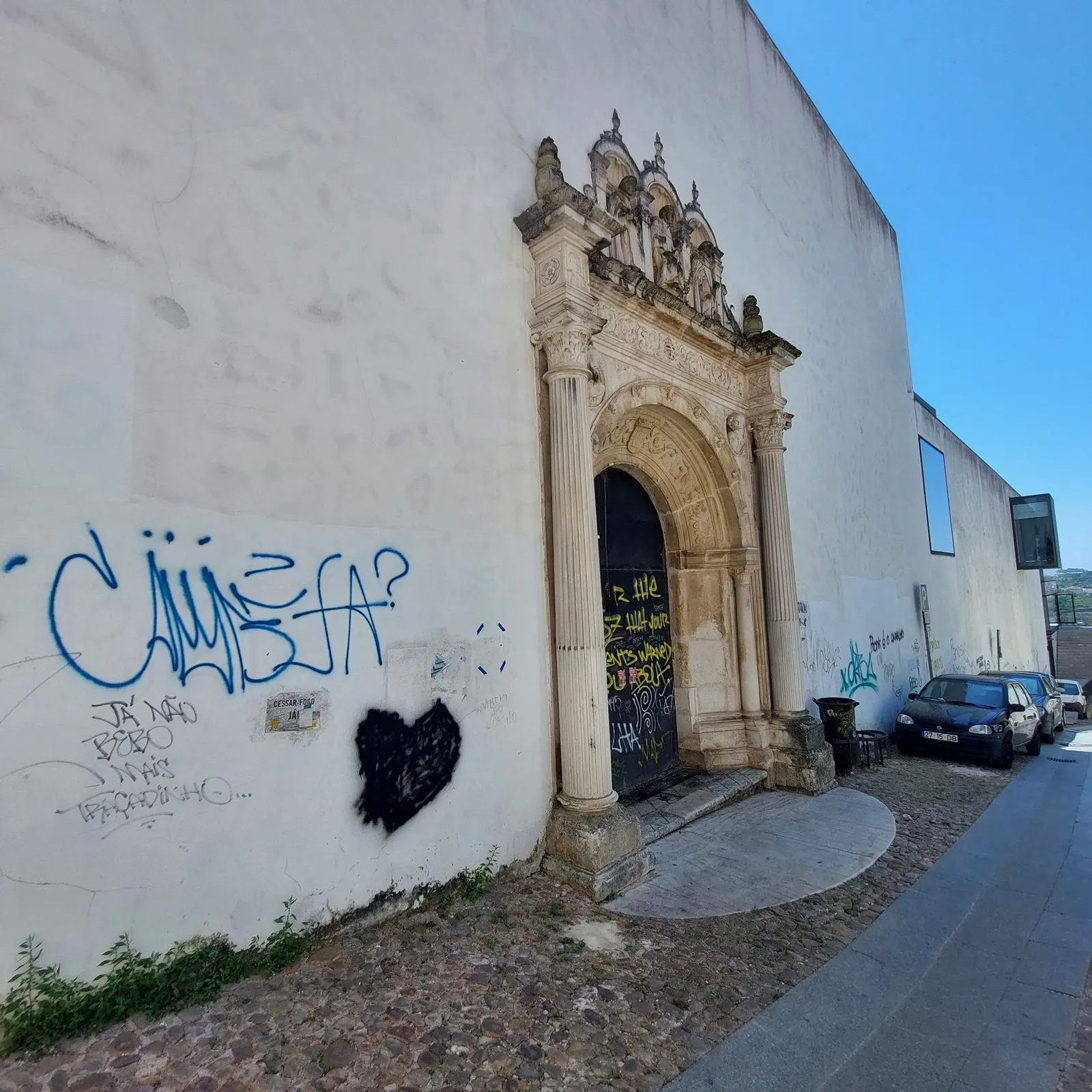
Portals of the former church and convent of Santa Ana
The Atlas (NINV 2557) lists them as a National Monument, by the decree of 16 June 1910, in the parish of Coimbra (Sé Nova, Santa Cruz, Almedina and São Bartolomeu). I was unable to read the descriptive file, so I do not state where they are today or their period.
Arco Pequeno de Almedina
The Atlas (NINV 2532) also uses the name Arco de Almedina. I read Portaria no. 2:789, of 16 June 1921, in which, on the proposal of the Council of Art and Archaeology of the 2nd Circumscription, the Minister of Public Instruction considered as a national monument the «so-called Arco Pequeno de Almedina, of the city of Coimbra»; the Atlas also adds the 1910 decree and another of 1921. There is a second record, the Cerca de Coimbra, namely the Arco de Almedina (NINV 2536), with the alternative designation «Muralhas de Coimbra incluindo o Arco Pequeno de Almedina» (Walls of Coimbra including the Arco Pequeno de Almedina). I did not read the arch’s file, so I do not describe its history.
Rua da Sofia: two different records
The official record (code 74886, NINV 2560) is for an Imóvel de Interesse Público (Property of Public Interest), by Decree no. 516/71, of 22 November 1971, whose article 2 classifies «Rua da Sofia, no seu conjunto» (Rua da Sofia, as a whole). According to the record, it was cut in 1535, with unusual width and regularity, to accommodate the colleges of the University; there rose seven colleges, those of Carmo, Graça, São Pedro, São Tomás, São Bernardo and São Boaventura, and that of the Artes, alongside the Convent of São Domingos and the Palace of the Inquisition. The text notes that much of the built heritage has been distorted, and that the street is valued above all for its ensemble of urban solutions.
The relationship with UNESCO is as follows: the Alta and the Sofia were inscribed in 2013 as «Universidade de Coimbra — Alta e Sofia» (UNESCO, 1387). In the Atlas, this property has NINV 74436, category «MN — monumento nacional / património mundial», with Aviso no. 14917/2013 (Diário da República, 2nd series, no. 236, of 5 December 2013); the database has three polygons for it, among them one named «Rua da Sofia» and another «Alta de Coimbra». There are therefore two entries: the street as an IIP since 1971, and the street as a component of the National Monument/World Heritage property since 2013. They are not the same classification, and Rua da Sofia is not, in itself, a separate UNESCO inscription. The Atlas adds that the property was extended in 2019 to include the Machado de Castro Museum. For the ensemble, see Alta e Sofia, the Paço de Sub-Ripas and the Biblioteca Joanina.
How to visit
When consulted on 5 November 2026 I found no opening hours in official sources for the Manga garden, the former Colégio de São Jerónimo or the portals. The Portal of São Tomás can be seen from the exterior of the Machado de Castro Museum, and Rua da Sofia and the Arco de Almedina are urban spaces. Please confirm access with the Municipality of Coimbra and the University.
Photograph by Threeohsix, 6 July 2025. Original on Wikimedia Commons, under CC BY-SA 4.0; resized and compressed for the web, without altering the composition.

Frequently asked questions
- Is Rua da Sofia a National Monument?
- The street has its own classification as an Imóvel de Interesse Público (Property of Public Interest) (NINV 2560, Decree no. 516/71, of 22 November 1971). The Atlas also lists it, together with Alta de Coimbra, under a National Monument/World Heritage record (NINV 74436) corresponding to the property «Universidade de Coimbra — Alta e Sofia», inscribed by UNESCO in 2013.
- Is the Portal of the Colégio de São Tomás still on the college building?
- No. According to the record, the college was greatly altered after the dissolution of the religious orders, and the portal was placed around 1912 on the north façade of the Machado de Castro Museum.
- What remains of the Manga cloister?
- A garden of about 1,400 m², with a central templete on eight columns, a cruciform pool and four cylindrical oratories. The record attributes the design to João de Ruão and dates the works from 1533 to 1534/35.
- Are the Arco de Almedina and the Arco Pequeno de Almedina the same thing?
- The Atlas holds two National Monument records: the Arco Pequeno de Almedina (NINV 2532, also called Arco de Almedina) and the Cerca de Coimbra, namely the Arco de Almedina (NINV 2536).
Sources
- Património Cultural, I.P. — Atlas do Património Classificado e em Vias de Classificação (NINV 271, 2532, 2536, 2546, 2557, 2558, 2560 e 74436)
- Património Cultural, I.P. — Antigo claustro da Manga do Mosteiro de Santa Cruz (69815)
- Património Cultural, I.P. — Portal do Colégio de São Tomás (70314)
- Património Cultural, I.P. — Rua da Sofia (74886)
- Arquivo da Universidade de Coimbra — Colégio de S. Jerónimo (fundo PT/AUC/MC/CSJCBR)
- Diário do Governo, I série, n.º 274, de 22-11-1971 — Decreto n.º 516/71
- Diário do Governo, I série, n.º 121, de 1921 — Portaria n.º 2:789, de 16 de junho de 1921
- UNESCO — University of Coimbra – Alta and Sofia (1387)