Monuments
Paço de Sub-Ripas
In Coimbra, Paço de Sub-Ripas is João Vaz's 16th-century house over a city wall tower, with a Manueline doorway and Renaissance reliefs. Exterior only.
- Location
- Coimbra, Coimbra
- Built
- Século XVI (c. 1514; ampliação c. 1542–1547)
- Style
- Manuelino e Renascentista
The Paço de Sub-Ripas, also called Paço de Sobre-Ripas, Casa e Arco de Sub-Ripas or Palácio de Sub-Ribas, is a sixteenth-century house in the Alta of Coimbra, on a steep street that descends towards the Mondego. It is notable for its portal of naturalistic decoration and the dozens of relief carvings on its walls. According to the sources consulted, it is not a municipal building: part of it serves today the University of Coimbra and it is not visitable inside.
Two houses, one town-wall tower
The complex consists of two bodies separated by the street and joined by an arch: the Casa de Cima (or Casa do Arco) and the Casa de Baixo (or Casa da Torre). The latter was built over a tower of the city’s medieval wall, which popular sources identify as the Torre da Contenda. The original name, Sobre-Ribas, alludes to its position on the slope, “sobre a riba” (above the bank).
The commission of the work is attributed to João Vaz, who adapted the tower into a residence and acquired the houses on the opposite side, linking them by an arch-walkway. The dates circulate with some discrepancies. Popular and encyclopaedic sources point to interventions from around 1514, in the Manueline style, and a Renaissance extension in 1542–1547; the reference study on the building, by Luísa Trindade (Conimbriga, 2006, “O Paço sobre a Riba: histórias de uma Torre na cerca coimbrã”), could not be consulted directly. The Hotel Oslo states that the Casa de Cima is the oldest and in the Manueline style; I could not confirm this sequence in an official source. What the sources agree on is that the building results from successive remodelling throughout the sixteenth century.
What can be seen from the street
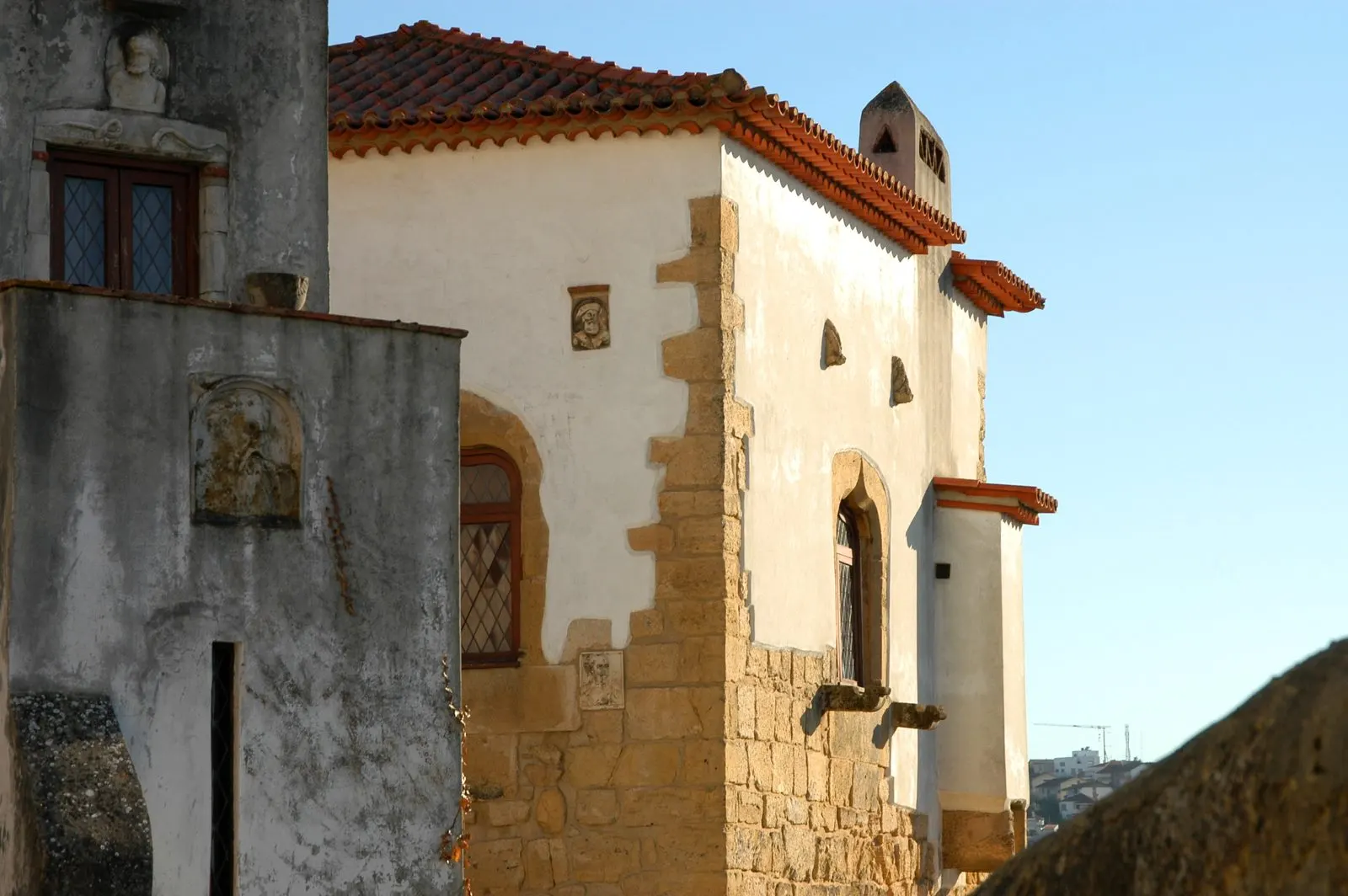
The Rota da Bairrada and the Hotel Oslo highlight two things. The first is the Manueline portal of the Casa de Baixo, dated to the first half of the sixteenth century, with motifs of twisted ropes, knotted cable and chains of diminishing links: a naturalistic and maritime vocabulary characteristic of the Manueline style. The second is the dozens of bas-reliefs on the exterior walls, with busts of warriors, noblemen, ladies and mythical and biblical figures, which are attributed, on stylistic and technical grounds, to the workshop of the sculptor João de Ruão, established nearby. The coexistence of a Manueline portal and Renaissance reliefs can be read alongside the Renaissance in Portugal.
In the photograph that illustrates this page, beside a window with simple mouldings, small medallions with carved faces can be seen set into the whitewashed wall. The contrast between the white render and the exposed ashlar near the corner reveals the various phases of construction.
Legal protection
The national cultural heritage register, through the Atlas do Património Classificado, identifies the Paço de Sub-Ripas as a National Monument, classified by decree of 16 June 1910, published in the Diário do Governo no. 136, of 23 June 1910, and records a special protection zone set by the Portaria of 7 November 1961. The other designations in the register are Paço de Sobre-Ripas, Casa e Arco de Sub-Ripas and Palácio de Sub-Ribas. The parish is the union of the parishes of Sé Nova, Santa Cruz, Almedina and São Bartolomeu. I did not confirm whether the building falls within the perimeter or buffer zone of the UNESCO property “University of Coimbra – Alta and Sofia”; its national classification is independent of that inscription.
How to visit
The Rota da Bairrada and the Hotel Oslo note that the palace houses services of the Institute of Archaeology of the Faculty of Arts of the University of Coimbra and that it is not open to the public: it can only be seen from the outside. The address is Rua de Sub-Ripas, 3000-395 Coimbra. In the consultation of 5 November 2026 I found no visiting hours. The simplest route is to walk up from the Baixa by the stairs known as Quebra-Costas and turn left, as the hotel suggests; for institutional enquiries, the contact is the Faculty of Arts itself.
A collaborative source states that the Casa de Cima belongs to a private owner; I found no official confirmation of this. As for municipal use, no consulted source indicates it.
Photograph by HenGomes, 6 September 2011. Original on Wikimedia Commons, under CC BY-SA 3.0; resized and compressed for the web, without altering the composition.
Frequently asked questions
- Is the Paço de Sub-Ripas a municipal building?
- No consulted source indicates that it is. The Rota da Bairrada and other sources state that it houses services of the Institute of Archaeology of the Faculty of Arts of the University of Coimbra, and that it is not open to visitors.
- Who commissioned the Paço de Sub-Ripas?
- The works are attributed to João Vaz, who adapted a tower of Coimbra's medieval city wall into a residence and acquired the houses on the opposite side of the street, joining them by an arch. The interventions are dated from around 1514 onwards.
- What is the legal protection of the Paço de Sub-Ripas?
- It is a National Monument, classified by decree of 16 June 1910, published in the Diário do Governo no. 136, of 23 June 1910, according to the national register of cultural heritage (Património Cultural).
- Can the interior be visited?
- In the consultation of 5 November 2026 I found no visiting hours; sources indicate that the palace is not open to the public and can only be seen from the outside, on Rua de Sub-Ripas.
Sources
- Património Cultural, I.P. — Atlas do Património Classificado e em Vias de Classificação (NINV 2554, Paço de Sub-Ripas)
- Diário do Governo — Decreto de 16 de junho de 1910 (I Série, n.º 136, 23-06-1910)
- Rota da Bairrada — Palácio de Sub-Ripas
- Hotel Oslo Coimbra — Palace Sub-Ripas, an example of the civil construction of the XVI century
- Conimbriga — Luísa Trindade, O Paço sobre a Riba: histórias de uma Torre na cerca coimbrã (2006), referência bibliográfica
- Wikidata — Paço de Sobre-Ribas (Q66941991)
- Wikipédia — Paço de Sobre-Ribas (apenas como ponteiro)
Keep exploring
Heritage nearby
More places to discover from here. Approximate straight-line distances, within 50 km.