Monuments
Biblioteca Joanina (Joanine Library), Coimbra
Joanine Library, Coimbra: the Casa da Livraria of 1717–1728, gilded woodwork with chinoiseries, painted ceilings, academic prison and visits by timed entry.
- Location
- Coimbra, Coimbra
- Built
- 1717–1728
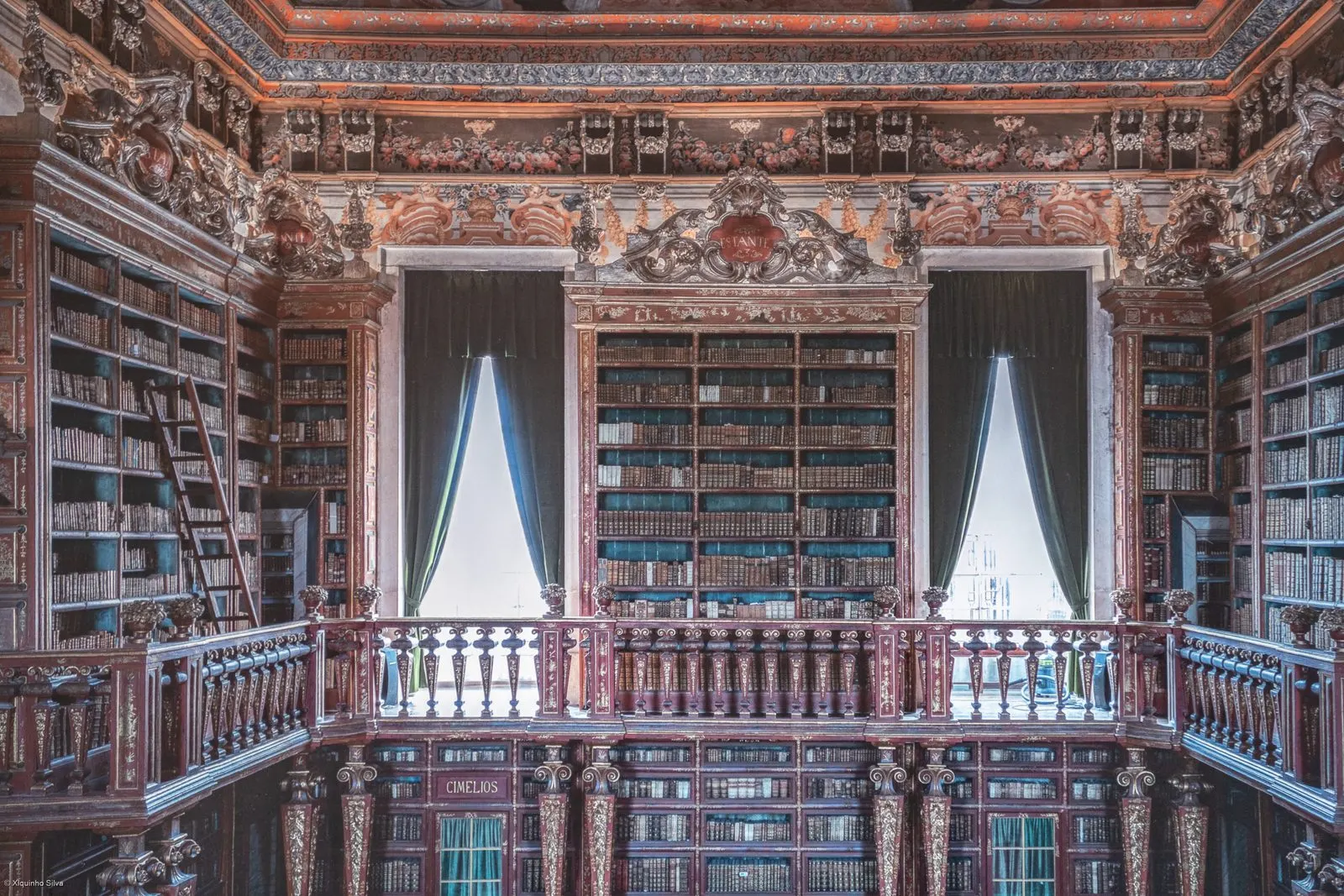
The Joanine Library is the former Casa da Livraria of the University of Coimbra, built between 1717 and 1728 beside the Chapel of São Miguel, in the Paço das Escolas. From the outside it is a sober block; inside it houses three rooms of gilded woodwork, shelves painted with oriental motifs and ceilings in illusionistic perspective. The University presents it as the «supreme expression of Portuguese Baroque»; it is a central work of Joanine Baroque and of the University of Coimbra – Alta and Sofia.
A building constructed for books
The historian Pedro Ferrão, in the Bulletin of the University’s General Library, reconstructs the building’s origins. In 1716, the rector wrote to the king explaining that the University lacked suitable premises for its books and requested authorisation to adapt a space. The reply of King João V, dated 31 October that year, went further and authorised the construction of a dedicated building within the university precinct. An uneven plot beside the Chapel of São Miguel was chosen, where the ruins of the palace’s old prison, dating from the late 14th century, stood.
The first stone was laid on 17 July 1717, in the presence of the rector Nuno da Silva Telles. The work lasted eleven years and was completed in 1728. The library was later named after the king who sponsored it: the Joanine Library.
The architect’s name remains unclear. Ferrão notes that the documents are meticulous about contracts and payments, but do not identify the author of the design. They mention the master builder João Carvalho Ferreira, replaced by Gaspar Ferreira, a contractor initially engaged for the shelving. The same author considers the French sculptor Claude Laprade the probable author, without treating this as certain.
The building was conceived as a strongroom. According to the University, the exterior walls are 2.11 metres thick. The shelves are made of oak, chosen for its density, durability and the odour that deters insects.
The noble floor: woodwork, chinoiserie and ceilings
The noble floor is a long rectangle divided into three rooms, linked by round arches that repeat the design of the portal. The walls are lined with two-storey shelving, with galleries, in gilded and polychrome wood. Each room has a background of a different colour: green, red and black. Ferrão associates these colours with the faculties represented in the emblems: Medicine and Mathematics, Canon and Civil Law, Theology and Arts.
The painting of the shelves with chinoiseries, exotic landscapes in the oriental taste, was the work of the painter Manuel da Silva, over forty months, between 1723 and 1727. The gilded woodwork of the shelves is attributed to Gaspar Ferreira, and the gilding to Manuel da Silva. The trompe-l’œil ceilings were commissioned in 1723 from the Lisbon painters Vicente Nunes and António Simões Ribeiro. They depict the Library, the University and Wisdom, with Latin inscriptions. According to Ferrão, the six reading desks were made between 1725 and 1727, in Brazilian woods, by the Italian Francesco Realdino.
The axis of the rooms leads to the portrait of King João V, attributed to Domenico Duprà and dated to around 1725. Outside, the triumphal-arch portal, with Ionic columns and the royal arms, announces the same programme. To situate these choices, continue with Baroque architecture in Portugal and Portuguese Baroque painting.
Books and bats
The University indicates some 60,000 volumes across the three floors. The library functioned as the University Library from 1777 until the first half of the 20th century. Most of the books are in the electronic catalogue and remain in use.
The same source notes that, for at least two and a half centuries, two colonies of bats have lived in the library, contributing to pest control. For this reason, at the end of each day, the tables are covered with leather «cloths» to protect them from droppings.
The intermediate floor and the academic prison
The intermediate floor served to support the guards of the academic prison and as a store for books read on the noble floor. It was incorporated into the visitor circuit on 1 November 2010. The staircases that now connect it to the noble floor were only built at the end of the 19th century. Stonemasons’ marks can be seen on the arcades, identifying the work of each craftsman.
On the lower floor is the academic prison. The University had its own jurisdiction until 1834, and members of the academy were held separately from common criminals. The prison occupied a space roughly coinciding with the former gaol of the Royal Palace. The University presents it as the oldest surviving medieval-origin prison in Portugal. Two narrow cells and a spiral staircase remain. In 1782, common cells, a visiting room, an oratory and latrines were added.
Classification and World Heritage
No separate classification record for the Joanine Library was found in the Atlas do Património Classificado. Its site lies within the perimeter of the Paços da Universidade de Coimbra, a National Monument under the Decree of 16 June 1910 (Diário do Governo no. 136, of 23 June 1910). It also lies within the property University of Coimbra – Alta and Sofia, inscribed on the UNESCO World Heritage List in 2013 and published by Notice no. 14917/2013. The library is part of that property, not a separate inscription. The context for historic libraries is in libraries and universities.
Preparing the visit
The visit is organised by the University of Coimbra’s tourism service. Entry to the library has a day and time set at the time of purchase; the other spaces included in the ticket may be visited during its validity. When consulted on 5 November 2026, the University indicated:
- Joanine Library: every day, 09:00–13:00 and 14:00–17:00, with last entries at 12:40 and 16:40;
- ticket office and kiosk: every day, 09:00–17:00;
- closures announced for 24 and 25 December 2026 and for 31 December 2026 and 1 January 2027;
- ticket holders should be at the library access, through the Academic Prison, five minutes before the entry time; the general meeting point is the ticket office, at the Colégio de Jesus.
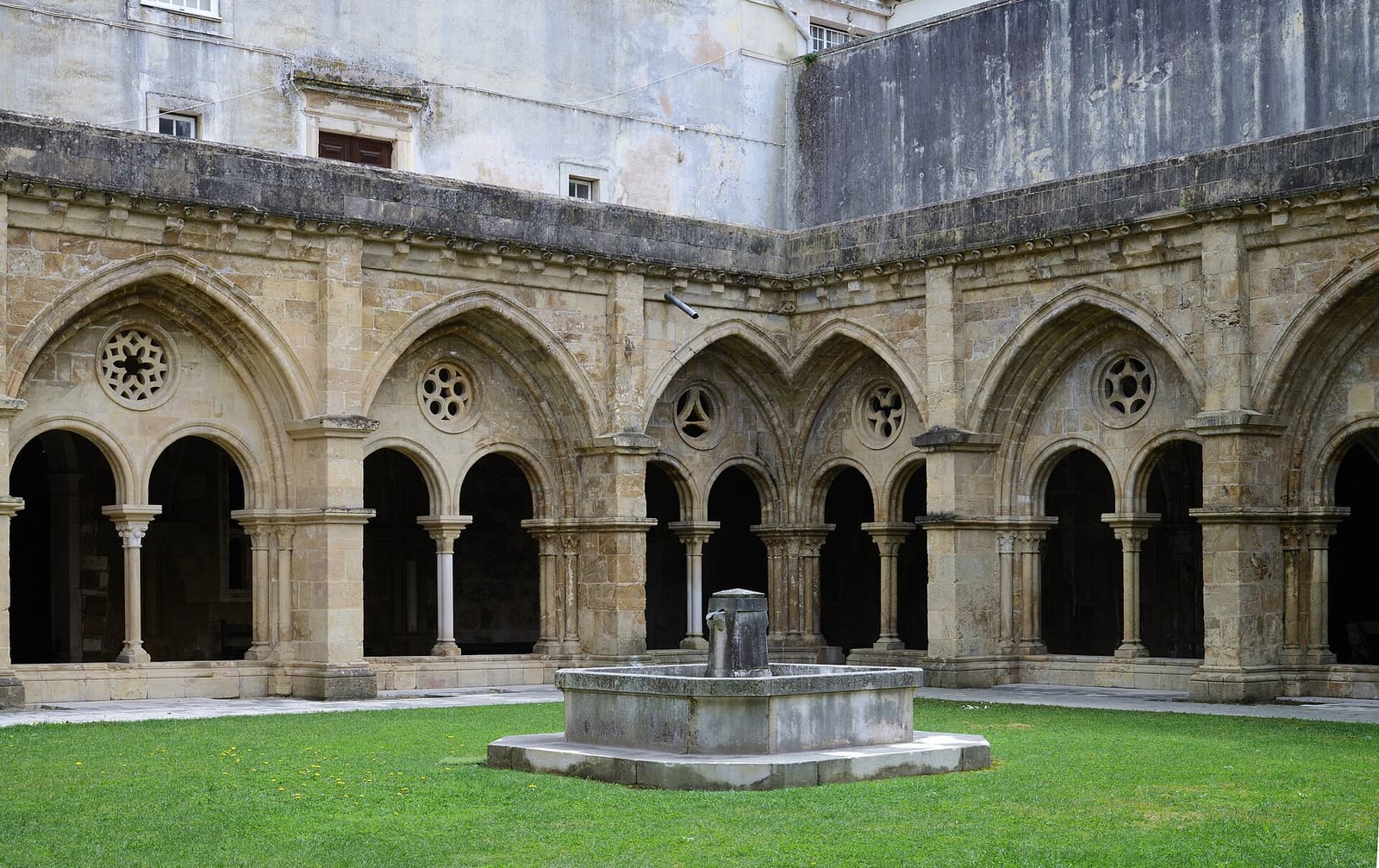
Tickets are non-refundable, except in the case of an occasional closure of the library. Confirm prices, ticket combinations and visiting rules at visit.uc.pt. For context on the city, start with the University of Coimbra – Alta and Sofia page and the Old Cathedral (Sé Velha).
Photograph by Xiquinho Silva (xiquinhosilva), of 24 November 2018. Original on Wikimedia Commons, under CC BY 2.0; resized and compressed for the web, without altering the composition.
Frequently asked questions
- When was the Joanine Library built?
- The first stone of the Casa da Livraria was laid on 17 July 1717, and the work was completed in 1728, during the reign of King João V, who authorised and sponsored the construction.
- Who designed the library?
- The construction documents do not identify the architect. They mention the master builder João Carvalho Ferreira, who was replaced by Gaspar Ferreira. The historian Pedro Ferrão considers the French sculptor Claude Laprade the probable author, without treating this as certain.
- Is it true that there are bats in the library?
- Yes. The University of Coimbra states that for at least two and a half centuries two colonies of bats have lived in the library, helping to control pests; for this reason the tables are covered with leather cloths at the end of each day.
- How does one visit the Joanine Library?
- With a University of Coimbra ticket and an entry time booked at the time of purchase. When consulted on 5 November 2026, the library was open every day, 09:00–13:00 and 14:00–17:00. Confirm at visit.uc.pt.
Sources
- Universidade de Coimbra — Visitar a UC: Biblioteca Joanina
- Universidade de Coimbra — Visitar a UC: Horário de funcionamento
- Pedro Miguel Ferrão — A Casa da Livraria da Universidade de Coimbra ao tempo de D. João V, Boletim da Biblioteca Geral da Universidade de Coimbra, 46/47 (2015/2016)
- Universidade de Coimbra — Diário de Coimbra, 27-09-2017: emissão filatélica dos 300 anos da Biblioteca Joanina
- Património Cultural, I.P. — Atlas do Património Classificado: Paços da Universidade de Coimbra (NINV 2555) e Universidade de Coimbra – Alta e Sofia (NINV 74436)
- Wikidata — Biblioteca Joanina (Q1773229)
Keep exploring
Heritage nearby
More places to discover from here. Approximate straight-line distances, within 50 km.