Monuments
Flor da Rosa Monastery
Flor da Rosa Monastery in Crato, begun c. 1340: a Gothic fortress-church of the Order of the Hospital with palace, cloister, tomb of D. Álvaro, and a pousada.
- Location
- Flor da Rosa, Crato, Portalegre
- Built
- início da construção c. 1340; sede da Ordem do Hospital oficializada em 1356; claustro e paço remodelados no séc. XVI
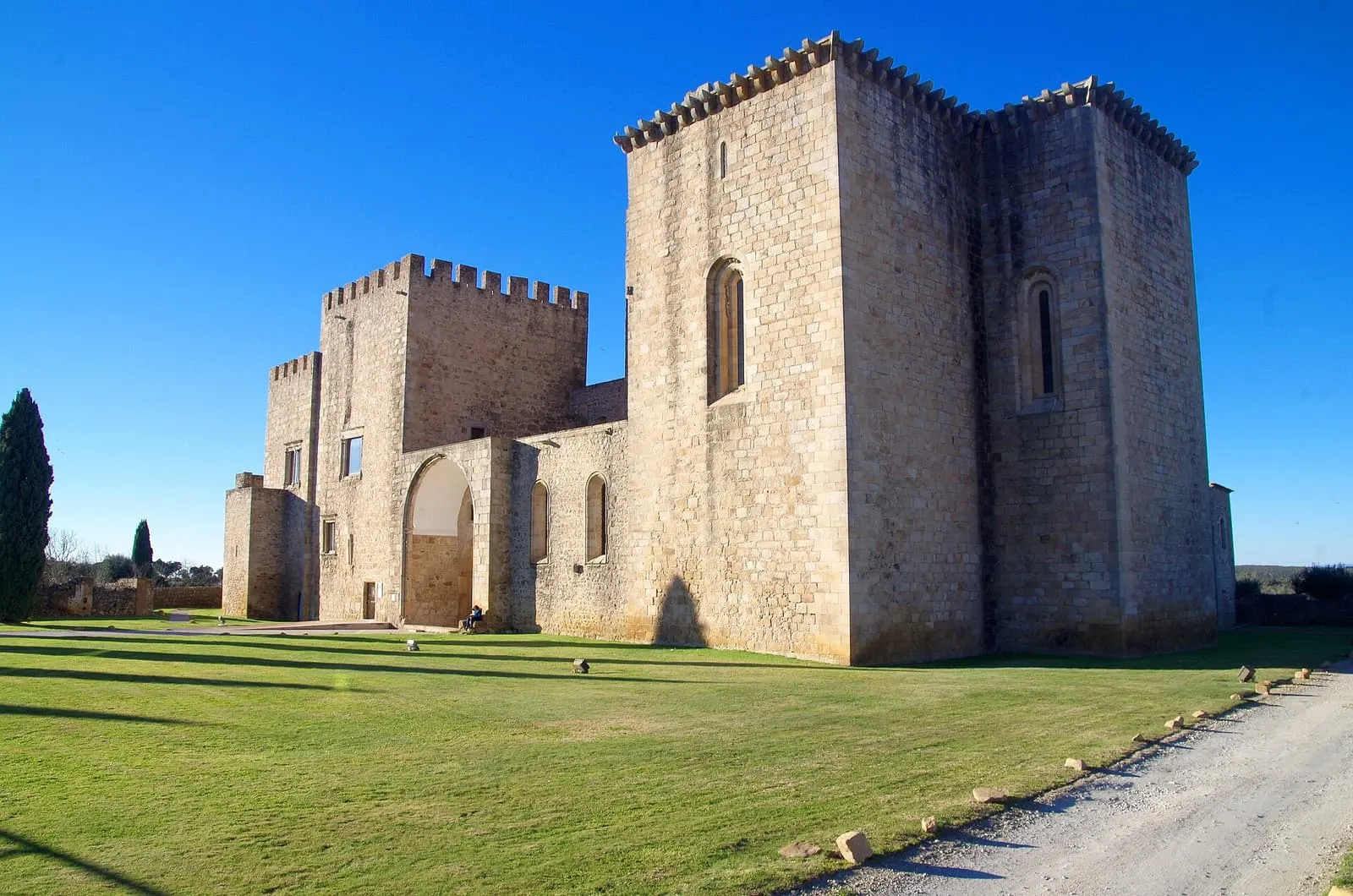
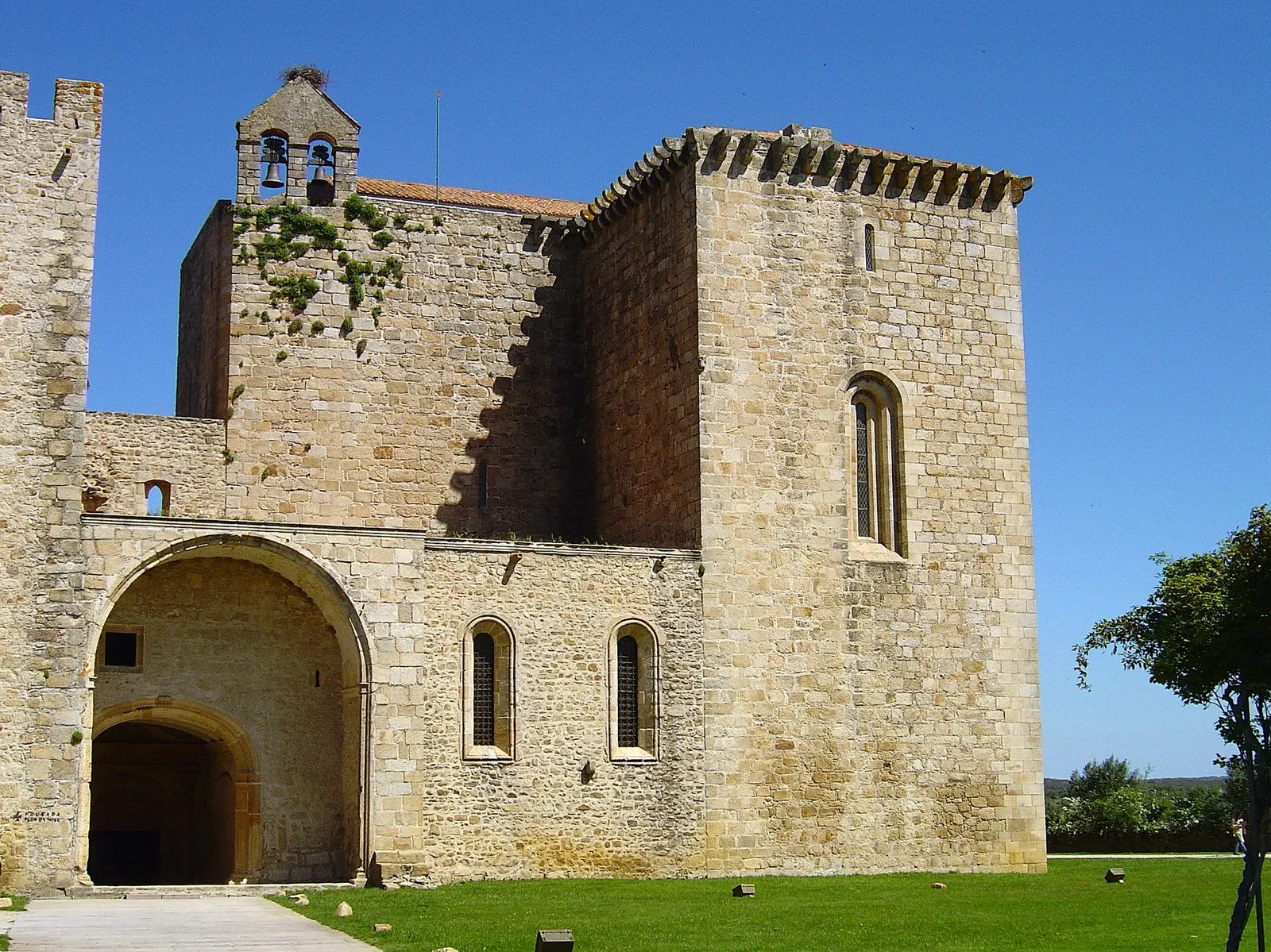
The Flor da Rosa Monastery stands in the village of the same name, in the municipality of Crato, in the Alto Alentejo. At first sight it looks like a castle: massive granite walls, corner towers and a corbelled crown. In fact it is a complex of three parts, church, monastery and palace, conceived in the fourteenth century as the seat of the Order of the Hospital in Portugal. The national register considers it one of the most important Gothic monuments in the country and recalls that it has been described as the «most important Portuguese church-fortress».
A seat for the Hospitallers
The Order of the Hospital, later of Malta, had its Portuguese centre in the Priory of Crato. According to the guide published by the Municipality of Crato, signed by Paulo Pereira and Jorge Rodrigues, archaeological remains suggest that the site began as a simple quadrangular defensive enclosure, with an advanced tower to the north, a fortress probably inspired by military architecture of the Holy Land.
The Cultural Heritage register, I.P. places the start of construction around 1340, when the Grand Prior D. Álvaro Gonçalves Pereira is said to have opened the worksite, possibly making use of the facilities of an earlier community. The municipal text specifies that the programme only becomes clear from 1341, with defensive towers that also served as a fortified palace, and that the decision to erect a great church beside the enclosure came after 1356, the year in which the seat of the order was made official. The medieval complex would have been completed around 1380, and D. Álvaro was buried, as he had expressly wished, in a marble monument from Estremoz.
The church-fortress
The church occupies the eastern half of the building and opens laterally in relation to the main façade, through an atrium with a flattened star vault, rebuilt by the Directorate-General for Buildings and National Monuments in the 1940s. The plan is a Greek cross with unequal arms: the chancel is shallow, while the transept arms extend much further. The crossing, covered by a ribbed vault with pointed arches, is the same height as the other spaces, which gives the interior its unity.
What strikes the visitor is the verticality, the thickness of the walls and the absence of decoration. The national register explains the square apse and the austere interior, without columns or capitals, by Cistercian influence, to which models from the mendicant orders are added. The reconstruction of the elevations made by Jorge Rodrigues and Paulo Pereira shows, according to the register, a building with tall crenellated towers, wall walks and military protective features, a solution without equivalent in Portuguese Gothic. For the stylistic context, see Gothic architecture in Portugal.
Cloister, palace and sixteenth-century works
The cloister was greatly transformed in the sixteenth century. It preserves important parts of the original period, somewhat discontinuous, and traces of an upper timber gallery that gave access to the raised quarters of the monastic wings. The first decades of the sixteenth century were an important phase: there were works in the cloister, the palace and the church, including the tomb of D. Diogo de Almeida, and the mixture of Manueline, Mudéjar and Renaissance vocabularies leads the national register to admit several campaigns through the first half of the century. The Municipality of Crato describes the campaign as Manueline-Mudéjar, followed by a Renaissance decorative phase, and attributes to it the Chapter House, with its monumental portal, the new cloister, the refectory and the dormitories. For context, see Manueline style.
Ruin and restoration
The palace was in ruins by 1615, according to Pedro Nunes Tinoco, and the building was abandoned from the eighteenth century onwards. In 1897 a significant part of the church collapsed. Between the 1940s and 1960s the monument was restored by the DGEMN and, in the 1990s, adapted into a pousada to a design by architect João Luís Carrilho da Graça, who remodelled spaces and added a wing for hotel functions. The official designation, «Igreja da Flor da Rosa (ruínas)», thus preserves the memory of the state in which the building was classified.
Classification
The Flor da Rosa Monastery has been a National Monument since the Decree of 16 June 1910, published in the Diário do Governo no. 136, of 23 June 1910, under the designation «Igreja da Flor da Rosa (ruínas), compreendendo o túmulo de D. Álvaro Gonçalves Pereira». The special protection zone, without restrictions, is set out in Portaria no. 524/97, published in the Diário da República, I série-B, no. 167, of 22 July 1997. The register does not indicate any inscription on UNESCO lists.
How to visit
Most of the building operates as the Pousada Mosteiro Crato, so the visit is shared with its hotel use. When consulted on 5 November 2026, the Municipality of Crato’s page for the monument, in a record updated on 12 January 2022, gave the opening hours as Monday to Friday 9:30 to 12:30 and 14:00 to 17:30, and Saturday, Sunday and public holidays 10:00 to 13:00 and 14:30 to 18:00. Given the date of that record and the fact that the building is run as a pousada, confirm the hours and accessible areas with the Municipality of Crato or the pousada before travelling. The pousada states on its website that it is 22 km from Portalegre; accommodation, dining and prices should be checked on the pousadas.pt portal.
To place the visit in context, see the page on Crato, the list of monasteries and the overview of Portuguese castles, with which Flor da Rosa is linked through its military character.
Photograph by Vitor Oliveira from Torres Vedras, Portugal, dated 1 November 2006. Original on Wikimedia Commons, under CC BY-SA 2.0; resized and compressed for the web, without altering the composition.
Frequently asked questions
- Who had the Flor da Rosa Monastery built?
- The national heritage register attributes the start of the works, around 1340, to the Grand Prior of the Hospital, D. Álvaro Gonçalves Pereira. The Municipality of Crato, citing a guide by Paulo Pereira and Jorge Rodrigues, dates the clear architectural programme to 1341 and the official establishment of the seat, along with the decision to build the great church, to 1356.
- Is the Flor da Rosa Monastery a National Monument?
- Yes. It is classified as a National Monument by the Decree of 16 June 1910 (Diário do Governo no. 136, of 23 June 1910), under the designation «Igreja da Flor da Rosa (ruínas), compreendendo o túmulo de D. Álvaro Gonçalves Pereira». The special protection zone was set by Portaria no. 524/97, of 22 July 1997.
- Is it possible to stay overnight in the monastery?
- Yes. The building was adapted into a pousada (state-run hotel) at the end of the 20th century, to a design by architect Carrilho da Graça, who added a new wing. When consulted on 5 November 2026, the pousadas.pt portal listed the Pousada Mosteiro Crato, part of the Pestana brand, with rooms in the old wing, including the towers, and in the new wing.
- Is it part of the World Heritage List?
- No. The Cultural Heritage register does not indicate any inscription on the World Heritage List.
Sources
- Património Cultural, I.P. — Igreja da Flor da Rosa (ruínas), compreendendo o túmulo de D. Álvaro Gonçalves Pereira (69839)
- Património Cultural, I.P. — Atlas do Património Classificado e em Vias de Classificação (NINV 3515)
- Diário do Governo — Decreto de 16 de junho de 1910 (n.º 136, 23-06-1910)
- Município do Crato — Mosteiro de Santa Maria de Flor da Rosa
- Pousadas de Portugal — Pousada Mosteiro Crato
- Wikidata — Mosteiro de Flor da Rosa (Q10332618)
Keep exploring
Heritage nearby
More places to discover from here. Approximate straight-line distances, within 50 km.