Monuments
Church of Santo António (Lagos)
Igreja de Santo António, Lagos: gilded woodcarving interior, 1718 altarpiece, rebuilt in 1769, and a visit through the Dr. José Formosinho Lagos Museum.
- Location
- Lagos, Faro
- Built
- 1707 (segundo o município); reedificada em 1769
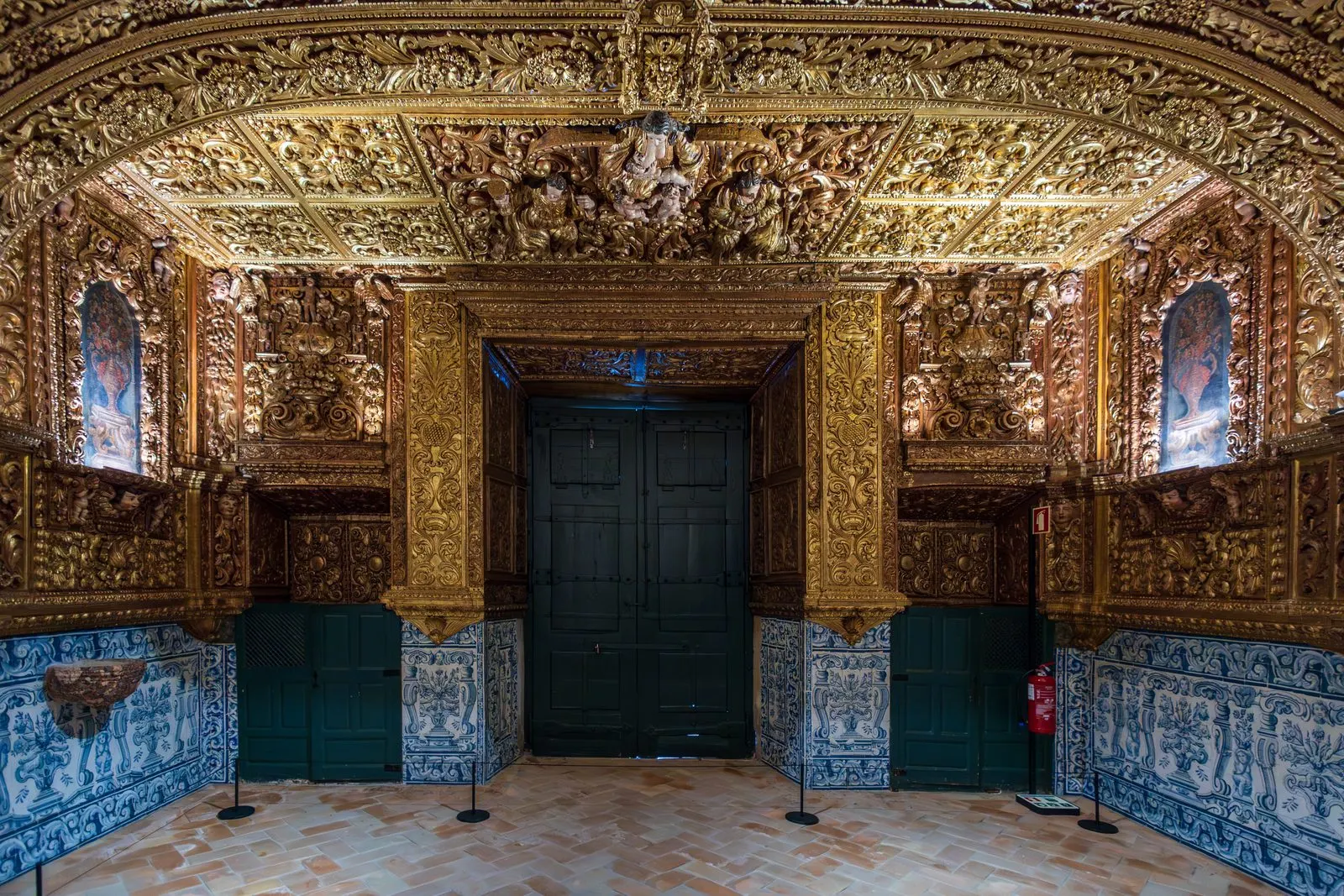
The Church of Santo António stands on Rua General Alberto da Silveira, in the historic centre of Lagos, adjoining the municipal museum building. The façade is plain. The interior, a single nave without side chapels, is lined with gilded woodcarving from floor to ceiling, and the national Património Cultural, I.P. register considers it one of the most remarkable examples of a church “lined in gold” in the south of the country. Today it is visited as part of the Lagos Museum.
A confraternity of soldiers
The municipality dates the construction to 1707. The national register places the existence of the Confraternity of Santo António from 1702 and notes that several documents attest to a church earlier than the present one. The confraternity was administered by officers of the Lagos Infantry Regiment: the Lagos Museum describes the church as belonging to the Brotherhood of Santo António of the Military of that regiment.
In 1718, the infantry commander Álvaro Pereira de Lacerda, brother of the Bishop of the Algarve, commissioned the high altarpiece from the woodcarver Gaspar Martins (1676–1746) for 612 thousand réis, with completion planned for the following year, according to the national register, which cites the historian Francisco Lameira.
The earthquake and the rebuilding of 1769
The 1755 earthquake ruined much of the building and its woodcarving. The Lagos Municipal Chamber and the national register agree that the high altarpiece survived. The rebuilding was completed in 1769, on the initiative of Hugo Beaty, commander of the Lagos Infantry Regiment. Irish by birth, he arrived in Lagos during the war with Spain, under the command of the Count of Lippe, and remained in the city until his death: his tombstone is set in the church floor.
What to see inside
- The high altarpiece of 1718, one of the most significant examples of a Nationalist Style altarpiece in the Algarve, with four pseudo-Solomonic columns, a central tribune and a pyramidal throne bearing the image of Saint Anthony with the Infant Christ.
- The woodcarving of the walls, the lower choir and the entrance wall, later than the altarpiece and attributed to the woodcarver Custódio Mesquita. Among the atlantes supporting the pilasters, Roman soldiers and caryatids, appear small figures with scenes of pig slaughter, fishing and hunting, and personages in Moorish dress.
- The canvases with miracles of Saint Anthony, attributed to the painter F. J. Rasquilho, a native of Loulé.
- The ceiling, imitating a barrel vault in perspective painting, with the arms of Portugal at the centre and the four Evangelists in the corners.
- A dado of blue and white azulejos of albarradas, which completes the effect of gold and blue.
To place the technique and phases of Portuguese gilded woodcarving in context, see gilded woodcarving and Joanine baroque. In central Algarve, the Church of São Lourenço de Almancil shows the inverse combination, with azulejos dominating and gold reserved for the altar.
The museum next door
The municipal museum was founded in 1930 by José Formosinho, according to the Lagos Municipal Chamber, and grew with the excavations he organised and with donations. At the entrance has been placed the Renaissance portal of the former church of the Brotherhood of the Corpo Santo, of the fishermen and seafarers of Lagos, which the national register relates to the portals of the Church of São Sebastião and of Mexilhoeira Grande. Today the complex is called the Dr. José Formosinho Nucleus of the Lagos Museum, a municipal institution with several nuclei across the city.
Classification
The church is a National Monument under Decree No. 9 842 of 20 June 1924, the same instrument that classified the Church of São Sebastião of Lagos. It has a special protection zone set by ordinance of 30 October 1969, published on 24 November, shared by the churches of Santo António and São Sebastião and the walls and towers of Lagos. It is not part of any UNESCO inscription.
Planning the visit
Entry is through the museum, at Rua General Alberto da Silveira, 8600-594 Lagos. When consulted on 5 November 2026, the Lagos Museum published:
- opening hours of Tuesday to Sunday, 10:00–13:00 and 14:00–18:00, with last entry half an hour before closing;
- closures on 1 January, Easter Sunday, 25 April, 1 May and 24 and 25 December;
- a standard ticket of 3 euros and a reduced ticket of 1.50 euros (young people aged 12 to 18, over-65s, holders of the Cartão Jovem, students and groups with a certified guide);
- a combined ticket with the Slave Trade Route Nucleus for 5 euros;
- free entry, among other cases, for children under 12, residents of the municipality and all visitors on dates such as 18 April, 18 May, 23 August and 27 October.
The visitor regulations prohibit flash photography or tripods without authorisation. Confirm the conditions on the museum’s Visit page or by telephone at 282 762 301.
Photograph by Matthias Süßen, 2025. Original on Wikimedia Commons, under CC BY-SA 4.0; resized and compressed for the web, without altering the composition.
Frequently asked questions
- How can one visit the Church of Santo António in Lagos?
- The church is part of the Dr. José Formosinho Nucleus of the Lagos Museum and is visited with the museum ticket. When consulted on 5 November 2026, the published opening hours were Tuesday to Sunday, 10:00–13:00 and 14:00–18:00, with a standard ticket costing 3 euros.
- Does the woodcarving predate the 1755 earthquake?
- Only in part. The high altarpiece was commissioned in 1718 from the woodcarver Gaspar Martins and survived the earthquake. The remaining woodcarving on the walls, the lower choir and the entrance wall is considered later and is attributed to Custódio Mesquita.
- Why is it described as a military church?
- The Confraternity of Santo António was administered by officers of the Lagos Infantry Regiment. The Lagos Museum describes the church as belonging to the Brotherhood of Santo António of the Military of that regiment, and it was the commander Hugo Beaty who promoted the rebuilding of 1769.
- What is the church's classification?
- It is a National Monument under Decree No. 9 842 of 20 June 1924, and a special protection zone was set by ordinance of 1969, shared with the Church of São Sebastião and the walls of Lagos.
Sources
- Património Cultural, I.P. — Igreja de Santo António (69860)
- Património Cultural, I.P. — Atlas do Património Classificado e em Vias de Classificação (NINV 2839)
- Diário do Governo — Decreto n.º 9 842, de 20 de junho de 1924
- Câmara Municipal de Lagos — Igreja de Santo António
- Câmara Municipal de Lagos — Museu de Lagos Dr. José Formosinho
- Museu de Lagos — Núcleo Dr. José Formosinho
- Museu de Lagos — Visitar
- Wikidata — Igreja de Santo António (Q5994200)
Keep exploring
Heritage nearby
More places to discover from here. Approximate straight-line distances, within 50 km.