Resources
Alberto Sampaio Museum (Guimarães)
Museu de Alberto Sampaio, Guimarães: cloister of the Colegiada da Oliveira, goldsmithing treasure, D. João I's loudel and triptych, and visitor information.
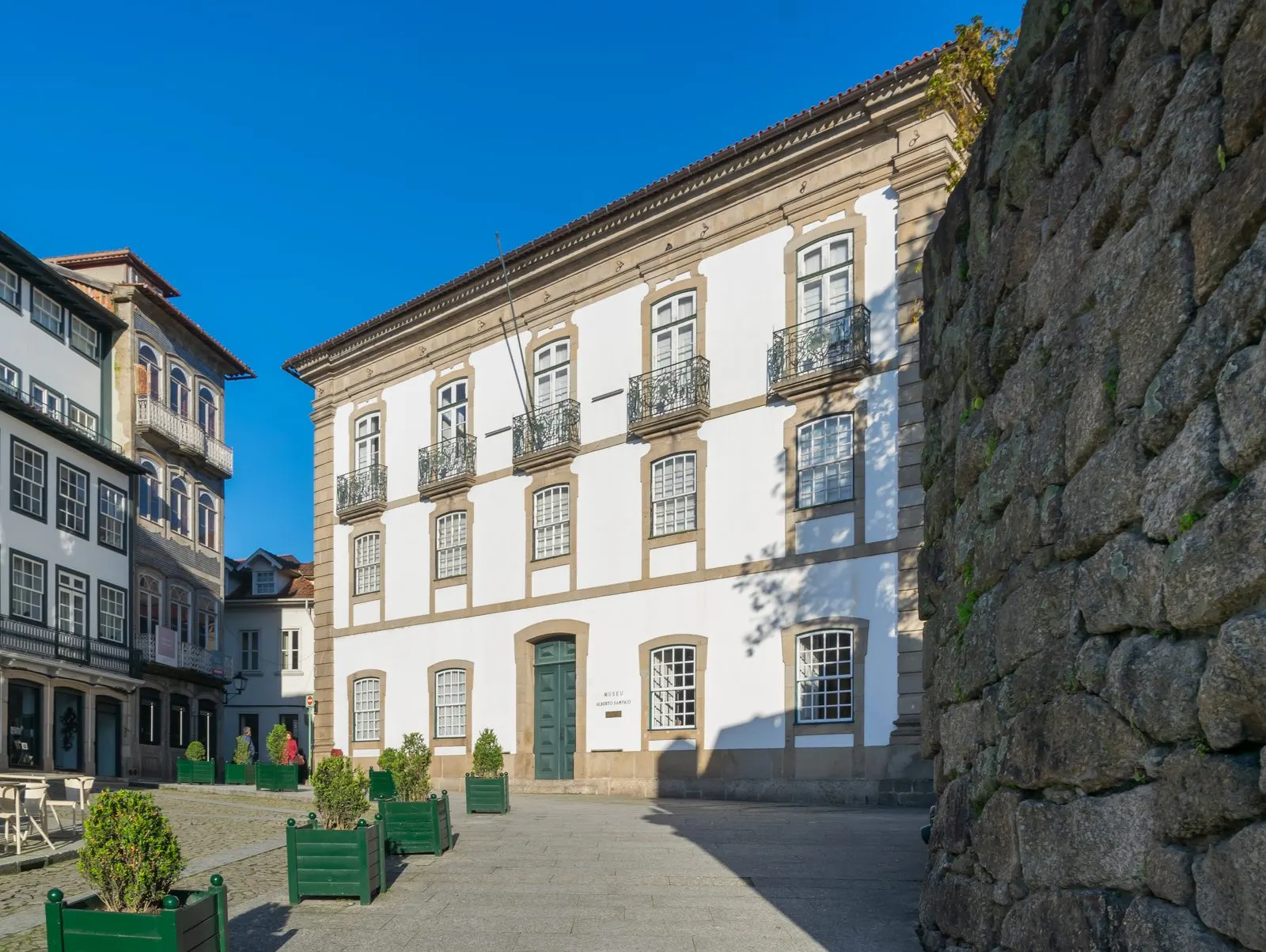
- Location
- Guimarães, Braga
- Built
- Edifícios da Colegiada: claustro reformado no século XVI, Casa do Cabido com obras do final do século XVIII
The Museum of Alberto Sampaio preserves the sacred art of the former Collegiate Church of Our Lady of Oliveira, in the institution’s own buildings, beside the Largo da Oliveira, in the historic centre of Guimarães. The pieces and the place explain each other: the cloister, the chapter hall and the houses of the prior and the chapter house hold the treasury the Collegiate Church gathered over centuries. The museum belongs to the network of Museus e Monumentos de Portugal, E.P.E..
From Mumadona’s monastery to the museum
The museum stands where Countess Mumadona had a monastery built in the 10th century. Initially double, the monastery became a collegiate church at the beginning of the 12th century. The reign of John I brought major expansion works, including the new church dedicated to Our Lady of Guimarães. In the 16th century the church, the cloister and the Priory House were renovated; at the end of the 18th century important works were carried out on the Chapter House, now the museum’s main entrance.
The Collegiate Church was suppressed in 1911, and the cloister fell into neglect. The museum was established by Decree No. 15 209 of 17 March 1928 to bring together the artistic heritage of the Collegiate Church and of other churches and convents in Guimarães that were held by the State. It is named after Alberto Sampaio, the museum’s patron, who worked at the Banco de Guimarães. Alfredo Guimarães, its first director, led a public campaign to save the cloister. Students paraded through the city with placards reading “Vimaranenses, save the cloister of your Collegiate Church”.
Adaptation works began in May 1928, and the restoration of the cloister continued until 1931. The Regional Museum of Alberto Sampaio was officially inaugurated on 1 August 1931. In the 1960s, the Directorate-General for National Buildings and Monuments restored the Priory House and the Chapter House, and the new spaces opened in 1967. A refurbishment between 1999 and 2004 renewed the reception, the shop and the galleries. On 26 June 2014 the Palacete de Santiago, a nineteenth-century building on Praça de Santiago, was inaugurated as an extension for temporary exhibitions, a library and storage.
The cloister
The cloister has an irregular plan that wraps around the Church of Our Lady of Oliveira. Its round arches led several authors to date it to the 13th century and to call it Romanesque. The museum, however, cites a study by Lúcia Rosas according to which the original medieval structure did not survive: the cloister was remodelled in the 16th century, during the priorate of D. Diogo Pinheiro, whose coat of arms appears on a voussoir. Some elements are reused and others were copied to imitate the earlier cloister. The 42 capitals are all different, and some were remade during the 1928–1931 restoration.
On the low walls can be seen carved medieval game boards, the alguergues. The cloister also houses the museum’s lithic collection: coats of arms, holy-water stoups, capitals and tombstones. It also retains the Gothic funerary chapel of Saint Blaise, founded in the 15th century by Álvaro Gonçalves de Freitas, treasurer of John I’s household, with the recumbent effigies of the founder and his wife.
The collections
Goldsmithery is the best-known core. About 70% of the pieces come from the Collegiate Church, and the treasury of Our Lady of Oliveira comprises works from the 12th to the 19th century, offered by kings, priors, canons and devotees or commissioned for worship. The museum stresses the unity and good documentation of this ensemble, which includes much local production. For the national context, see Portuguese goldsmithery and sacred art and treasures.
In the Aljubarrota Room are the pieces associated with the Battle of 14 August 1385. John I sought the protection of Our Lady of Guimarães before the battle and, after the victory, offered her his arms: the loudel, a military garment he is believed to have worn in the battle, and the gilt silver triptych of the Nativity. The room also displays the commemorative inscriptions recording the foundation and consecration of the church that the king rebuilt.
Painting documents above all the Guimarães workshops from the 15th to the 18th century, with works from elsewhere such as the panels from the workshop of Frei Carlos and a canvas by André Reinoso. The museum highlights the Lamentation Triptych, from the Collegiate Church’s cloister. Sculpture includes the image of Our Lady of Guimarães, from the 13th century, which was venerated in the Collegiate Church, as well as 16th-century works with Flemish influence. There are also collections of fresco painting, gilded woodcarving and textiles.
Protection and World Heritage
The Atlas of Cultural Heritage, I.P. does not register the museum as an independently classified property. The neighbouring Church of Our Lady of Oliveira is a National Monument under the Decree of 16 June 1910, and the museum lies within the joint special protection zone of the church, the Padrão do Salado and the Town Hall buildings, established by ordinance of 1 February 1956. According to the Atlas, the museum is also within the perimeter of the Historic Centre of Guimarães and Leather Zone, inscribed on the World Heritage List in 2001 and extended in 2023. It therefore has no UNESCO inscription of its own: it forms part of the urban fabric of the inscribed property.
Planning your visit
The museum is at Rua Alfredo Guimarães, 4800-407 Guimarães, next to Praça da Oliveira. When consulted on 5 November 2026, the official ticketing and opening hours page stated:
- opening hours Tuesday to Sunday, 10:00–18:00, closed on Easter Sunday, 1 January, 1 May and 25 December;
- standard ticket €5 and cloister-only entry €1;
- 50% discount for visitors over 65, young people aged 13 to 24, and families with at least one adult and one minor;
- free entry with the Voucher 52 for residents of Portugal and for children up to 12 years old, among other cases (see free entry to museums and monuments);
- a €13 combined ticket with the Palace of the Dukes of Braganza and the Guimarães Castle.
In summer, Museu à Noite extends opening until midnight, on dates announced by the museum, with a single ticket of €5. The Voucher 52 does not apply at that time. The Palacete de Santiago opens Monday to Friday, 10:00–18:00, only when there are exhibitions or events. Confirm the conditions on the museum’s website or by telephone at +351 253 423 910.
Photograph by Krzysztof Golik, dated 18 February 2020. Original on Wikimedia Commons, under CC BY-SA 4.0; resized and compressed for the web, without altering the composition.
Frequently asked questions
- Where is the Museum of Alberto Sampaio housed?
- In the buildings of the former Collegiate Church of Our Lady of Oliveira, in the historic centre of Guimarães: the cloister, the Priory House and the Chapter House, which is now the main entrance. Since 2014, the Palacete de Santiago has served as an extension of the museum.
- When was it founded?
- It was established by Decree No. 15 209 of 17 March 1928, to safeguard the artistic heritage of the extinct Collegiate Church and of other churches and convents in Guimarães. It was officially inaugurated on 1 August 1931.
- Which pieces linked to Aljubarrota can be seen?
- The loudel, a military garment that King John I is believed to have worn at the Battle of Aljubarrota in 1385, and the gilt silver triptych of the Nativity, which the king offered to Our Lady of Guimarães in thanksgiving for the victory.
- Is the museum part of the World Heritage Site?
- It has no separate inscription. According to the Atlas of Cultural Heritage, the museum lies within the perimeter of the property Historic Centre of Guimarães and Leather Zone, inscribed by UNESCO in 2001 and extended in 2023.
Sources
- Museu de Alberto Sampaio — História
- Museu de Alberto Sampaio — Claustro
- Museu de Alberto Sampaio — Sala de Aljubarrota
- Museu de Alberto Sampaio — Ourivesaria
- Museu de Alberto Sampaio — Pintura
- Museu de Alberto Sampaio — Escultura
- Museu de Alberto Sampaio — Têxtil
- Museu de Alberto Sampaio — Palacete de Santiago
- Museu de Alberto Sampaio — Legislação
- Museu de Alberto Sampaio — Bilhética e horários
- Património Cultural, I.P. — Atlas do Património Classificado e em Vias de Classificação (Igreja de Nossa Senhora da Oliveira, NINV 2280; Centro Histórico de Guimarães e Zona de Couros, NINV 71271)
- Diário do Governo — Decreto de 16 de junho de 1910 (classificação de monumentos nacionais)
- UNESCO — Historic Centre of Guimarães and Couros Zone (1031)
- Wikidata — Museu de Alberto Sampaio (Q17167645)
Keep exploring
Heritage nearby
More places to discover from here. Approximate straight-line distances, within 50 km.

Resources for research
Find the sources. Follow the story.
Guides to researching buildings, exploring museum collections and understanding heritage protection.
SIPA
Get to know the architectural inventory, building records and documentary archive.
Read the guideMuseum collectionsMatrizNet
Explore the museum catalogue and records of works, materials, authorship and provenance.
Read the guideHeritage protectionHeritage classification
Understand cultural property categories and the levels of national, public and municipal interest.
Read the guide