Monuments
Church of São Miguel do Castelo (Guimarães)
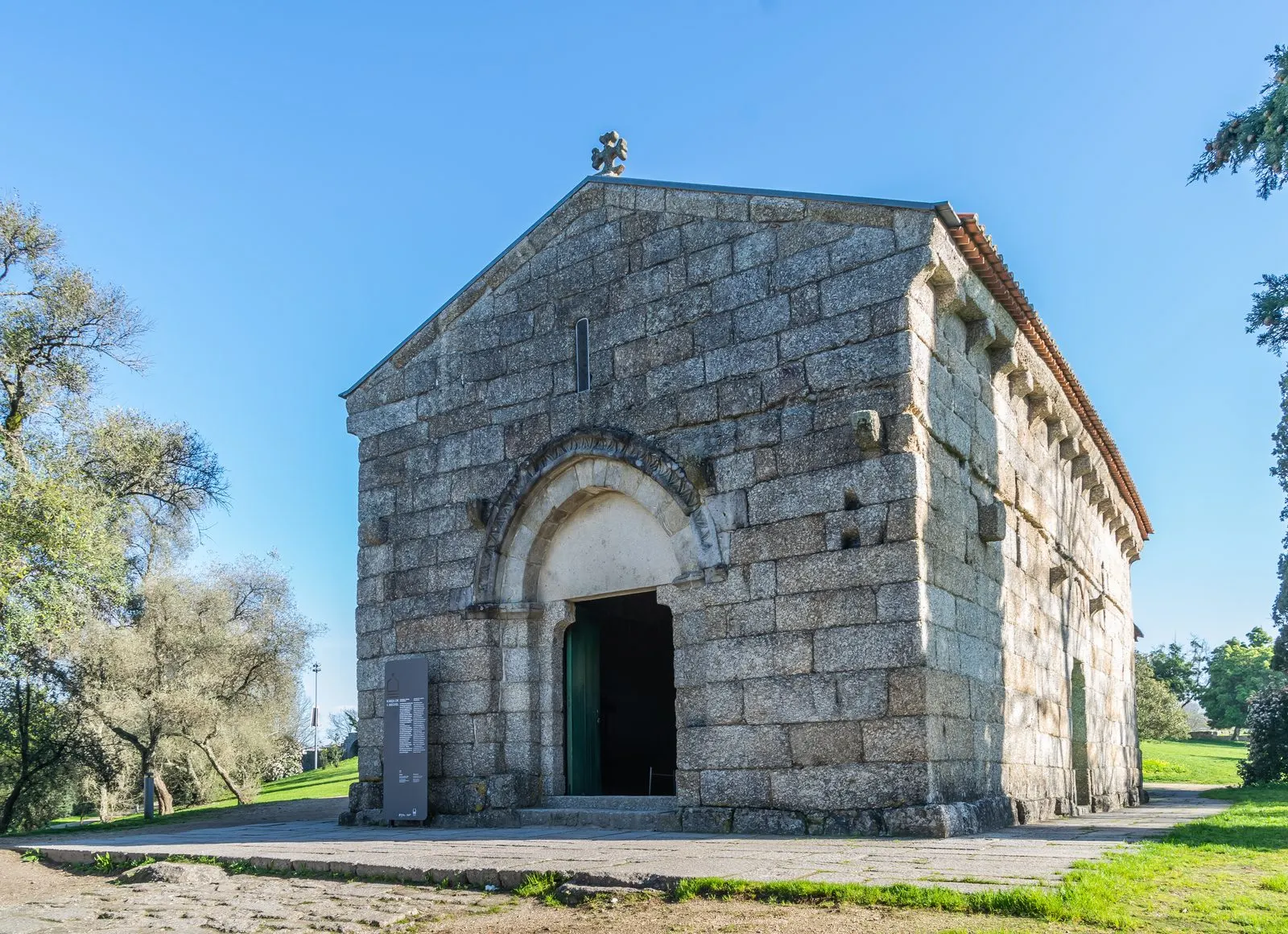
In Guimarães, the Romanesque Church of São Miguel do Castelo, near the castle, was consecrated in 1239; Afonso Henriques' baptism there is a legend.
- Location
- Oliveira, São Paio e São Sebastião, Guimarães, Braga
- Built
- Construída nas primeiras décadas do século XIII; sagrada em 1239; restauros de 1874-1880 e da DGEMN (séculos XIX e XX)
The Church of São Miguel do Castelo (also called Capela de São Miguel) stands on Monte Latito, beside the Castle of Guimarães and the Paço dos Duques de Bragança, in the civil parish of Oliveira, São Paio and São Sebastião. It is a small late Romanesque church, a National Monument since 1910, which the official record places in the 13th century. The tradition that made it famous, the baptism of D. Afonso Henriques, is a legend; what can be documented is a far more prosaic history of disputes between institutions and of restorations.
The legend and what is known
A nationalist historiographical current, heir to the nineteenth-century Romanticism, perpetuated the idea that Afonso Henriques was baptised in this chapel. The record of the Património Cultural, I.P. notes that this reading sought to link the monument to a historical event to the taste of the period and that, by exalting the church’s antiquity, it pushed its origins back to a primitive palatine complex of the countess Mumadona Dias, at the turn of the 9th to the 10th century. Setting that interpretation aside, the building that stands today is from the 13th century, built during the first three decades of that century.
The church arose at the initiative of the Collegiate Chapter of Guimarães, at a moment of dispute with the Archbishop of Braga that came to armed confrontation, and the decision to build a church escaped the prelate’s authority. This helps explain the modest character of the work. The record adds that the building was nonetheless consecrated by the archbishop himself, in 1239. The Paço dos Duques de Bragança specifies that the oldest document mentioning it is from 1216, that the date 1239 comes from an inscription that has since disappeared, and that the church appears as São Miguel in the Inquirições of 1258 and as Santa Margarida in 1285.
A poor and compact church
The record, drawing on Manuel Monteiro, reads in the church’s simplicity its secondary status: carelessly laid ashlar masonry, almost no decoration, compact walls, scant light coming through narrow slit windows, and a plan of a single nave with an adjoining chancel. It would have been, to some extent, a construction outside the normalising action of the archbishopric. Stylistically, the date of 1239 shows a Romanesque already late, at a time when Gothic was beginning to emerge in the country. For context, see the page on Romanesque architecture in Portugal.
According to the Paço dos Duques, it is a small church of local granite, with a rectangular nave and rectangular apse, a wooden ceiling, three doors and six windows. Of the twelve consecration crosses, ten remain visible. On the western façade there are two arcosolia (funerary niches), which are thought to contain the precentor Martim Pais (d. 1223) and the attorney João Anes Enxate. The church served for centuries as a burial place and, in the Middle Ages, local administrative sessions were held under its porch.
Ruin and restorations
In 1872 the bell tower and part of the main façade collapsed. The record states that, in the 1870s, the church was almost completely in ruins and that a commission of notables from Guimarães, gathered around the Sociedade Martins Sarmento, restored it; the Paço dos Duques dates the restoration to 1874–1880, funded by public subscription, a government subsidy and a donation from Francisco Martins Sarmento, and notes that the arch of the present chancel comes from that intervention.
In the twentieth century the DGEMN carried out here one of its first restoration campaigns, according to the theory of stylistic unity: it removed non-medieval elements, especially the Baroque altars in the nave, took down the bell tower, walled up doors and windows opened at random in the nineteenth century, and placed the corbels that support the tympanum of the main portal. The Paço records works in 1928 (demolition of a sacristy and roof repairs) and in 1938–1940. Visitors therefore encounter a church that the twentieth century wished to return to a medieval appearance, rather than an untouched building.
The baptismal font
The font associated with the baptism tradition remained in São Miguel until 1664, when the prior Diogo Lobo da Silveira took it to the church of Nossa Senhora da Oliveira; it returned to its original location in 1927, according to the Paço dos Duques. The tradition is what sustains the object’s interest: the building’s 13th-century chronology does not coincide with that of the first king, who lived in the 12th century. On the page for the Castle of Guimarães the same point is addressed in connection with the birth of Afonso Henriques.
Classification
It is a National Monument, under the Decree of 16 June 1910 (Diário do Governo no. 136, of 23 June 1910). The special protection zone, with a non aedificandi zone, covers the ensemble of Castle, Church of São Miguel and Paço dos Duques, fixed by the Ordinance of 15 April 1955 (Diário do Governo, II series, no. 170, of 23 July 1955); the record also refers to an ordinance of 24 November 1951 (Diário do Governo, II series, no. 103, of 30 April 1952). The text of the 1910 decree is an image scan that we could not transcribe. The record lists the Historic Centre of Guimarães and Leather Zone as another classification, that is, the ensemble described on the page about Guimarães; we have not, however, confirmed that the church lies within the exact limits of the UNESCO inscription, so we do not present it as a listed property in its own right.
Planning the visit
As consulted on 5 November 2026, the church’s page on the website of the Paço dos Duques de Bragança listed the Paço’s contacts (telephone +351 253 412 273, +351 253 423 912 and +351 253 423 918; general email [email protected]), but did not publish opening hours or prices for the church, referring instead to the Paço’s hours and ticketing page. Please confirm this information at pacodosduques.gov.pt before travelling. The church is a few steps from the castle; for the city, see Guimarães and the page on the North.
Photograph by Krzysztof Golik, dated 18 February 2020. Original on Wikimedia Commons, under CC BY-SA 4.0; resized and compressed for the web, without altering the composition.
Frequently asked questions
- Was D. Afonso Henriques really baptised at São Miguel do Castelo?
- It is a tradition, not a documented fact. The record of the Património Cultural, I.P. describes it as a legend sustained by a nationalist historiographical current and points out that the church standing today dates from the 13th century, built during the first three decades of that century, long after the time of the first king.
- When was the church built and consecrated?
- According to the record, the church dates from the 13th century, erected at the initiative of the Collegiate Chapter of Guimarães, and was consecrated by the Archbishop of Braga in 1239. The Paço dos Duques de Bragança notes that the oldest document referring to it is from 1216 and that the date 1239 comes from an inscription that has since disappeared.
- Is the church a National Monument?
- Yes. The Atlas do Património Classificado cites the Decree of 16 June 1910, published in the Diário do Governo no. 136, of 23 June 1910. The special protection zone, shared with the Castle and the Paço dos Duques, was established by ordinance of 15 April 1955.
- Where is the baptismal font?
- According to the Paço dos Duques de Bragança, the font was taken in 1664 to the church of Nossa Senhora da Oliveira and returned to São Miguel in 1927. It is to this font that the tradition links the baptism of Afonso Henriques.
Sources
- Património Cultural, I.P. — Igreja de São Miguel do Castelo (70512)
- Património Cultural, I.P. — Atlas do Património Classificado e em Vias de Classificação (NINV 2287)
- Diário do Governo — Decreto de 16 de junho de 1910 (n.º 136, de 23 de junho de 1910)
- Paço dos Duques de Bragança — Igreja de S. Miguel
- Wikidata — Igreja de São Miguel do Castelo (Q3780680)
Keep exploring
Heritage nearby
More places to discover from here. Approximate straight-line distances, within 50 km.