Monuments
São Gonçalo Bridge (Amarante)
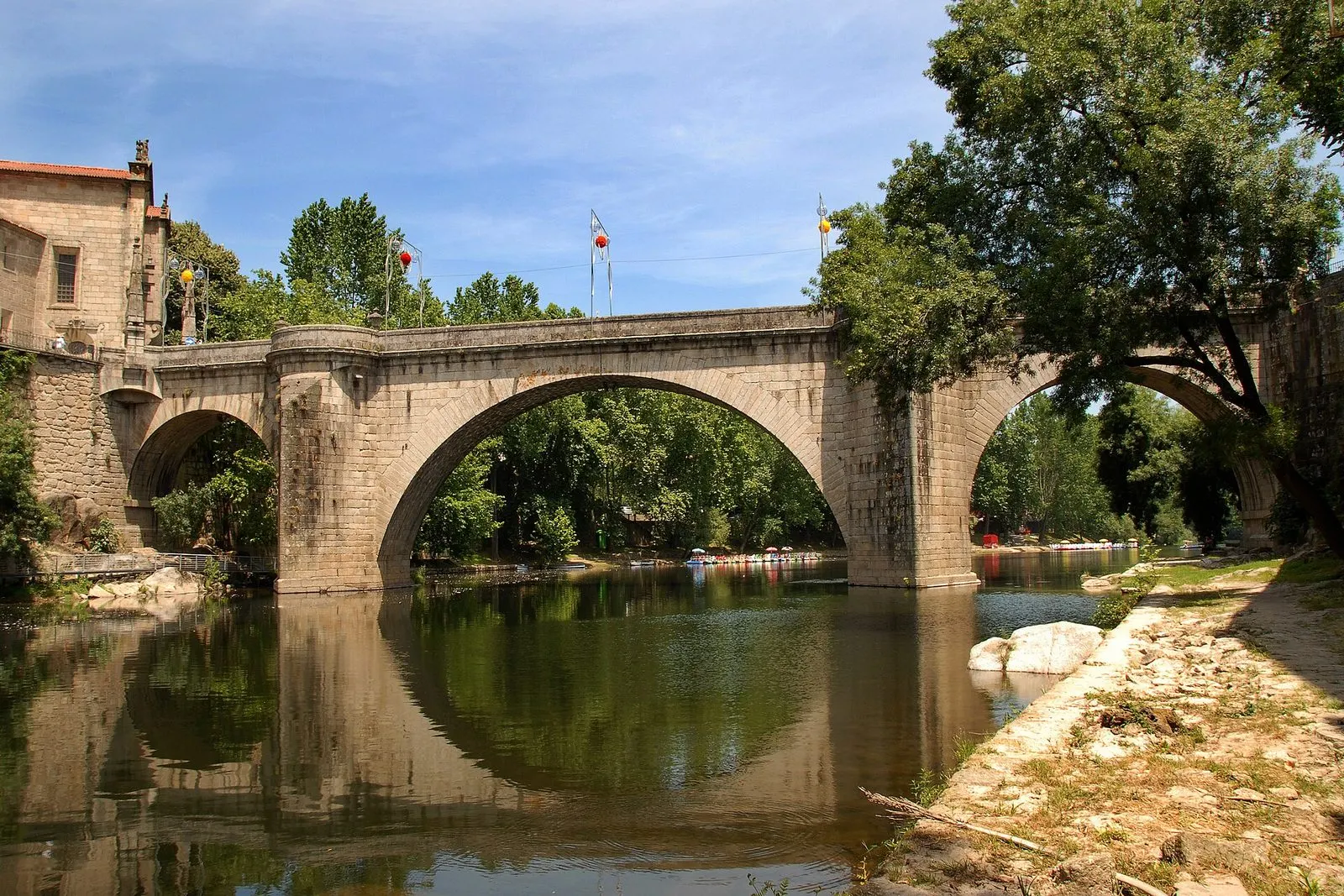
Ponte de São Gonçalo in Amarante: three-arch 1700s bridge over the Tâmega, built after the medieval one was ruined in 1763. National Monument since 1910.
- Location
- Amarante, Porto
- Built
- século XVIII (reconstrução após 1763; concluída por volta de 1790)
The Ponte de São Gonçalo links the two banks of the River Tâmega in the centre of Amarante, between Praça da República and Rua 31 de Janeiro, and is the crossing framed by the convent and the church of São Gonçalo. Its official name is Ponte sobre o Tâmega (Bridge over the Tâmega). It is a National Monument, but it is not a medieval bridge: it is an eighteenth-century work, built after the previous one collapsed.
A bridge that fell
The Património Cultural record (no. 70622) notes that the original bridge dated back to the 13th century. It collapsed in 1763, and what can be seen today «results from an eighteenth-century construction». Before the old bridge was lost, the images of Nossa Senhora da Piedade and of Christ Crucified, which stood on the granite cross at the midpoint of the crossing, were taken to the convent church.
Local tradition links the first bridge to the titular saint of the convent, São Gonçalo. This is a tradition, and the official record merely places the original bridge in the 13th century.
The eighteenth-century work
As for the date of completion, the sources are not uniform. The SIPA inventory attributes the design to Carlos Amarante and gives 1790 as the year the new bridge opened, according to the summaries we consulted (we were unable to open the original file). Another record from the same system, on the urban core of Amarante, indicates 1788. We therefore speak here of a construction «from the late eighteenth century, around 1790». The Património Cultural file gives neither a year nor an author, and the precise chronology remains to be confirmed with the municipal archive.
What can be seen
The bridge has a horizontal deck carried on three round arches of unequal spans. The piers have triangular buttresses, upstream and downstream, topped by four semicircular balusters. The parapet is of granite, resting on a carved cornice, and the ends have two pairs of Baroque pinnacles set on small spheres. According to the record, the surface has since been asphalted. It is a work of late Baroque taste, in which the design of the balusters and pinnacles matters more than the structural solution, which is simpler than that of the Gothic bridges of Minho. For those, see the medieval bridges.
Classification and surroundings
It is a National Monument under the decree of 16 June 1910, published in the Diário do Governo no. 136, of 23 June 1910. The bridge is covered by the protection zone of the ensemble of streets and public spaces of Amarante and of the church of São Gonçalo, with its cloister, and the record stresses that its historical and artistic relevance justified its inclusion in the first Portuguese decree classifying «national monuments».
Visiting
The bridge is a public road in the historic centre, beside the river. When consulted on 5 November 2026 we found no official information on traffic restrictions; for traffic and for events taking place on the riverbank, consult the Amarante municipality. The church and former convent stand beside the bridge, on one of its banks.
Photograph by António Amen, dated 4 June 2010. Original on Wikimedia Commons, under CC BY-SA 3.0; resized and compressed for the web, without altering the composition.
Frequently asked questions
- Is the Ponte de São Gonçalo medieval?
- No. The official record states that the original bridge dates from the 13th century and collapsed in 1763; the bridge seen today results from an eighteenth-century construction.
- When was it completed?
- The official record only indicates eighteenth-century construction. The SIPA inventory, according to summaries consulted, gives 1790 for the opening of the new bridge, but another record from the same system, on the urban core of Amarante, gives 1788.
- What arches and features does it have?
- Three round arches of unequal spans, triangular buttresses on the piers, four semicircular balusters, granite parapets on a moulded cornice, and two pairs of Baroque pinnacles at the ends.
- Is it listed?
- Yes, as a National Monument, by decree of 16 June 1910, published in the Diário do Governo no. 136, of 23 June 1910.
Sources
- Património Cultural, I.P. — Ponte sobre o Tâmega (registo 70622, NINV 3613)
- Património Cultural, I.P. — Atlas do Património Classificado (NINV 3613)
- Diário do Governo n.º 136, de 23 de junho de 1910
- SIPA — Ponte sobre o Tâmega / Ponte de São Gonçalo (IPA, id 3885)
- SIPA — Núcleo urbano da cidade de Amarante (id 6137)
- Wikidata — Ponte de São Gonçalo (Q10351445)
Keep exploring
Heritage nearby
More places to discover from here. Approximate straight-line distances, within 50 km.