Monuments
Church of Gatão
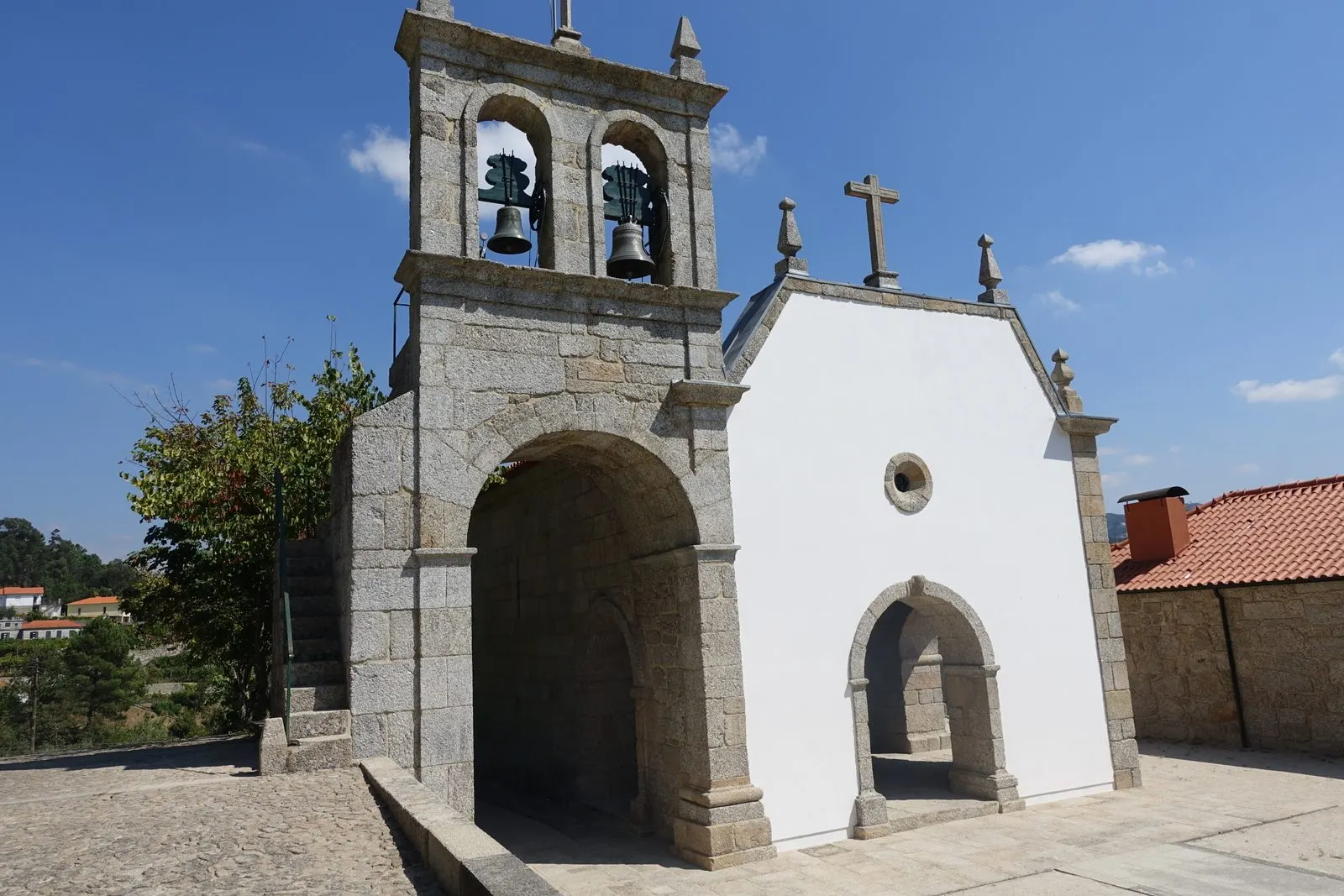
Gatão Church in Amarante: a Romanesque chancel with Lombard blind arches, 15th- and 16th-century mural paintings, and the tomb of Teixeira de Pascoaes.
- Location
- Gatão, Amarante, Porto
- Built
- Capela-mor românica (meados do século XIII, segundo a hipótese citada pelo registo); corpo refeito na época moderna; restauro de 1941-1951
The Church of Gatão (Church of Saint John the Baptist, of Gatão) stands on Largo da Igreja, in the village of Gatão, in the municipality of Amarante. Its official designation is “Church of Gatão, including the fresco mural paintings that decorate it”. It is a National Monument and one of the monuments of the Romanesque Route. It is of interest for two reasons: a Romanesque chancel of greater importance than its modest scale would suggest, and a set of late medieval mural paintings, still on view today.
Origins still unclear
According to the record of the Património Cultural, I.P., the origins of the church remain unclarified. A tradition, “for now legendary” but systematically repeated in the historiography, attributes its foundation to the 9th century, at the time when the territory around the Douro was organised under the initiative of the Asturian monarchy. The oldest part that survives today is the chancel, Romanesque, of unidentified date which, according to the hypothesis of Carlos Alberto Ferreira de Almeida cited by the record, may coincide with the mid-13th century. The Romanesque Route describes the construction as extending through the 13th and 14th centuries, with the most significant Romanesque elements in the apse.
The Romanesque chancel
Despite its relatively modest construction and common square plan, the chancel is, for the record, a piece of greater importance within the Romanesque of the Amarante region. On the exterior, the narrow slit windows contrast with the elegance of the blind arcades of full round arches, in the Lombard manner, which precede the cornice on which the roof rests. Almeida compares them with those of Roriz and sees in them the direct influence of the Romanesque workshops of the Guimarães region in the Amarante area. On the south side there are traces of an attached porch, certainly later.
Inside, the triumphal arch is a full round arch with two archivolts, the outer one framed by a chequered border, one of the most frequent motifs of Portuguese Romanesque. It rests on two stocky columns with capitals decorated with vegetal motifs which, according to the Galician historian Xosé Lois García, cited in the record, carry allegorical content: the wheat and the vine symbolise bread and wine, a direct representation of the Eucharist. For the stylistic context, see Romanesque architecture in Portugal; in the town itself, the Church of São Gonçalo belongs to a different period and style.
The mural paintings
At the transition to the Early Modern period the church was greatly altered, especially its devotional elements in the interior. Much of the walls was covered by panels of mural painting, of which six large ensembles survive. The record states that they await a monographic study that will clarify their importance within the context of northern mural painting in the final decades of the Middle Ages. Axially above the triumphal arch is a Calvary, a composition of static, hieratic figures; flanking the arch are four panels with saints in niches, as if they were sculptures; on the back wall of the chancel are Saint Anthony and Christ on the way to Calvary, which suggests that other panels with the last moments of Christ’s life once existed.
The Romanesque Route dates the frescoes to the 15th and 16th centuries, refers to the Coronation of the Virgin, the martyrdom of Saint Sebastian, Saint Catherine of Alexandria and Saint Lucy, and notes that Father Manuel Couto drew attention to the paintings in 1937 and that they were included in a conservation intervention in 2015. The official record and the Route describe the subjects differently, so the exact list of panels should be confirmed on site.
From the Romanesque body to restoration
The Romanesque body was replaced by another in the modern era; apart from the galilee that precedes the church, the medieval proportion of the nave is likely to have been preserved. In the 17th century the bell tower was erected, attached to the façade on the north side, in two stages. In the early 1950s the DGEMN restored the monument, rebuilding the south wall of the nave and the main façade of the galilee and replacing roofs and floors; the Romanesque Route indicates a principal restoration in 1941-1951. In the attached cemetery is the tomb of the poet Teixeira de Pascoaes (1877-1952), a distinguished native of Amarante.
Classification
It is a National Monument, including the fresco mural paintings. The Atlas of Classified Heritage cites Decree No. 33 587, of 27 March 1944 (Diário do Governo, I series, No. 63); the record also lists Decrees No. 30 762, of 26 September 1940, and No. 30 838, of 1 November 1940 (the latter suspended the former with respect to privately owned properties), and the Romanesque Route gives the classification as 1940. The protection zone was fixed by the Portaria of 23 January 1951 (Diário do Governo, II series, No. 38, of 16 February 1951). The text of the 1944 decree is an image scan that we were unable to transcribe. The church is not part of any UNESCO inscription.
Preparing the visit
When consulted on 5 November 2026, the Romanesque Route’s page indicated visits by appointment (telephones +351 255 810 706 and +351 918 116 488; email [email protected]) and, for worship, Mass on Sundays at 11:15 and on Saturdays at 16:30 in the months of January, April and October. The same page did not indicate a price. These details may change: confirm them on the official page of the monument before travelling. For the rest of the municipality, see Amarante and the page for the North.
Photograph by Joseolgon, of 8 September 2016. Original on Wikimedia Commons, under CC BY-SA 4.0; resized and compressed for the web, without altering the composition.
Frequently asked questions
- Is the Church of Gatão really from the 9th century?
- There is no proof of this. The record of the Património Cultural, I.P. states that its origins remain unclarified and that the attribution of its foundation to the 9th century is, for now, a legendary tradition. The oldest surviving part is the Romanesque chancel, of unidentified date, which may coincide with the mid-13th century.
- What is special about the interior?
- The mural paintings. The record describes six large ensembles, with a Calvary above the triumphal arch, four saints in niches flanking the arch and, on the back wall of the chancel, Saint Anthony and Christ on the way to Calvary. The Romanesque Route dates the frescoes to the 15th and 16th centuries and mentions a conservation intervention in 2015.
- Is it part of the Romanesque Route?
- Yes. The Church of São João Baptista de Gatão is on the list of monuments of the Romanesque Route, which indicates that visits are by appointment.
- What is its classification?
- National Monument, including the fresco mural paintings. The Atlas of Classified Heritage cites Decree No. 33 587, of 27 March 1944; the record also refers to Decrees No. 30 762 and No. 30 838, both of 1940.
Sources
- Património Cultural, I.P. — Igreja de Gatão, incluindo as pinturas murais a fresco que a decoram (70372)
- Património Cultural, I.P. — Atlas do Património Classificado e em Vias de Classificação (NINV 3603)
- Diário do Governo — Decreto n.º 33 587, de 27 de março de 1944 (I série, n.º 63)
- Rota do Românico — Church of Saint John the Baptist of Gatão
- Wikidata — Igreja de Gatão (Q39865077)
Keep exploring
Heritage nearby
More places to discover from here. Approximate straight-line distances, within 50 km.