Archaeology
Dolmens of Sintra
The dolmens of Belas, Adrenunes and Agualva, in Sintra: National Monuments since 1910, excavations by Carlos Ribeiro, current state and how to visit.
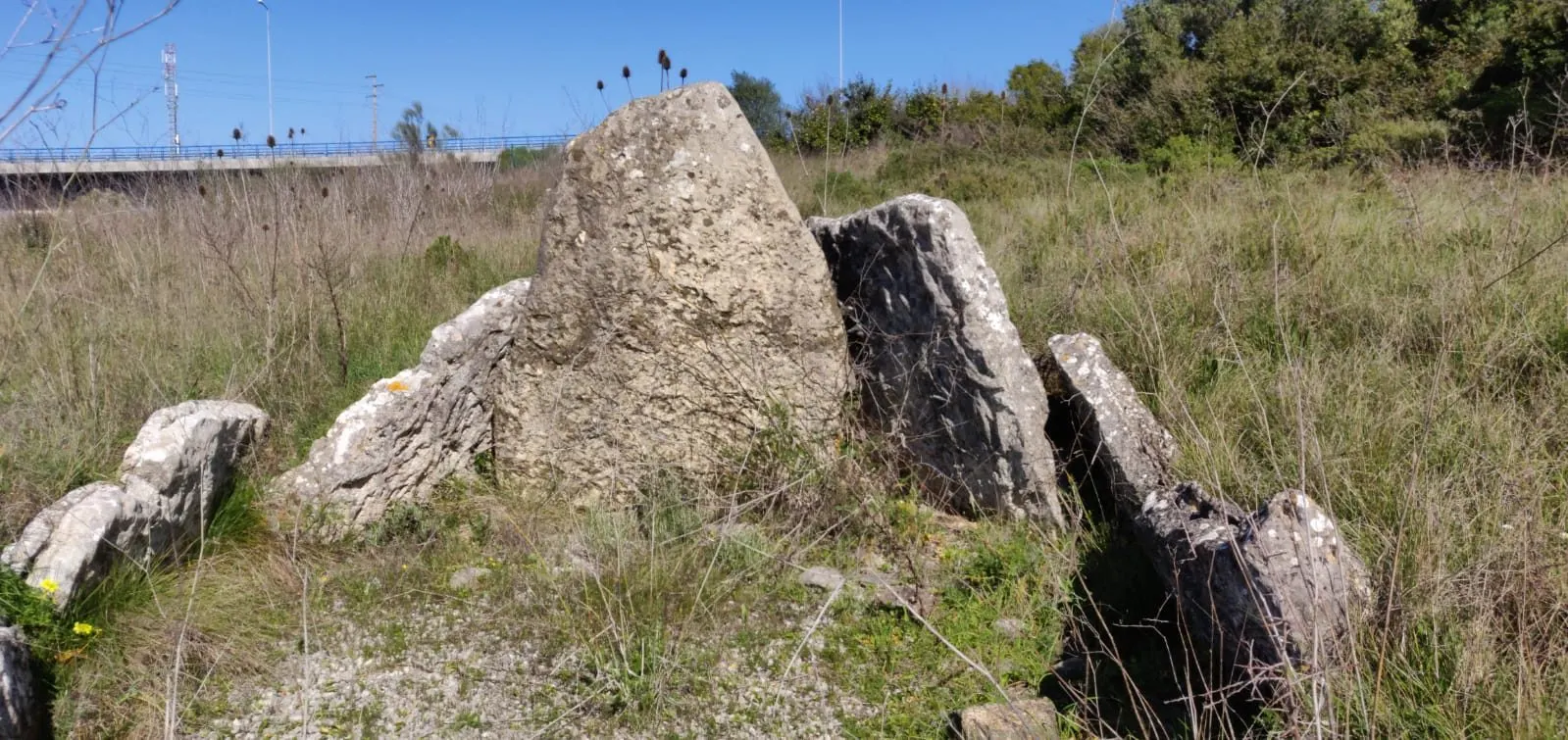
- Location
- Belas, Sintra, Lisboa
- Built
- c. 3500–2500 a.C.
The municipality of Sintra is best known for its palaces and its mountain range, but it also holds a small group of megalithic monuments classified since the early twentieth century. The Atlas do Património Cultural lists as National Monument three properties bearing the name anta in Sintra, all classified by the same instrument, the Decree of 16 June 1910, published in the Diário do Governo no. 136, of 23 June 1910: the Antas de Belas (a group of three monuments), the Anta de Adrenunes and the Anta de Agualva. This page gathers them into a single guide because each, taken alone, has little official information available.
Antas de Belas
The Antas de Belas are a group recorded in the Atlas under inventory number 9035, in the parish of Belas. It comprises three monuments: the Anta do Senhor da Serra or Anta da Pedra dos Mouros, the Anta da Estria and the Anta do Monte Abraão. They were made known by the geologist Carlos Ribeiro, who excavated them in the 1870s (the Estria in 1875 and Monte Abraão between 1876 and 1878, according to Wikipedia, which refers to the studies of Rui Boaventura and João Luís Cardoso). The finds, such as stone axes, arrowheads and vessels, are held at the Museu Geológico, in Lisbon.
According to these same secondary sources, the Anta da Estria has a polygonal chamber with a passage, built in local limestone and dated to the late Neolithic and early Chalcolithic; it was almost destroyed during the construction of the A9 motorway in the 1990s, and access is difficult. The Anta do Monte Abraão is said to have had a chamber about 3.6 metres in diameter and a passage of about 8 metres, with signs of graffiti. The Pedra dos Mouros preserved, according to Ribeiro, orthostats of large dimensions; news reports from June 2010, cited by Wikipedia, stated that the dominant stone was found broken, with the hypothesis of vandalism or blasting linked to the A9, without a confirmed cause. It has not been possible to confirm the current state of the three monuments from an official source.
Anta de Adrenunes
The Anta de Adrenunes (inventory number 3410) belongs to the parish of Colares, on a rise above Cabo da Roca, within the Parque Natural de Sintra-Cascais. It is the most unusual of the group: granite blocks form a gallery about 5 metres high. It was studied by Possidónio da Silva, who presented it in 1871 as a funerary megalithic monument. According to Wikipedia, no funerary remains were found, and other authors argue that it is a natural granite formation modified by human action. Granite wedges beneath some blocks indicate human intervention. The nature of the monument therefore remains under discussion, and its chronology is not established in an official source.
Access is on foot along a track, about 1 kilometre from a surfaced road, according to the same secondary sources.
Anta de Agualva
The Anta de Agualva, also called Anta do Carrascal (inventory number 3411), is located in the parish of Agualva e Mira-Sintra, in the middle of the urban fabric. It has a polygonal chamber of about 3.7 by 3.8 metres, formed by seven orthostats, and an access passage. Carlos Ribeiro identified and excavated it in 1875. According to the secondary sources consulted, it was in use between the middle and late fourth millennium BC, and it was incorporated into a municipal garden opened in 2004; in 2017 it reportedly underwent a further intervention by the municipality, reopening in April that year. This conservation information has not been verified against a municipal source. It is the most easily visited dolmen in the municipality.
Classification
The three properties were classified as National Monument by the Decree of 16 June 1910, published in the Diário do Governo no. 136, of 23 June 1910 (the original text is held in a digitised file of the Diário da República).
Comparison with regional megalithism
The dolmens of Sintra and the Lisbon region are less monumental than those of the Alentejo, such as those described under megalitismo and arte megalítica portuguesa, but they belong to the same phenomenon: collective tombs with polygonal chambers and passages, built from the stones available, here limestone rather than granite or schist. They are now surrounded by urban development, which makes them harder to read in the landscape than those in the interior.
Preparing the visit
The Anta de Agualva is the most accessible, in an urban public space. The Antas de Belas lie beside fast roads and may require routes that are not obvious. The Anta de Adrenunes requires a walk. When consulted on 5 November 2026, we found no opening hours, access rules or up-to-date municipal information; please confirm with the Sintra municipality before travelling. The Palácio Nacional de Sintra and the historic centre are on the opposite side of the municipality.
Photograph: Roundtheworld, 14 February 2019, AntaEstria1.jpg, licence CC BY-SA 4.0, resized and compressed for the web, composition unaltered.
Frequently asked questions
- Which dolmens in Sintra are National Monuments?
- The Antas de Belas (Pedra dos Mouros or Senhor da Serra, Estria and Monte Abraão), the Anta de Adrenunes and the Anta de Agualva, all classified by the Decree of 16 June 1910.
- Who excavated the Antas de Belas?
- The geologist Carlos Ribeiro, in the 1870s, according to the secondary literature consulted. The materials recovered are held at the Museu Geológico, in Lisbon.
- Is the Anta de Adrenunes really a dolmen?
- It is classified as one, but its nature is debated: some authors consider it a natural granite formation modified by human action.
- Which is the easiest to visit?
- The Anta de Agualva, set within an urban public garden. Opening hours and conservation information should be confirmed with the Sintra municipality.
Sources
- Património Cultural, I.P. — Atlas do Património Classificado (Antas de Belas, NINV 9035; Adrenunes, 3410; Agualva, 3411)
- Diário do Governo — Decreto de 16 de junho de 1910 (n.º 136, de 23 de junho de 1910)
- Wikidata — Antas de Belas (Q47353823)
- Wikipédia — Anta da Estria (apontador para fontes)
- Wikipédia — Anta de Agualva (apontador para fontes)
- Wikipédia — Anta de Adrenunes (apontador para fontes)
Keep exploring
Heritage nearby
More places to discover from here. Approximate straight-line distances, within 50 km.