Archaeology
Islamic Baths of Loulé
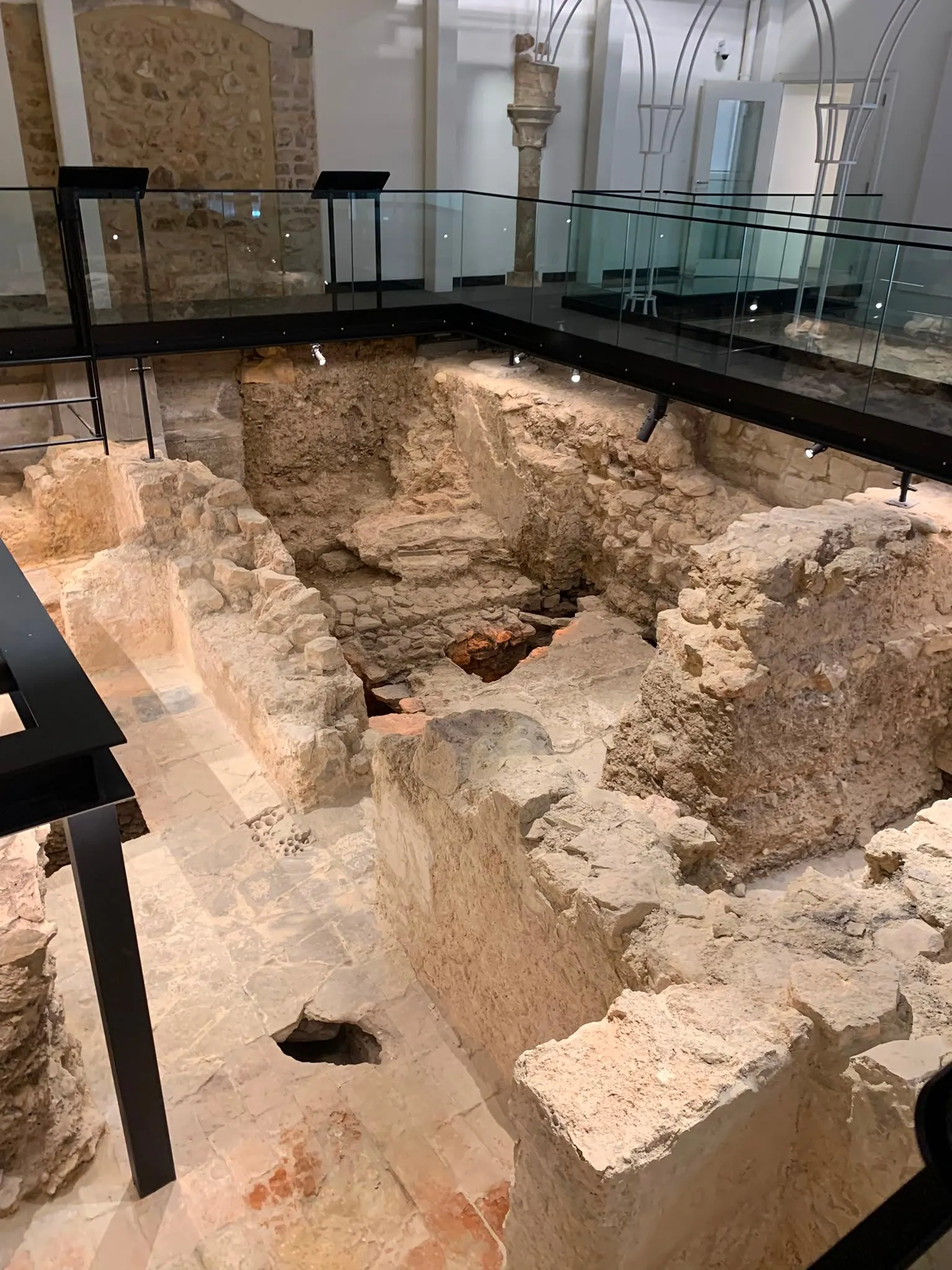
Loulé Islamic Baths: a 12th-century Almohad hammam beside the town wall, discovered in 2006, a National Monument since 2023 and now a museum space.
- Location
- Loulé, Faro
- Built
- século XII (datação conjetural)
Beneath a building in the historic centre of Loulé survives a public bathhouse from the Islamic period, the hammam of the former al-Ulyã (the Arabic name of Loulé). The Islamic Baths of Loulé are today a National Monument and a municipal museum space. The SIPA inventory classifies them as exceptional for the state of conservation of their structures, unique in Portugal in their typology.
A public bath against the wall
The SIPA dates the construction to the 12th century, in the Almohad phase of Islamic rule in the Algarve, but marks this dating as conjectural. The bathhouse was set against the wall and one of its towers, with about 50 metres of the building’s southwest boundary resting on the urban enclosure, and the inventory records traces of a barbican tower inside. This positioning is described as almost unprecedented: public baths were normally located near mosques or city gates.
The plan is slightly trapezoidal, with three naves of similar dimensions, oriented east to west. They correspond to the hot bathing room, the warm room and the cold room, each with a small service compartment at one end. The floors are suspended over the hypocaust, the heating system using ducts of hot air produced by a furnace, and the walls of the hot room include chimneys for the smoke to escape. The cold room is only partly exposed, and the building’s original entrance has not yet been identified, possibly in an area still to be excavated.
From the end of Islamic occupation to oblivion
After the Christian conquest, King Afonso III granted Loulé its charter in 1266, and the document, according to the SIPA, reserved public buildings, including the baths, for the Crown. The inventory indicates the bathhouse was in use until the 14th–15th centuries; afterwards it was converted or abandoned and buried, and the space reused for new construction. Inside remained brick pointed arches, resting on limestone columns with decorated capitals, of medieval construction and later than the bathing phase. In 1985, Martins and Matos had already revealed the existence of these arches, walled up in an interior wall.
Discovery and excavation
The bath structures were identified in 2006, during the excavation of trenches for a rainwater collection tank during works in the historic centre. The property was acquired by the Municipality of Loulé in 2006, according to the municipal website, and the SIPA notes a protocol with the Mértola Archaeological Field to continue the excavations and prepare a project for enhancement and musealisation. The publications of Isabel Luzia and Alexandra Pires, in the journal Al-ulyã of the Municipal Archive of Loulé, are among the studies cited in the inventory.
Classification
The Cultural Heritage Atlas, consulted on 5 November 2026, records the Islamic Baths of Loulé (NINV 75565) as a National Monument, classified by Decree No. 17/2023, Diário da República, 1st series, No. 136, of 14 July 2023. The record does not indicate, as of that date, a dedicated special protection zone. For context, see Islamic archaeology in Gharb al-Andalus, where Mértola and Silves are the best-known cases, Islamic art in Portugal and Moorish and Islamic heritage.
Planning the visit
The space, which shares the building with the Barreto Manor House, is at Rua Garcia de Orta, No. 4, in Loulé, and is integrated into the Municipal Museum. When consulted on 5 November 2026, the municipal website indicated opening Tuesday to Sunday, 10:00 to 12:30 and 13:30 to 18:00, closed on Mondays, and did not list prices. Municipal contacts: [email protected] and 289 400 953; guided visit bookings via 289 400 611. Always confirm on the municipal website.
Photograph: Pedroz16, 9 June 2026, Banhos Islâmicos de Loulé - 1.jpg, dedicated to the public domain (CC0), resized and compressed for the web, without altering the composition.
Frequently asked questions
- What are the Islamic Baths of Loulé?
- They are the remains of a public bathhouse from the Islamic period, a hammam, located in the historic centre of Loulé and built against the city's old wall. The SIPA describes it as built in the 12th century, in the Almohad period, with a dating marked as conjectural.
- Are they classified?
- Yes, as a National Monument, by Decree No. 17/2023, published in the Diário da República, 1st series, No. 136, of 14 July 2023.
- When were they discovered?
- The structures were identified in 2006, during the excavation of trenches for a rainwater collection tank during works in the historic centre, according to the SIPA. As early as 1985, the existence of pointed arches inside the building was already known.
- Can I visit?
- When consulted on 5 November 2026, the municipal website indicated opening hours from Tuesday to Sunday, 10:00 to 12:30 and 13:30 to 18:00, closed on Mondays. Please confirm on the municipal website before going.
Sources
- Património Cultural, I.P. — Atlas do Património Classificado (Banhos Islâmicos de Loulé, NINV 75565)
- Diário da República — Decreto n.º 17/2023, de 14 de julho de 2023
- DGPC — SIPA, Banhos Islâmicos de Loulé / Hammam de Al-Ulyã / Casa das Bicas (IPA.00036182)
- Município de Loulé — Banhos Islâmicos de Loulé e Casa Senhorial dos Barreto
- Wikidata — Banhos Islâmicos de Loulé (Q109521540)
Keep exploring
Heritage nearby
More places to discover from here. Approximate straight-line distances, within 50 km.