Monuments
Church of São Lourenço of Almancil
Church of São Lourenço of Almancil: 1730 azulejos signed by Policarpo de Oliveira Bernardes, the life of the saint, gilded woodcarving and visiting information.
- Location
- Almancil, Faro
- Built
- final do séc. XVII ou início do séc. XVIII; azulejos de 1730
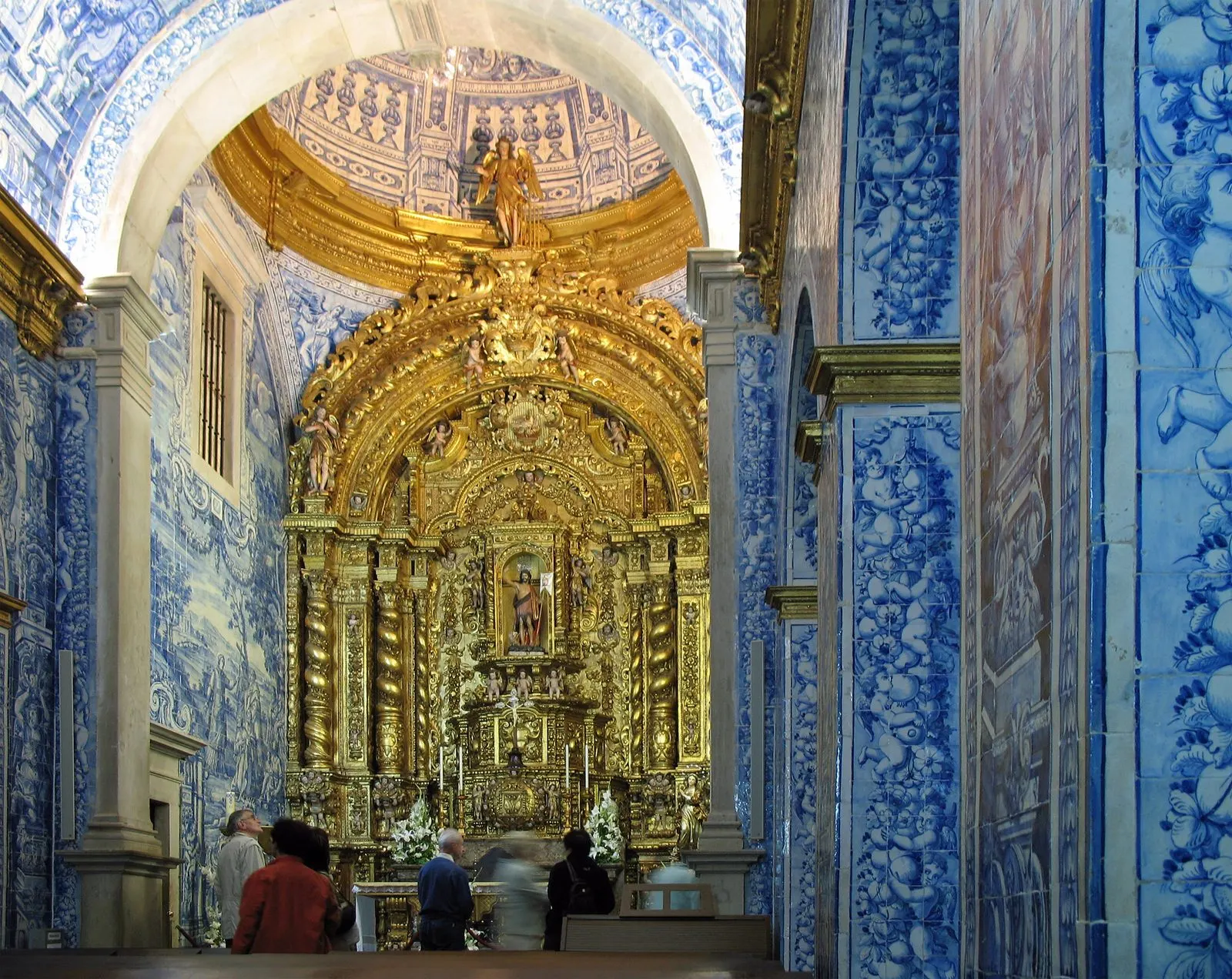
The Church of São Lourenço of Almancil stands in the parish of Almancil, in the municipality of Loulé. Outside, it is a sober church, its façade crowned by a triangular pediment. Inside, walls, pillars, vault and dome are covered in blue and white azulejo, to the point that the historian Santos Simões called it the “church of china” (“igreja de louça”). It is a rare case of full dated and signed tile cladding, and a good starting point for understanding blue and white azulejo of the first half of the eighteenth century.
A small church, a complete programme
The National Cultural Heritage Register (Património Cultural, I.P.) finds the earliest reference to the church in 1672, in the parish book of São João da Venda, to which it then belonged. The present plan, a single nave with side altars and a chancel covered by a dome, probably dates from the late seventeenth or early eighteenth century.
What gives the building its importance is its ceramic cladding. The panels are signed and dated 1730 by Policarpo de Oliveira Bernardes, son of António de Oliveira Bernardes and one of the names of the so-called “Great Masters” cycle of Portuguese azulejo painting. The commission came from the vicar-general, Doctor Manuel de Sousa Teixeira. In a 2023 article, the chronicler Paulo Larcher states that the notarial contract was signed on 16 November 1729, with installation planned for the following spring, and that the painter’s signature appears at the base of one of the decorative columns.
The authorship is nevertheless not entirely settled. The same national register notes that the researcher José Meco attributed the panels of the nave walls to another painter, not yet identified, close to Bernardes. The date and the signature are secure; the exact division of labour within the workshop remains under discussion.
The life of Saint Lawrence, in blue
The iconographic programme is read from the entrance towards the altar. The eight panels of the nave recount episodes from the life of Saint Lawrence, a deacon of Rome martyred in 258: according to the tradition summarised in the national register, he distributed the Church’s treasure to the poor rather than handing it over to the emperor, and was tortured and laid on glowing coals. On the pillars, allegorical figures represent virtues such as Poverty, Chastity, Patience, Humility, Justice and Truth.
In the chancel the scenes of the saint return. In the dome, supported on squinches where angels hold the instruments of martyrdom, Saint Lawrence is carried up to heaven. The national register highlights the scenographic effect of these curved surfaces, which suggests the use of treatises on perspective. The ensemble links the narrative of the nave with the final glorification: life, virtues and reward.
Gold on blue
The azulejo is interrupted only by the stonework of the triumphal arch, by the gilded cornice that runs round the church, and by the high altarpiece in gilded woodcarving, which the national register classifies as National Style. The azulejo and the woodcarving belong to the years when the taste of the João V Baroque was taking hold. Paulo Larcher writes that the woodcarving is thought to have been designed around 1735 by the Faro woodcarver Manuel Martins, and that the gilding was commissioned some years later; this is an attribution, not a document cited in the national register.
The municipal monograph published by Francisco Xavier d’Ataíde Oliveira in 1905 also describes the stone high altar with alabaster panels of various colours, the sacristy lined with azulejo to half height, and carved wooden chests. The same author criticises the opening of two niches that cut into part of the panels of the saint’s life.
Earthquake, parish and restoration
According to Paulo Larcher, the church was not seriously affected by the 1755 earthquake: only five tiles from the vault are said to have fallen. This is why the 1730 cladding survived almost intact, unlike many Algarve churches rebuilt after the quake. The same author mentions a major refurbishment campaign in the 1960s.
The transcription of the 1905 monograph, published by the parish, explains that the parish of Almancil was created in the nineteenth century, under the historical designation São Lourenço dos Matos de Almancil, and that the parish seat moved to this church in 1849. Today, parish life is centred on another church; São Lourenço is above all a monument open to visitors.
Classification
The national register classifies the church as an Imóvel de Interesse Público (Property of Public Interest) by Decree No. 35 443 of 2 January 1946. It is neither a National Monument nor part of any UNESCO inscription. For comparison with another great church of central Algarve, see the Sé de Faro; for the regional context, the Algarve page.
Planning the visit
The church is located at Rua da Igreja, 8135-027 Almancil. At the consultation of 5 November 2026, the Parish of Almancil indicated that the Church of São Lourenço is for visits only, with no masses, with paid admission (the price was not published). The posted opening hours were:
- 15 April to 15 October: Monday, 3 p.m.–5 p.m.; Tuesday to Saturday, 10 a.m.–1 p.m. and 3 p.m.–5 p.m.;
- 16 October to 14 April: Tuesday to Saturday, 10 a.m.–1 p.m. and 3 p.m.–5 p.m.;
- closed on Sundays.
Please confirm hours and price on the parish page or by telephone at 289 395 451 before travelling, especially on feast days or during ceremonies.
Photograph by Marc Ryckaert (MJJR), 20 April 2007. Original on Wikimedia Commons, under CC BY 3.0; resized and compressed for the web, without altering the composition.
Frequently asked questions
- Who made the azulejos of the Church of São Lourenço of Almancil?
- The panels are signed and dated 1730 by Policarpo de Oliveira Bernardes. The National Cultural Heritage Register (Património Cultural, I.P.) notes, however, that José Meco has attributed the panels of the nave walls to another painter, not yet identified, close to Bernardes.
- What do the azulejos depict?
- The eight panels of the nave and those of the chancel recount the life and martyrdom of Saint Lawrence, a deacon who died in Rome in 258. On the pillars appear allegories of virtues and, in the dome, the saint is carried up to heaven.
- Is the church a National Monument?
- No. It is classified as an Imóvel de Interesse Público (Property of Public Interest) by Decree No. 35 443 of 2 January 1946. It is not part of any UNESCO inscription.
- Are masses celebrated in the church?
- At the consultation of 5 November 2026, the Parish of Almancil listed the Church of São Lourenço as a place for visits only, with no masses. The parish's masses take place at the Church of Nossa Senhora de Fátima, in Almancil.
Sources
- Património Cultural, I.P. — Igreja de São Lourenço de Almancil (72985)
- Património Cultural, I.P. — Atlas do Património Classificado e em Vias de Classificação (NINV 2848)
- Diário do Governo — Decreto n.º 35 443, de 2 de janeiro de 1946
- Paróquia de Almancil — Locais de culto e horário de visitas da Igreja de S. Lourenço
- Paróquia de Almancil — História de Almancil (transcrição de F. X. d'Ataíde Oliveira, Monografia do Concelho de Loulé, 1905)
- Postal do Algarve — Paulo Larcher, Ouro sobre Azul na Igreja de São Lourenço de Almancil (2-02-2023)
- Wikidata — Igreja de São Lourenço de Almancil (Q1907600)
Keep exploring
Heritage nearby
More places to discover from here. Approximate straight-line distances, within 50 km.