Monuments
Church of Santa Eulália of the Monastery of Arnoso
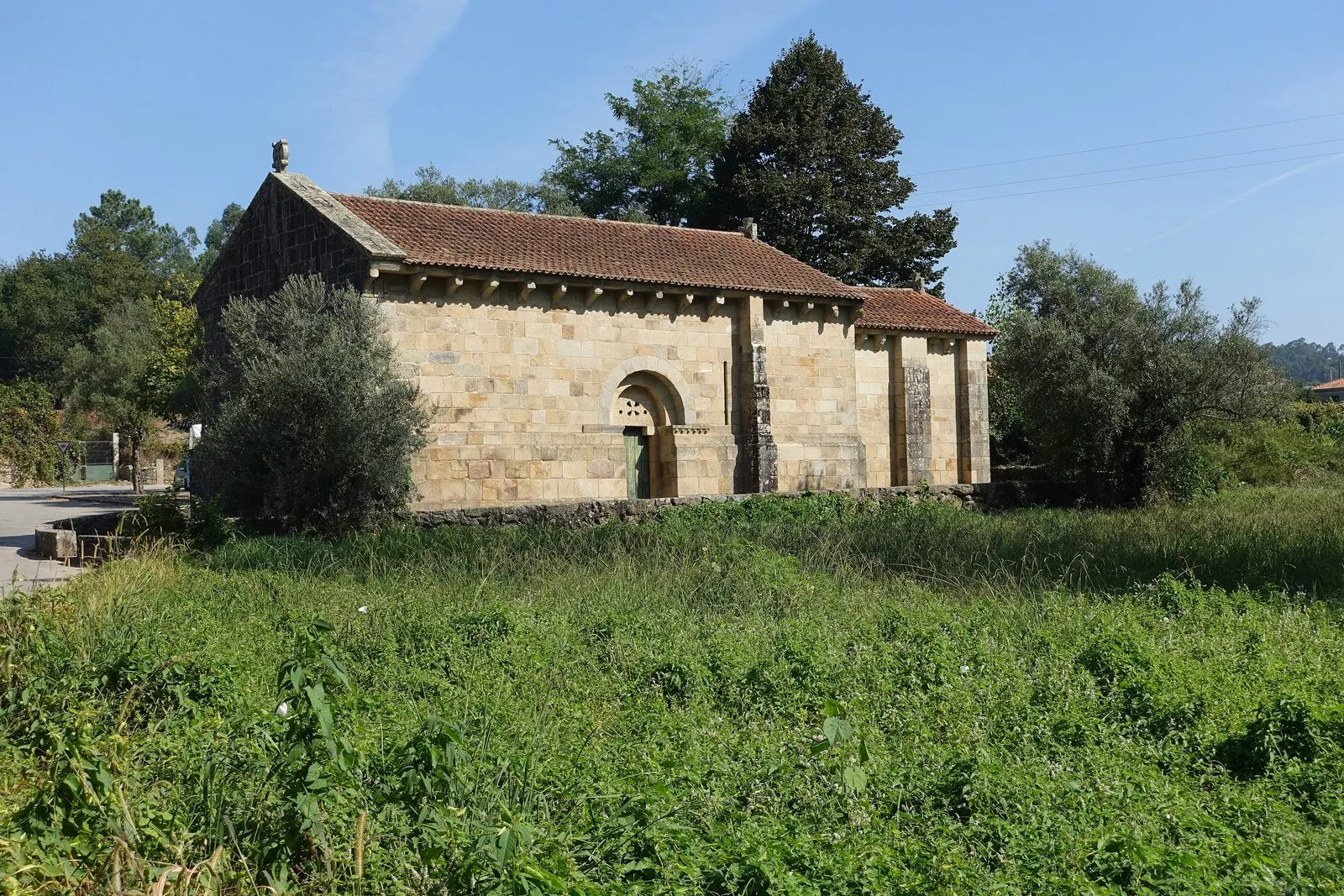
Church of Santa Eulália of the Monastery of Arnoso, in Famalicão: Romanesque church of a former Benedictine monastery, with carved portals; National Monument.
- Location
- Arnoso (Santa Maria e Santa Eulália) e Sezures, Vila Nova de Famalicão, Braga
- Built
- Igreja românica de antigo mosteiro beneditino; datação por confirmar (as fontes divergem entre a fundação no século VII e uma reconstrução medieval; uma inscrição lida como de 1156 não foi confirmada)
The Church of Santa Eulália of the Monastery of Arnoso (also called Igreja de São Salvador) stands in the civil parish union of Arnoso (Santa Maria e Santa Eulália) and Sezures, in the municipality of Vila Nova de Famalicão. It has been a National Monument since 1938 and is a Romanesque church in light granite. The name preserves the memory of the Benedictine monastery of which it was the church; of the monastery itself, the sources we consulted report no remains.
A note on sources: when consulted on 5 November 2026, the records of the Património Cultural, I.P. and the SIPA inventory entry were not accessible to us. The classification comes from the Atlas do Património Classificado; the history and description rest on inventory records reproduced in encyclopaedias and on a local page, which diverge from one another on important points, as noted below. We did not consult any monographic study.
A monastery of uncertain origin
The secondary sources agree that the church is what remains of the Monastery of São Salvador de Arnoso, Benedictine. They attribute the first foundation to the 7th century, on the initiative of Saint Frutuoso, bishop of Dume and of Braga; they relate that the monastery was destroyed by the Moors in the 11th century (one gives 1067) and was later rebuilt. One of the descriptions adds a reconstruction by Garcia II of Galicia. None of these attributions cites documentation, and the link between the church seen today and the original monastery is not demonstrated. A local page refers to a date of 1156 carved in the stone of the side portal; we have not been able to confirm it in an official record, so we do not use it as the date of construction.
The Romanesque church
The plan is longitudinal, with a single nave, whose side wall has engaged blind arches, and a two-bay chancel covered by a barrel vault. The main façade has a portal with a tympanum pierced in a cross, with round-arched archivolts resting on capitals with geometric decoration, interlacing and zoomorphic motifs. The local page highlights capitals with birds with spread wings, horses in motion and human heads, and regards the archivolts as sculpture of rare quality. Under the eaves, the photograph illustrating this page shows a corbel table of carved modillions. At the top of the building there are two crosses which the descriptions compare to Celtic crosses. For the stylistic context, see Romanesque architecture in Portugal; in Ponte da Barca, the Church of the Salvador of Bravães also has a carved portal of great quality.
Inside there are wall paintings with episodes from the life of Our Lady. The sources differ on the date: one speaks of the 16th century, another of the 14th century. They are worn but survive. The dating should be confirmed in a specialised study.
Classification
It is a National Monument under Decree No. 28 536, published in the Diário do Governo, I series, No. 66, of 22 March 1938. The special protection zone was set by ordinance of 6 April 1971 (Diário do Governo, II series, No. 89, of 16 April 1971). The text of the decree is an image scan that we could not transcribe. The church is not part of any UNESCO inscription. When consulted on 5 November 2026, the municipalities of the Rota do Românico did not include Vila Nova de Famalicão, so the church does not belong to that route.
Preparing a visit
We did not find visiting hours published by an official source for this church. It is a parish church, open mainly for worship: confirm with the parish or the Câmara Municipal de Vila Nova de Famalicão before going. For other former monasteries in Minho, see the Monastery of Tibães, and for the region the North page and the Monasteries page.
Photograph by Joseolgon, 11 September 2020. Original on Wikimedia Commons, under CC BY-SA 4.0; resized and compressed for the web, without altering the composition.
Frequently asked questions
- Was there a monastery in Arnoso?
- Yes, according to the descriptions consulted. The church is what remains of a Benedictine monastery, the Monastery of São Salvador de Arnoso, which is credited with a foundation before the Middle Ages and a destruction in the 11th century, followed by reconstruction. These dates appear in inventory records and local pages without documentary sources and have not been confirmed.
- What is the church's exact name?
- The official designation in the Atlas do Património Classificado is Igreja de Santa Eulália do Mosteiro de Arnoso, with the alternative designation Igreja de São Salvador.
- What is its classification?
- National Monument, by Decree No. 28 536, published in the Diário do Governo, I series, No. 66, of 22 March 1938. The special protection zone was set by ordinance of 6 April 1971.
- Can it be visited?
- We did not find visiting hours published by an official source. It is a parish church, open mainly for worship; please confirm with the parish or the Câmara Municipal de Vila Nova de Famalicão.
Sources
- Património Cultural, I.P. — Atlas do Património Classificado e em Vias de Classificação (NINV 2331)
- Diário do Governo — Decreto n.º 28 536, de 22 de março de 1938 (I série, n.º 66)
- Wikipédia — Igreja de Santa Eulália do Mosteiro de Arnoso (ponto de partida; descrição de inventário)
- Aldeias Portuguesas — Arnoso (Santa Maria e Santa Eulália) e Sezures
- Rota do Românico — Monumentos (lista de concelhos)
- Wikidata — Igreja de Santa Eulália do Mosteiro de Arnoso (Q5994148)
Keep exploring
Heritage nearby
More places to discover from here. Approximate straight-line distances, within 50 km.