Monuments
Church of Cete (Monastery of Saint Peter of Cete)
Igreja de Cete, former Monastery of São Pedro in Paredes: Romanesque and Gothic, crenellated tower, Manueline founder's tomb. National Monument since 1910.
- Location
- Lugar do Mosteiro, Cete, Paredes, Porto
- Built
- Fundação atribuída ao século X; igreja românica reconstruída no início do século XIV; torre e capela funerária quinhentistas
The Monastery of Saint Peter of Cete (in the spelling used by the Rota do Românico, Cête) stands at Lugar do Mosteiro, in the parish of Cete, municipality of Paredes, in the Sousa river valley. For official classification purposes the monument is called «Igreja de Cete»: it is what remains of a former Benedictine monastery, now reduced to the church, the chapter house and the cloister. The national register describes it as a late testimony to Romanesque architecture of Entre Douro e Minho, with a military suggestion. It is part of the Rota do Românico.
A monastery of uncertain origin
Tradition attributes the foundation to the nobleman D. Gonçalo Oveques, and the Rota do Românico places it in the 10th century, with a second foundation at the end of the 11th century and the adoption of the Rule of Saint Benedict in the first quarter of the 12th century. The Cultural Heritage, I.P. register is more cautious: the work seen today was begun by the mid-12th century, although some tradition points to a foundation in the 9th century, based on a document of 882 cited by Jorge Rodrigues. According to the same register, the monastery was promoted by the Cluniac Benedictines, gained independence from its supervising authority between 1121 and 1128, and, over the 12th and 13th centuries, enjoyed a period of peace and patrimonial consolidation.
The present church results from the medieval works: between the end of the 12th century and the beginning of the 14th, the reconstruction was due to the abbot D. Estêvão Anes (the register speaks of Abbot Estevão I), and the Rota links to him a limestone inscription near his tomb. In 1551 the monastery ceased to belong to the Order of Saint Benedict and was annexed, according to the Rota, to the Colégio da Graça of the Hermits of Saint Augustine in Coimbra.
The church: solid volume and portals
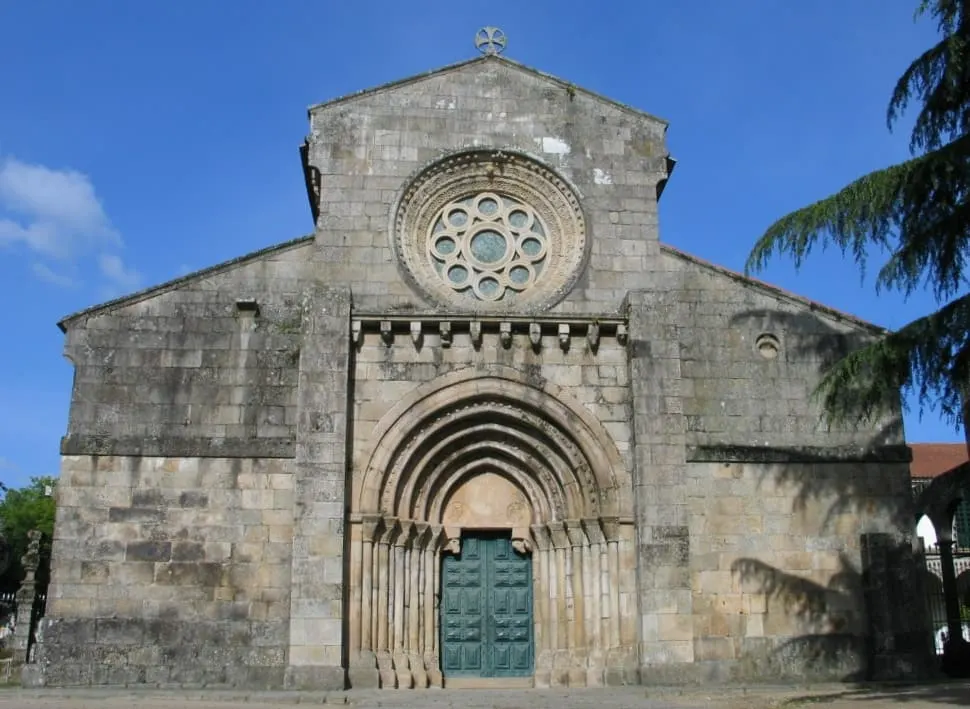
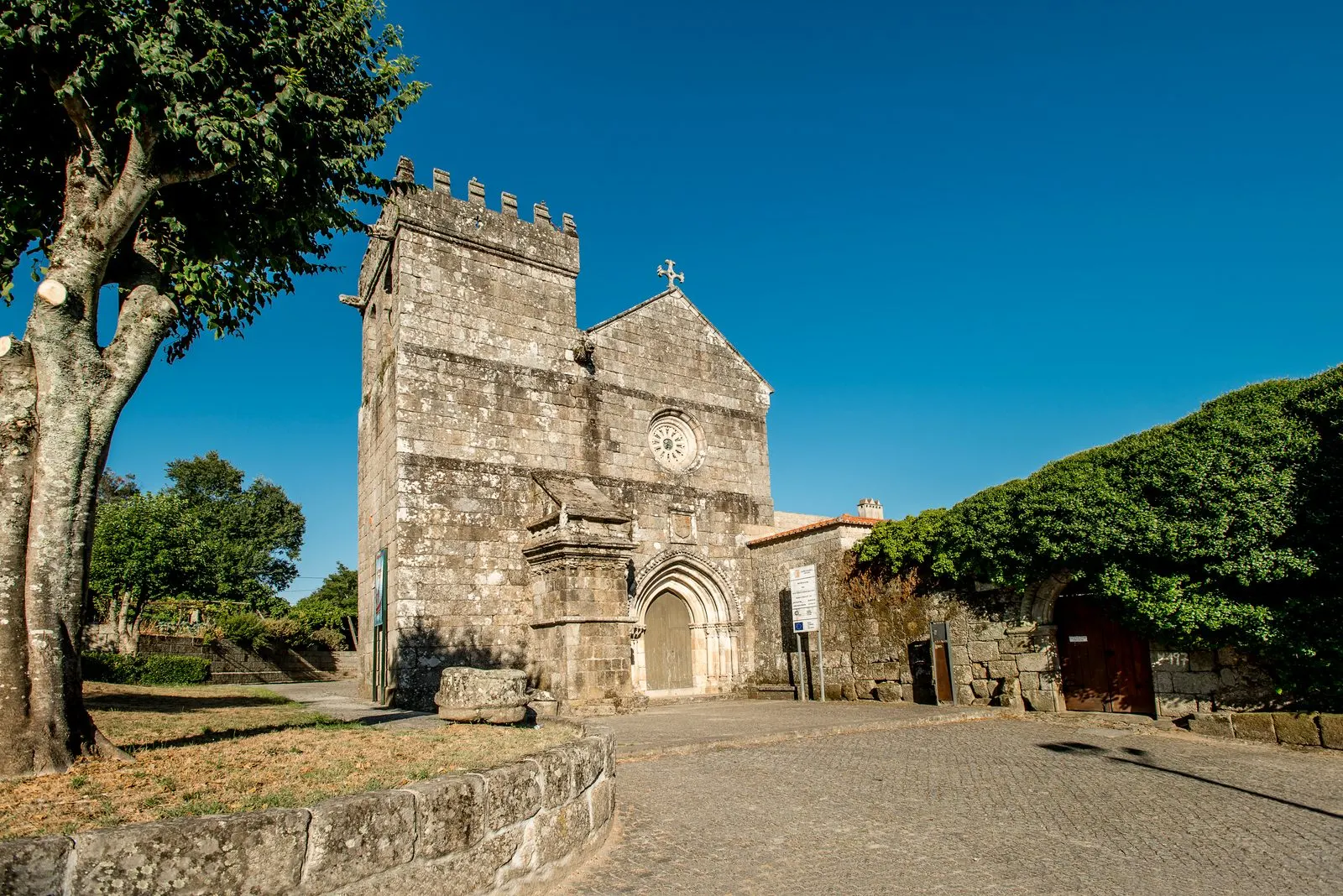
What stands out most is the massive volume: the register mentions the crenellated tower and the scarce loopholes as a memory of the attacks and devastation the monastery suffered. The main façade has a pointed-arch portal with three archivolts decorated with geometric circular motifs, resting on colonnettes with foliate capitals. Higher up opens a rose window, the result of a later restoration by the DGEMN, and the gable ends in a finial cross with fleur-de-lis. The tower, set against the north side and integrated into the façade, is reinforced by a stepped buttress with two twisted pinnacles, the work of a 16th-century campaign.
Among the oldest elements, the Rota indicates that only the first courses of the nave walls and the south portal, facing the cloister, from the 10th-century construction were reused, while the official register states that the oldest structural elements, from the 12th century, are recognisable in the decorative simplicity of the tympanum of the south portal. The two sources do not agree on the dating of this portal, so the most prudent course is simply to say that it is the oldest part of the ensemble.
Inside, the single nave has a timber roof, and the two-bay chancel ends in a quarter-sphere vault and is traversed by a blind arcade, solutions common to other Romanesque churches of the region. There are signs of Gothic vocabulary in the rose window, in the foliate and anthropomorphic decoration of the chancel, and in the north portal with its pointed arch. See Romanesque architecture and Gothic architecture.
Sixteenth-century works and the founder’s memory
From the 16th-century campaign survive a baptismal font, the multi-ribbed vault covering the funerary chapel inside the tower, the Manueline arcosolium of the tomb of D. Gonçalo Oveques, framed by 16th-century azulejos, and interventions in the cloister and the chapter house. The Rota describes the cloister and the chapter house as works of the Manueline period; for context, see the Manueline style. The Rota also highlights the limestone images of Saint Peter, Saint Lucy and Our Lady of Graça, and a 16th-century mural painting of Saint Sebastian.
Classification and restorations
It is a National Monument by decree of 16 June 1910, published in the Diário do Governo no. 136, of 23 June 1910. The special protection zone, without restrictions, was set by Portaria no. 740-CE/2012 (Diário da República, 2nd series, no. 248, supplement, of 24 December 2012). The Atlas of Classified Heritage lists the Património Cultural, I.P. as the responsible entity. The church is not part of any UNESCO inscription.
The Rota do Românico records parish restorations in 1881-1882, a DGEMN campaign from 1936, various works between 1948 and 1953, conservation in 1966, 1967, 1972, 1976, 1980 and 1982, the transfer to the IPPAR’s custody in the 1990s, its entry into the Rota in 1998, and conservation works in 2015.
Planning the visit
The Rota do Românico gives the address as Largo do Mosteiro, in Cete. When consulted on 5 November 2026, it indicated visits by appointment, Mass on Sundays at 10:00, full or partial accessibility for people with reduced mobility, and the Cête station, on the Douro Line, about 2 km away. The feast of Saint Peter is on 29 June. Confirm everything on the Rota’s page (rotadoromanico.com), which publishes the contacts for bookings.
In the same region, the Monastery of Paço de Sousa is the great Benedictine neighbour. For the general picture, see the monasteries of Portugal.
Photograph by MunParedes, dated 20 August 2013. Original on Wikimedia Commons, under CC BY-SA 4.0; resized and compressed for the web, without altering the composition.
Frequently asked questions
- Are the Church of Cete and the Monastery of Saint Peter of Cete the same monument?
- Yes. The national register of the Portuguese Cultural Heritage, I.P. designates the monument «Igreja de Cete» and lists as other designations Igreja de São Pedro de Cete, Mosteiro de Cete and Mosteiro de São Pedro de Cete. The Rota do Românico calls it Mosteiro de São Pedro de Cête. What remains of the former Benedictine monastery is the church, the chapter house and the cloister.
- When was the monastery founded?
- Tradition attributes the foundation to D. Gonçalo Oveques, and the Rota do Românico places it in the 10th century. The Cultural Heritage register notes that some tradition points to the 9th century, based on a document of 882, but states that the Romanesque work was begun by the mid-12th century. The oldest dates rest on tradition and on documentation cited by historians, not on remains visible today.
- Can it be visited?
- When consulted on 5 November 2026, the Rota do Românico indicated visits by appointment and Mass on Sundays at 10:00, with full or partial accessibility for people with reduced mobility. Please confirm on the Rota's page.
- What is its classification?
- National Monument, by decree of 16 June 1910, published in the Diário do Governo no. 136, of 23 June 1910. The special protection zone was set by Portaria no. 740-CE/2012, of 24 December 2012.
Sources
- Património Cultural, I.P. — Igreja de Cete (70221)
- Património Cultural, I.P. — Atlas do Património Classificado e em Vias de Classificação (NINV 3673)
- Diário do Governo — Decreto de 16 de junho de 1910 (n.º 136, de 23 de junho de 1910)
- Rota do Românico — Mosteiro de São Pedro de Cête
- Wikidata — Mosteiro de Cete (Q10332617)
Keep exploring
Heritage nearby
More places to discover from here. Approximate straight-line distances, within 50 km.