Monuments
Church of Gândara
Church of Gândara (Cabeça Santa), in Penafiel: a 13th-century Romanesque church linked to Cedofeita, with acrobat and dragon capitals; National Monument.
- Location
- Cabeça Santa, Penafiel, Porto
- Built
- Século XIII (primeiras décadas, segundo a Rota do Românico); capela do Rosário dos séculos XVI-XVII; restauro da DGEMN de 1936-1950
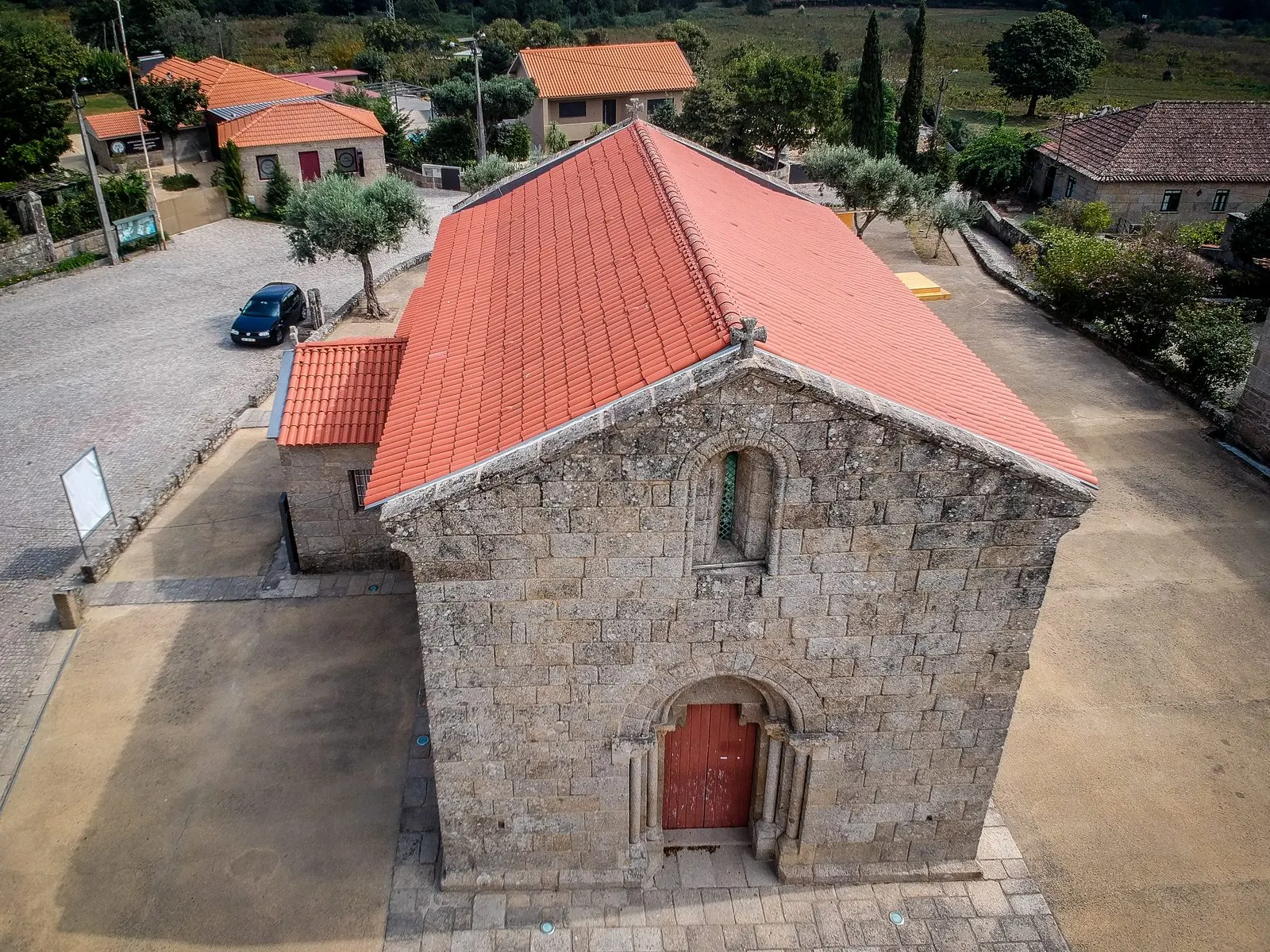
The Church of Gândara, also known as the Church of the Saviour of Cabeça Santa, stands on Largo Padre Carlos Pereira Soares, in the parish of Cabeça Santa, in the municipality of Penafiel. It is a National Monument and one of the monuments of the Rota do Românico. The building is an example of a single-nave Romanesque church with a rectangular apse, but what gives it its interest is the sculpture of the portals and of the triumphal arch, which brings this rural church of the Lower Tâmega close to Cedofeita, in Porto.
Two names for the same church
The Cultural Heritage register, I.P. gives the official designation as «Igreja de Gândara» and lists as other designations Igreja do Salvador de Cabeça Santa and Igreja do Divino Salvador. The Atlas of Classified Heritage also records the variant «Igreja de São Miguel da Gândara», which does not agree with the other sources: the Rota do Românico and the monograph it publishes always give the Saviour as the patron, and the patron’s feast, on the Rota’s page, is that of the Divine Saviour, on 6 August.
According to that monograph, the Inquirições of 1258 already refer to the church as São Salvador da Gândara, a name kept until the 17th century. Only then does the designation Cabeça Santa begin to appear, in reference to a skull kept in a silver reliquary, displayed on an altar in the nave and much sought after by pilgrims, who invoked it against various illnesses and against the bites of rabid dogs. The monograph adds that it was never known to whom the relic had belonged and that, in 1758, it was still kept in the church, though today no material trace of it remains.
A 13th-century church
The register attributes the foundation to Queen Saint Mafalda, daughter of King Sancho I, around the second quarter of the 13th century, and describes the church as a more modest copy of Cedofeita. The Rota do Românico dates it to the first half of the 13th century, and its monograph deduces the early decades of that century from the influences of the Porto Cathedral and of Cedofeita. It also speaks of an original building, since disappeared, from the 10th–11th centuries. These dates result from stylistic comparison, not from an inscription.
The plan is the most common in Portuguese Romanesque: a nave and a rectangular apse, both covered by a timber roof, a solution typical of Entre-Douro-e-Minho. The register notes that the timber roofing contradicts the full vaulting of Cedofeita, and that this has been attributed either to a reduction of the original plan or to a simplification from the start of the work. For the stylistic context, see Romanesque architecture in Portugal and the page on the Church of São Martinho de Cedofeita; the Porto influence seen at Cedofeita is explained, according to the monograph, by contacts between Porto and the French port of La Rochelle.
Portal sculpture
There are three portals. On the main portal, facing west, the tympanum rests on bovid heads, which the Rota interprets as a symbolic protection of the entrance, and the capitals bear confronted birds; on one of them, a recumbent figure is seized by the mouth of an animal, an image of man held captive by sin. The south portal holds the most cited capital, with an acrobat whose body is arched, which the register considers one of the finest sculptural works of northern Romanesque, and another with two dragons with bird-like bodies, practically identical to a capital on the main portal of Cedofeita. The register sees two possible building phases, with artists coming from Cedofeita and then labour of diverse origins, and notes the influence of the bevelled carving of the neighbouring Mosteiro de Paço de Sousa. Inside, the capitals of the triumphal arch repeat models from Cedofeita.
On the south façade there are corbels and a drip-stone that indicate the existence of a single-pitched porch. In the forecourt, on a granite outcrop, there are three rock-cut graves and, leaning against the south wall, three medieval sarcophagi with lids. The register mentions anthropomorphic graves behind the church, predating the 13th-century building.
The Rosary Chapel and the restoration
From the modern period survives the Chapel of Our Lady of the Rosary, on the north side, a rectangular space which in 1758 was the Chapel of the Blessed Sacrament. It combines gilded woodcarving in the national style, mid-17th-century tile panels with a pattern, and a 17th-century image of Our Lady with the Child. The DGEMN intended to demolish it, but kept it as evidence of local building effort. The register describes it as covered in Baroque woodcarving and tiles; on the gilded woodwork, see gilded woodcarving.
The DGEMN restoration took place between 1936 and 1950, with architects Rogério de Azevedo and Joaquim Areal, and sought to restore the original design: it removed the modern altars and the choir and took away the high altar, sent to São Vicente de Irivo. For this reason the interior is now almost bare, and the monograph reminds us that medieval churches were not like this, since they had colour, altars and furnishings. The bell tower was dismantled and rebuilt near the boundary of the forecourt. According to the Rota, the church joined the Rota do Românico of the Vale do Sousa in 1998, conservation works were carried out in 2003–2004 and 2013–2014, and in 2026 work to conserve the gilded woodwork of the side chapel is indicated.
Classification
It is a National Monument under Decree No. 14 425, published in the Diário do Governo, I series, No. 228, of 15 October 1927. The protection zone, with a non aedificandi zone, was set by the Portaria of 6 July 1951 (Diário do Governo, II series, No. 188, of 15 August 1951). The text of the decree is an image scan that we were unable to transcribe. The church is not included in any UNESCO inscription.
Planning a visit
When consulted on 5 November 2026, the Rota do Românico page indicated visits by appointment (telephone +351 255 810 706 and +351 918 116 488; email [email protected]), Mass on Sundays at 8:30, and full or partial accessibility for people with reduced mobility. The page did not indicate a price. These details may change: please confirm them on the official page of the monument before travelling. For the rest of the region, see the page on the North and, on the same route, the Church of São Gens de Boelhe.
Photograph by Vimacopeca, 14 September 2020. Original on Wikimedia Commons, under CC BY-SA 4.0; resized and compressed for the web, without altering the composition.
Frequently asked questions
- Gândara or Cabeça Santa: which is the correct name?
- Both. The official register designates the monument «Igreja de Gândara». The Rota do Românico calls it the Church of the Saviour of Cabeça Santa and explains that in the Inquirições of 1258 the church already appears as São Salvador da Gândara, a name it kept until the 17th century, when it also became known as Cabeça Santa, on account of a skull kept in a silver reliquary.
- Why is this church compared to Cedofeita?
- Because the capitals of the triumphal arch and of the portals are very similar to those of the Church of São Martinho de Cedofeita, in Porto. The Cultural Heritage register notes a capital on the south portal that is almost identical to another on the main portal of Cedofeita, and states that some authors accept that the same artists worked on both churches.
- Is it part of the Rota do Românico?
- Yes. When consulted on 5 November 2026, the Rota do Românico website included the Church of the Saviour of Cabeça Santa among its monuments and indicated visits by appointment.
- What is its classification?
- National Monument, by Decree No. 14 425, published in the Diário do Governo, I series, No. 228, of 15 October 1927. The protection zone was set by the Portaria of 6 July 1951.
Sources
- Património Cultural, I.P. — Igreja de Gândara (70702)
- Património Cultural, I.P. — Atlas do Património Classificado e em Vias de Classificação (NINV 3689)
- Diário do Governo — Decreto n.º 14 425, de 15 de outubro de 1927 (I série, n.º 228)
- Rota do Românico — Church of the Saviour of Cabeça Santa
- Rota do Românico — Igreja do Salvador de Cabeça Santa (monografia)
- Wikidata — Igreja do Salvador de Cabeça Santa (Q10300932)
Keep exploring
Heritage nearby
More places to discover from here. Approximate straight-line distances, within 50 km.