Archaeology
Menhirs of Reguengos de Monsaraz
Menir do Outeiro and Menir da Abelhoa, National Monuments in Monsaraz: dimensions, discovery in the 1960s–70s, the 1971 classification and notes for visiting.
- Location
- Monsaraz, Reguengos de Monsaraz, Évora
- Built
- c. 3500–2000 a.C.
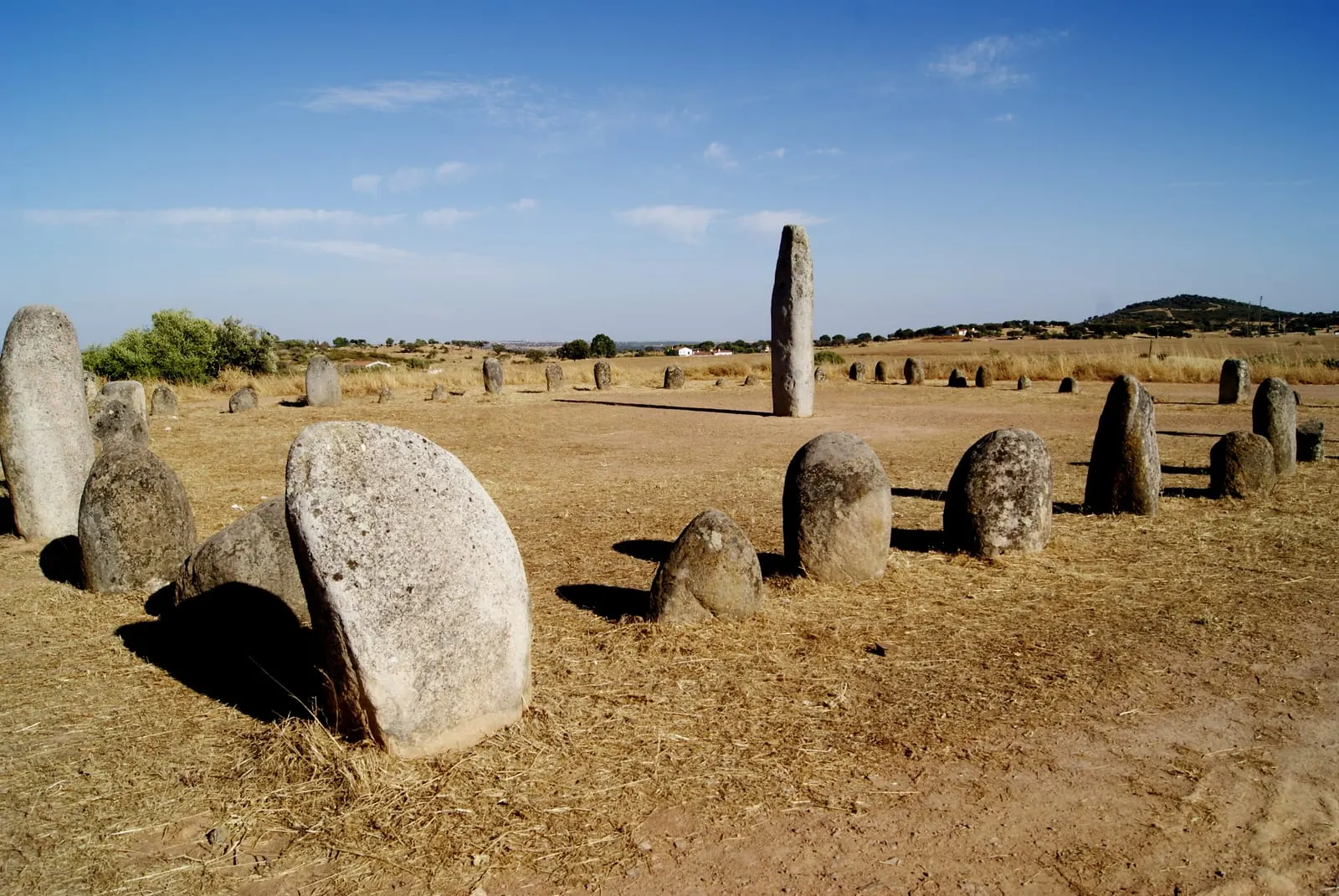
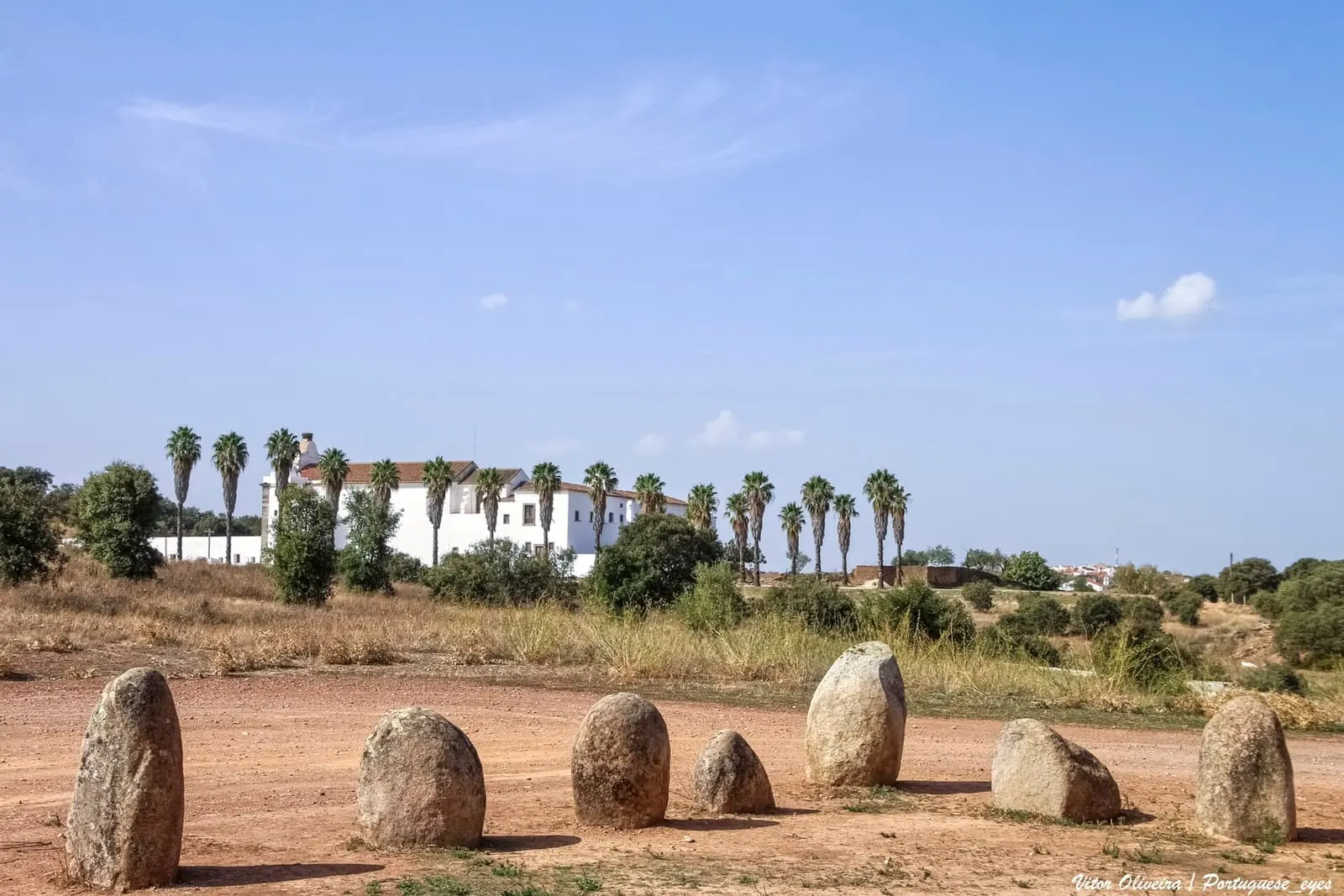
The menhirs of Reguengos de Monsaraz are stones raised in the agricultural landscape a few kilometres from Monsaraz, in Central Alentejo. Two of them, the Menir do Outeiro and the Menir da Abelhoa, are National Monuments, jointly classified by Decree No. 516/71 of 22 November 1971. Both belong to the parish of Monsaraz and form part of the same megalithic group that includes the Xerez cromlech and the complex described in complexo megalítico de Monsaraz.
What a menhir is
A menhir is a monolith fixed vertically in the ground. Unlike the antas, which housed collective burials, these monuments are not funerary. In Reguengos de Monsaraz, several menhirs were identified fallen and re-erected in the second half of the twentieth century, as happened with the two discussed here. The specialist bibliography in the Portal do Arqueólogo includes the studies of José Pires Gonçalves (1970) and Henrique Leonor Pina (1971), which documented these discoveries.
Menir do Outeiro
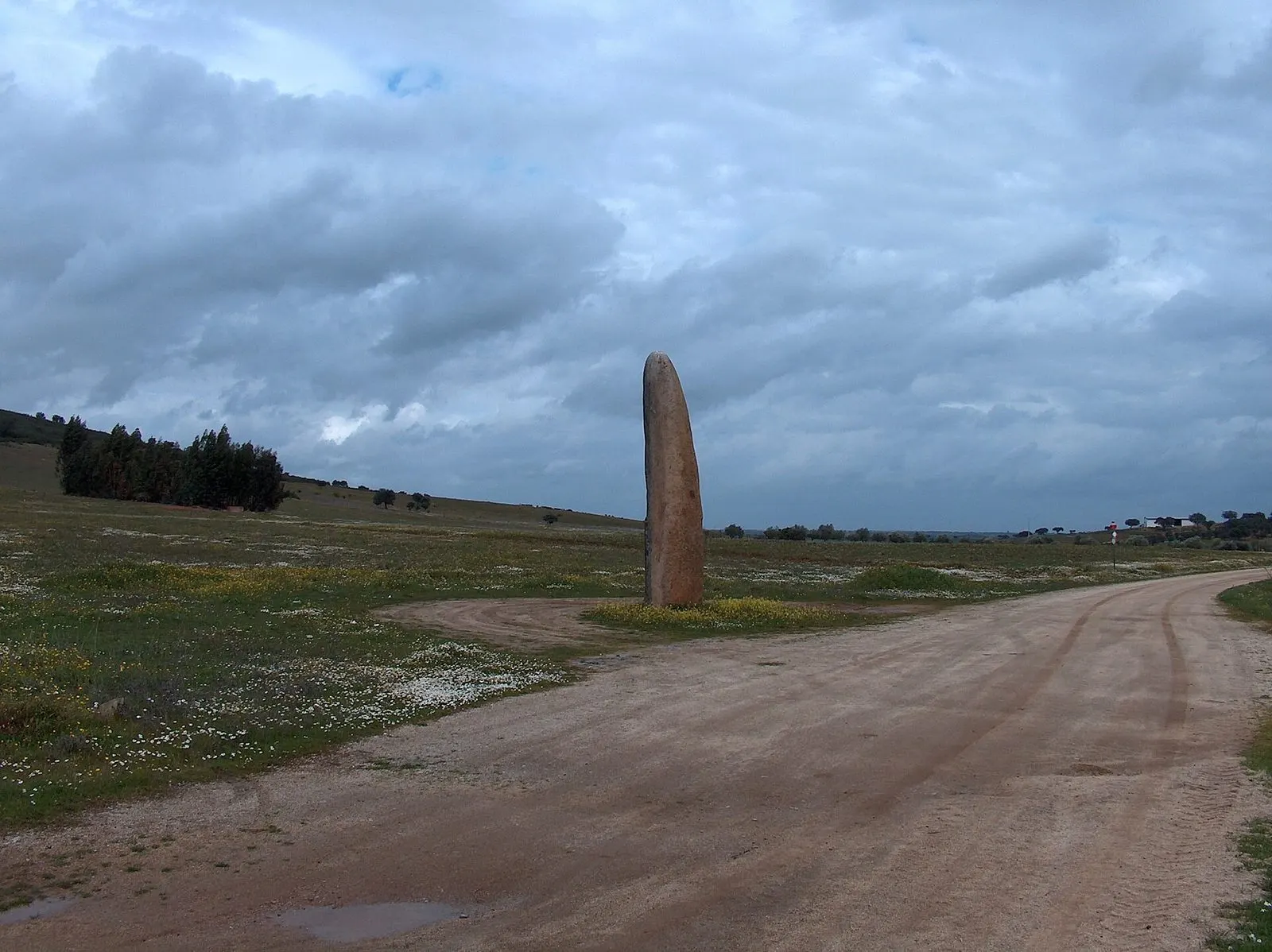
The Menir do Outeiro (also known as Penedo Comprido) stands isolated between the localities of Outeiro and Barrada, north of Monsaraz. The Atlas do Património Cultural identifies it as a classified property, with inventory number 2801, but a physical description could not be consulted in an official source. The dimensions and discovery history that follow come from secondary sources (Wikipedia and the Megalithic Portal, which refer to the article by João Luís Cardoso published in the journal Al-Madan in 2015) and should be read with that caveat.
According to these sources, it is a granite monolith about 5.6 metres high and close to 1 metre in average diameter, elongated in form with a phallic appearance. It is said to have been found fallen in 1969 and re-erected about a year later. The proposed dating, Late Neolithic or Chalcolithic, is based on comparison with other menhirs in the region rather than on excavation of the monument itself.
Menir da Abelhoa
The Menir da Abelhoa, also called Menir da Bulhoa, is described by the Portal do Arqueólogo, the database of Património Cultural, I.P. According to that record, it stands on a levelled area, isolated and prominent, beside the road between the villages of Telheiro and Outeiro, about 4 kilometres from Monsaraz. It is an elongated ovoid granite monolith with a phallic appearance, about 4.0 metres long. It is fractured, and its faces are profusely decorated with radiating solar motifs and wavy, serpentine and zigzag lines.
The record places it in the Late Neolithic and Chalcolithic (3500 to 2000 BC). It was identified lying toppled and fractured by José Pires Gonçalves in 1970 and re-erected that year on a granite base. The same record notes that the monument forms a group with the Menir do Outeiro and the Menir do Monte da Ribeira, which helps to read the three as part of a shared ritual landscape rather than as isolated finds.
Classification
The Atlas do Património Cultural, consulted on 5 November 2026, gives both the status of National Monument, under Decree No. 516/71, published in the Diário do Governo, I Série, No. 274, of 22 November 1971. The Menir do Outeiro has inventory number 2801 and the Abelhoa number 2799. The Portal do Arqueólogo records the Abelhoa’s situation as “in the process of classification, approved as a National Monument”.
In the context of Alentejo megalithism
The menhirs of Monsaraz belong to a broader tradition of Alentejo megalithism, which includes cromlechs such as the Almendres and the already mentioned Xerez, and an engraved art that Portuguese megalithic art seeks to interpret. The difference lies in scale: here the gesture is the isolated stone, visible from a long distance, perhaps linked to routes, pasture or seasonal rituals, although research does not allow us to go beyond hypotheses.
Preparing the visit
Both menhirs are located on rural property and beside tracks. The sources consulted do not give opening hours or access conditions. At the consultation on 5 November 2026, the Portal do Arqueólogo record indicated access to the Menir da Abelhoa between the villages of Telheiro and Outeiro. Before travelling, check the condition of the tracks and access rules with the municipality of Reguengos de Monsaraz, and respect fences and crops. Avoid touching the engraved surfaces.
You can combine the visit with Monsaraz, the Xerez cromlech and the castelo de Monsaraz, all in the same region.
Photograph: João Carvalho, 18 February 2006, Menir do Outeiro.jpg, licence CC BY-SA 3.0, resized and compressed for the web, composition unaltered.
Frequently asked questions
- Which menhirs in Reguengos de Monsaraz are classified?
- The Menir do Outeiro and the Menir da Abelhoa (or Bulhoa), both in the parish of Monsaraz and classified as National Monuments by Decree No. 516/71 of 22 November 1971.
- When were they found?
- According to the Portal do Arqueólogo, the Menir da Abelhoa was identified lying toppled and fractured by José Pires Gonçalves in 1970 and re-erected that same year. Secondary sources place the discovery of the Menir do Outeiro in 1969.
- What period do they date from?
- The Portal do Arqueólogo places the Menir da Abelhoa between 3500 and 2000 BC, in the Late Neolithic and Chalcolithic. The dating of the Menir do Outeiro is based on comparison with other menhirs in the region.
- Are the menhirs part of the Xerez cromlech?
- No. They are independent monuments, but they belong to the same megalithic group of Monsaraz, as referred to by the Portal do Arqueólogo in its record for the Menir da Abelhoa.
Sources
- Património Cultural, I.P. — Atlas do Património Classificado (Menir do Outeiro, NINV 2801)
- Património Cultural, I.P. — Portal do Arqueólogo, Menir da Abelhoa / Bulhoa
- Diário do Governo — Decreto n.º 516/71, de 22 de novembro de 1971
- The Megalithic Portal — Menhir de Outeiro
- Wikipédia — Menhir of Outeiro (apontador para fontes)
Keep exploring
Heritage nearby
More places to discover from here. Approximate straight-line distances, within 50 km.