Archaeology
Xerez Cromlech
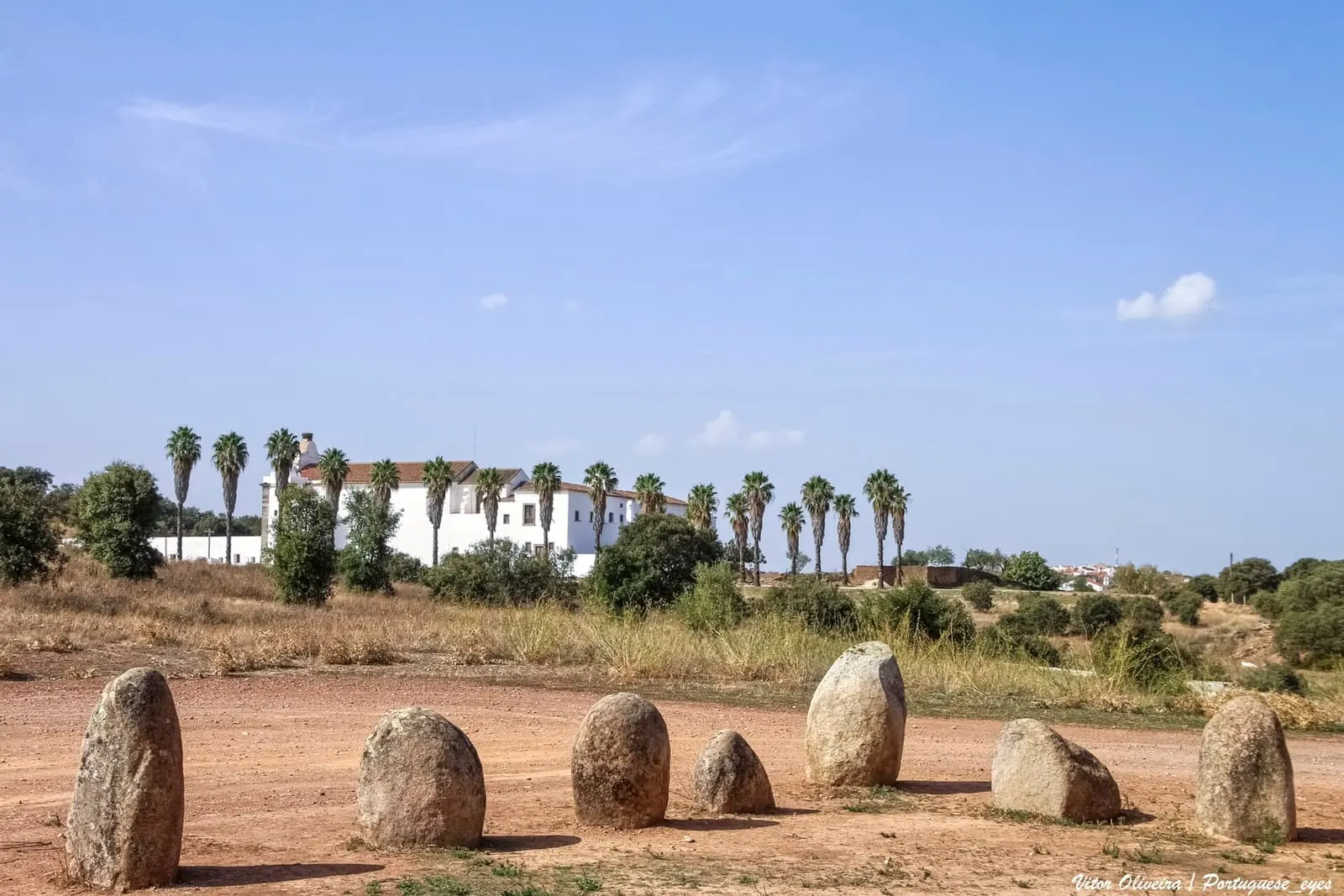
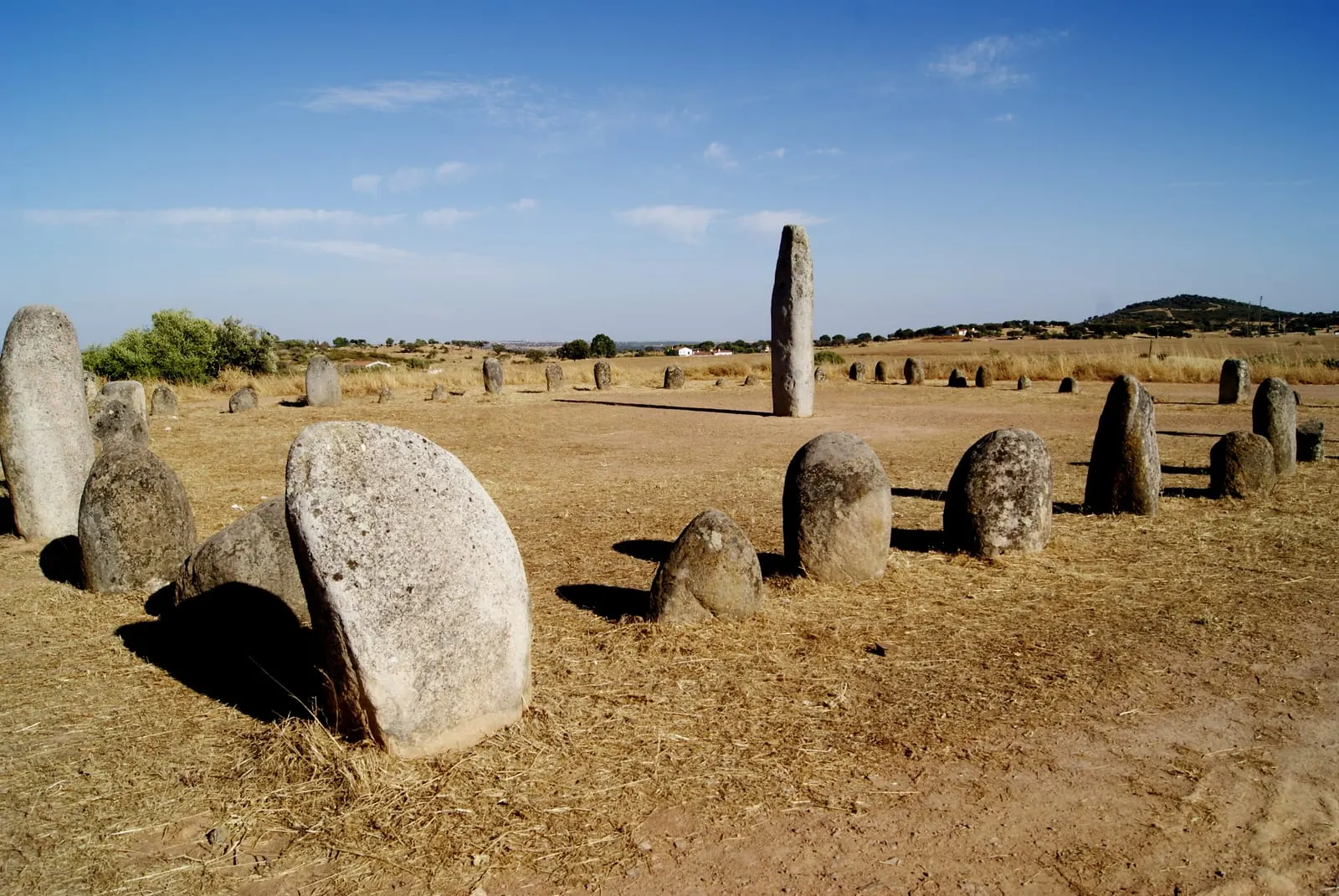
Xerez Cromlech, Monsaraz: a Neolithic enclosure of 55 standing stones and a 3.6 m central menhir, relocated due to Alqueva next to the Convento da Orada.
- Location
- Telheiro, Monsaraz, Évora
- Built
- Neolítico (remodelações no Neolítico final)
The Xerez Cromlech is a Neolithic megalithic enclosure that is no longer where it was built. Erected beside the Guadiana, about 5 km south of Monsaraz, it was dismantled and reinstalled near the Convento da Orada, in the village of Telheiro, because the Alqueva reservoir was going to cover its valley. Visiting it today means seeing a prehistoric monument and also a case of rescue archaeology. The great central menhir and the roughly fifty monoliths surrounding it stand on an open terrace, with Monsaraz on the horizon.
The original site
The national register describes the place of origin: the cromlech stood opposite the Xerez hill, in the centre of a small valley bounded by two watercourses. It was very close to the River Guadiana and about 300 metres from the Xerez de Baixo dolmen. It formed part of a wider megalithic landscape, which can be explored in the Monsaraz megalithic complex.
Discovery and a disputed reconstruction
The cromlech was identified in 1969 by José Pires Gonçalves, a physician and archaeology enthusiast, following a despedrega, that is, the clearing of stones from fields for agriculture. With the exception of the central menhir, the monoliths were found toppled and displaced. Pires Gonçalves excavated the site and rebuilt it in 1972, in the form of a quadrilateral with a central menhir.
The national register warns that this intervention did not follow strictly scientific criteria. The author assumed that the cup-marks engraved on one of the menhirs represented the original arrangement of the group. The sub-quadrangular or rectangular plan visible today is therefore an interpretation, not a proven arrangement. This is why Xerez reads differently from the Almendres Cromlech, with its circular and oval enclosures.
Menhirs and decoration
The municipality of Reguengos de Monsaraz describes 55 monoliths forming the sides of the enclosure and a large central menhir 3.6 metres high. According to the national register, the menhirs are of various local granites. They have very different shapes (ovoid, cylindrical, conical, polyhedral) and lengths between 0.37 and 2.10 metres, most being under 1.20 metres. Many are heavily fractured. Seven menhirs, including the central one, are decorated with cup-marks, crook-shaped motifs (báculos) and circular geometric forms, similar to those at other enclosures in the region.
Chronology
The 1998 excavations recovered highly fragmented materials: flint, schist, quartz and quartzite tools (trapezes, borers, bladelets and flakes), hammerstones, hand querns and fragments of bowls decorated with impressions. On the basis of the architecture, the decorations and these materials, the national register proposes a chronological hypothesis. The earliest construction phases would belong to the Early and Middle Neolithic. The great central menhir would have been placed during a remodelling in the Late Neolithic, and the site would have been reused during the Chalcolithic. For the wider context, see megalithism.
Alqueva and the relocation
The Alqueva dam led to a large programme of heritage impact mitigation in the Guadiana valley. In 1998, within that framework, Mário Varela Gomes excavated the cromlech area. The municipality adds that the site was also subject to geophysical survey before being relocated to its present position beside the Convento da Orada. The Convento da Orada is itself a protected property, recorded in the Atlas as a monument of municipal interest. The coordinates on this page correspond to the current location of the monument, according to the Atlas do Património Cultural, I.P. and Wikidata, and not to the original site, which lay within the area affected by the reservoir.
The materials and the sequence of Xerez therefore come from excavation at the original site. The arrangement seen today results from two successive reconstructions: that of 1972 and the reinstallation.
Protection
The Megalithic Complex of the Herdade do Xerez is a Property of Public Interest under Government Decree No. 1/86, of 3 January 1986. When consulted on 5 November 2026, the Atlas do Património Cultural, I.P. also included the “Cromeleque do Xarez / Xerez” within the Alentejo Megalithism group, pending national-level classification. That procedure was announced by Notice No. 17/2023, and the deadline was extended by one more year by Notice No. 61/2024. The cromlech is not part of any UNESCO inscription.
Planning a visit
The cromlech is outdoors, near the Convento da Orada in Telheiro, a short distance from Monsaraz and its castle. When consulted on 5 November 2026, neither the municipality nor the Património Cultural, I.P. published opening hours or entry conditions for the site. Confirm access with the Município de Reguengos de Monsaraz, by telephone at +351 266 508 040, or on the municipal page for the cromlech. Please respect the enclosure: many menhirs are fractured.
Photograph by Raquel Nunes Rodrigues, 30 July 2016. Original on Wikimedia Commons, under CC BY-SA 4.0; resized and compressed for the web, without altering the composition.
Frequently asked questions
- Where is the Xerez Cromlech today?
- Beside the Convento da Orada, in the village of Telheiro, parish of Monsaraz. It is not the original site: the monument stood about 5 km south of Monsaraz, near the Guadiana, in an area affected by the Alqueva reservoir.
- Why was it moved?
- The rising waters of the Alqueva dam were going to flood the valley where it stood. In 1998, as part of the dam's measures to minimise impacts on heritage, Mário Varela Gomes excavated the area, and the complex was then relocated to its present position.
- How many menhirs does it have?
- The municipality of Reguengos de Monsaraz describes 55 granite monoliths in a roughly quadrangular plan and one large central menhir 3.6 metres high. Seven menhirs, including the central one, are decorated.
- Is it listed?
- Yes. The Megalithic Complex of the Herdade do Xerez is a Property of Public Interest under Decree No. 1/86 of 3 January. When consulted on 5 November 2026, the Atlas do Património Cultural, I.P. also included it in the still-ongoing classification procedure for Alentejo Megalithism.
Sources
- Património Cultural, I.P. — Conjunto megalítico da Herdade do Xerez (69688)
- Património Cultural, I.P. — Atlas do Património Classificado e em Vias de Classificação (NINV 2796 e 75562)
- Diário da República — Decreto do Governo n.º 1/86, de 3 de janeiro
- Diário da República — Anúncio n.º 61/2024 (Megalitismo Alentejano)
- Município de Reguengos de Monsaraz — Cromeleque do Xerez
- Município de Reguengos de Monsaraz — Megalitismo
- Wikidata — Conjunto megalítico da Herdade do Xerez (Q1140864)
Keep exploring
Heritage nearby
More places to discover from here. Approximate straight-line distances, within 50 km.