Monuments
Giela Manor House (Paço da Giela)
Paço da Giela, Arcos de Valdevez: 15th-century Lima manorial tower and Manueline palace, National Monument since 1910, council-owned and open to visitors.
- Location
- Giela, Arcos de Valdevez, Viana do Castelo
- Built
- século XV (torre) e 1508–1527 (paço manuelino)
- Style
- Gótico / Manuelino
The Paço da Giela is a seigniorial complex in Arcos de Valdevez, in the Alto Minho, combining a fifteenth-century granite tower and a palace from the early sixteenth century. Património Cultural considers it one of the most interesting examples of noble rural dwellings from our Middle Ages, the result of two major building phases: a late-medieval one and a Manueline one. It belongs to the municipality and is open to the public.
A tower of the Limas
The origins are obscure. The official record notes that some authors attribute a first construction, still in the fourteenth century, to D. João Domingues, abbot of Sabadim. The present tower dates from the fifteenth century, when the property passed to Fernão Anes de Lima, by grant of D. João I, in 1399. The municipality’s tourism portal places the building of the tower in the mid-fourteenth century; this is a discrepancy that neither the record nor the council resolves.
His son, Leonel de Lima, was appointed Viscount of Vila Nova de Cerveira by D. Afonso V. The record notes that the Lima family was the most important in the Alto Minho during the Avis dynasty, and that they also carried out works on the castle and palace of Ponte de Lima and in Cerveira.
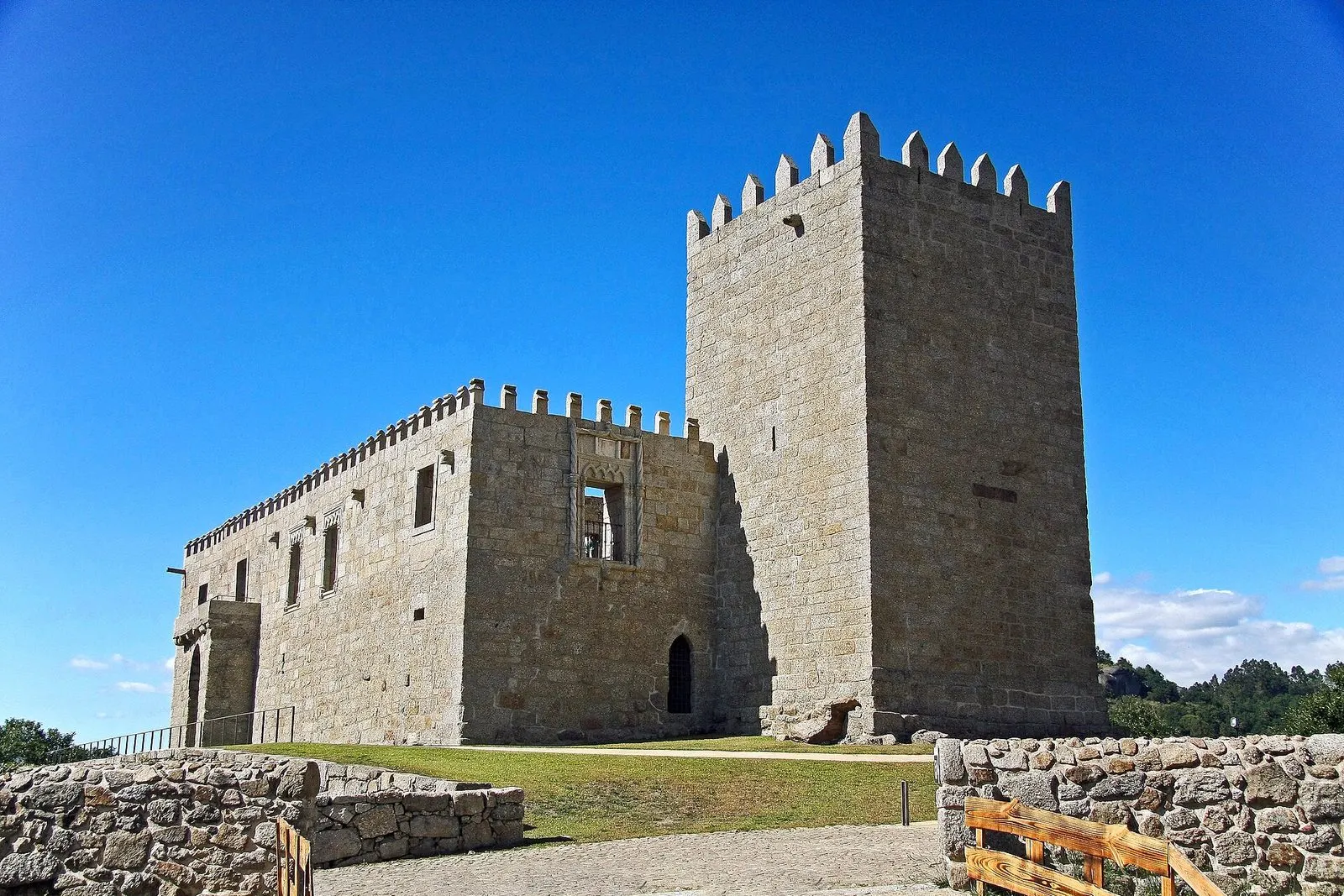
The tower is a fortis domus with a square plan. Its main access is from the east elevation, at the level of the second floor, and it has almost no openings: only a window above the doorway and a slit to the north. Its military solidity, a corbelled balcony and the battlemented top give it the appearance of a keep, which the record links to the intention of making it the head of the territory, facing the former Castelo de Santa Cruz. For this type of building, see seigniorial towers and fortified houses.
The Manueline palace
In the reign of D. Manuel the tower was incorporated into a large palace, but only symbolically: no passage was opened between it and the new residential block. The reform is due to the third viscount, D. Francisco de Lima, and the works date from between 1508 (when he succeeded to the title) and 1527 (when the palace is already mentioned). The block is rectangular, two storeys high, with a larger central hall flanked by two chambers.
The main façade faces west. The pointed-arch doorway bears a Lima coat of arms and is set within a projecting body with a balcony. On the south façade is the most decorated window, with a four-centred pointed arch and a twisted rectangular frame, which the record associates with the principal chamber of the palace. For the style, see Manueline style.
From decline to municipal ownership
The tourism portal of Arcos de Valdevez, which cites no sources, states that the building was completed in 1573, that in 1662 Portuguese artillery damaged it while expelling the Spanish general Pantoja, that there were alterations in the seventeenth and eighteenth centuries, and that from the nineteenth century a decline and abandonment set in. The same source indicates that in 1999 the property was acquired by the municipality.
Classification and visits
The Paço da Giela is a National Monument by decree of 16 June 1910 (Diário do Governo no. 136, of 23 June 1910). The Atlas do Património Classificado lists no special protection zone.
When consulted on 5 November 2026, the municipality’s tourism portal gave opening hours from Tuesday to Sunday, 9:30 to 13:00 and 14:00 to 17:30, with the last visit to the tower up to 30 minutes before closing, and closures on 1 January, Easter Sunday, 1 May, 11 July, 1 November and 25 December. The address is Giela, 4970-155 Arcos de Valdevez; the contact given is telephone 258 520 529 and the email [email protected]. We found no confirmed ticket prices, so please check them with the municipality. For regional context, see the North and Minho granite houses.
Photograph by Vitor Oliveira, dated 21 April 2020. Original on Wikimedia Commons, under CC BY-SA 2.0; resized and compressed for the web, without altering the composition.
Frequently asked questions
- What is the Paço da Giela?
- A seigniorial complex in Arcos de Valdevez formed by a fifteenth-century medieval tower and a palace built during the reign of King Manuel I, between 1508 and 1527, according to the records of Património Cultural. It stood overlooking the town, facing the former Castelo de Santa Cruz.
- Who commissioned it?
- The tower belonged to Fernão Anes de Lima, to whom King João I granted the property in 1399. The Manueline palace is due to D. Francisco de Lima, third Viscount of Vila Nova de Cerveira. Some authors accept an earlier construction in the fourteenth century, linked to D. João Domingues, abbot of Sabadim.
- Is it listed?
- Yes, as a National Monument, by decree of 16 June 1910, published in the Diário do Governo no. 136, of 23 June 1910.
- Can it be visited?
- Yes. When consulted on 5 November 2026, the tourism portal of Arcos de Valdevez listed opening hours from Tuesday to Sunday, 9:30 to 13:00 and 14:00 to 17:30, with closures on six days of the year. The property has belonged to the municipality since 1999.
Sources
- Património Cultural, I.P. — Paço da Giela (registo 70543), cópia arquivada de 2018
- Património Cultural, I.P. — Atlas do Património Classificado: Paço da Giela (NINV 4091)
- Diário do Governo n.º 136, de 23 de junho de 1910
- Turismo de Arcos de Valdevez — Paço de Giela (história, contactos e horário)
- Wikidata — Paço da Giela (Q10347010)
Keep exploring
Heritage nearby
More places to discover from here. Approximate straight-line distances, within 50 km.