Monuments
Pillories of Central Portugal and the Tagus Valley
Explore the National Monument pillories of Figueira da Foz, Alenquer, Colares, Vila Franca de Xira, Alcanede and Cabeço de Vide: dates, restorations, listing.
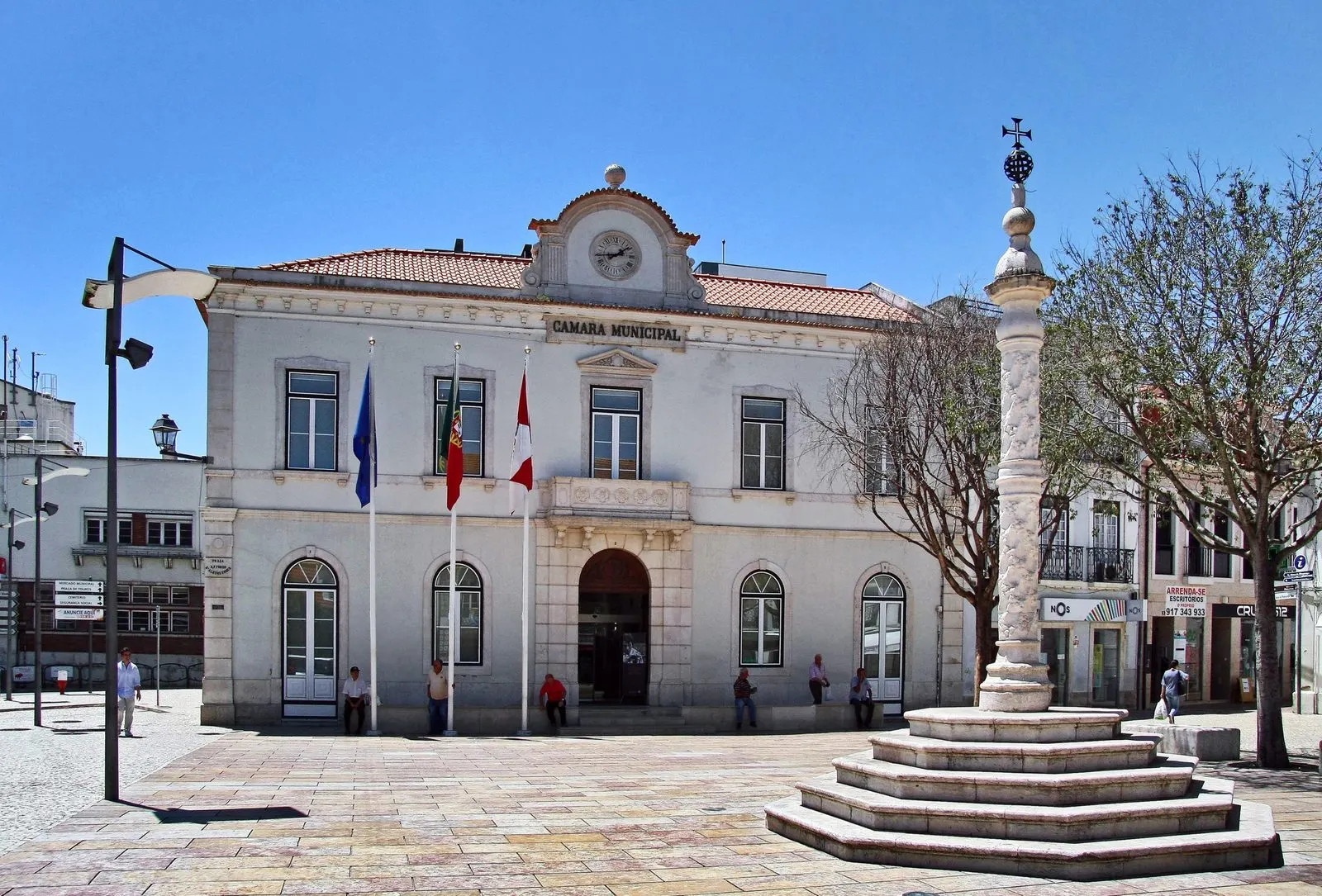
Six pelourinhos from Coimbra, Lisbon, Santarém and Portalegre complete this itinerary of National Monuments: Figueira da Foz, Aldeia Galega da Merceana (Alenquer), Colares (Sintra), Vila Franca de Xira, Alcanede (Santarém) and Cabeço de Vide (Fronteira). All were classified by the decree of 16 June 1910, published in the Diário do Governo No. 136, of 23 June 1910. The group is heterogeneous: there is one Baroque pillory, one from the nineteenth century, two heavily reconstructed and two Manueline examples of more faithful appearance. The function of the typology and its national context are covered on the page about pelourinhos. The descriptions follow the official record of the Património Cultural, I.P.
Figueira da Foz
Figueira da Foz was elevated to the status of town in 1771, and the pillory was erected in 1782, late in relation to the Manueline cycle; the record allows that it may have reinforced municipal authority or replaced a specimen that had since disappeared. It is therefore a Baroque pillory: the column is Solomonic, rests on a convex base and has a composite capital with the national coat of arms on one face. It stood north of the Praça Velha or Praça do Comércio, the oldest square in the town, and in 1932 it was moved about 25 metres to the centre of the present Praça General Freire de Andrade, on five steps. In the same municipality there are also the pillories of Buarcos and Redondos, classified only as Properties of Public Interest.
Aldeia Galega da Merceana (Alenquer)
The first charter of the settlement, then called Montes de Alenquer, is from D. Dinis (1305); the pillory should date from the new Manueline charter of 1513. It stands in the Largo do Pelourinho, in front of the Casa da Rainha or Paço de D. Leonor, today the seat of the parish council, where, according to tradition, Queen D. Leonor, wife of D. João II, spent the night on journeys between Lisbon and the Caldas da Rainha.
The shaft has four smooth colonnettes in a left-hand spiral, interspersed with bands decorated with pomegranates, acorns and vines, and it is divided at its midpoint by an ornamented ring. The capital bears the arms of the former municipality, now much worn, and the crown is an octagonal pine cone with four acanthus leaves. The two-step plinth dates from 1936, the year in which the Câmara replaced some of the stonework, including the original steps. On the municipality, see Alenquer.
Colares (Sintra)
Colares received a charter from D. Afonso III in 1255 and a new charter from D. Manuel in 1516, from which the present pillory was built in the main square of the town. The three-step octagonal platform supports a prismatic base, a cylindrical shaft with a central ring, spirals and rosettes, and a smooth octagonal capital with four acanthus leaves and a spiralled conical finial. The record notes its resemblance to those of Azambuja, Vila Franca de Xira and Alverca and suggests a workshop specialised in the typology.
In 1951 it was in very poor condition, due to cracks caused by the oxidation of the iron elements; the DGEMN restored it in 1952, replacing the very worn stone pieces and the dowels with brass elements, and the Escola Superior de Restauro de Sintra carried out a further intervention in 1997. See Sintra.
Vila Franca de Xira
The Manueline charter dates from 1510, and the royal text itself called for a pillory “of good workmanship, with its steps”. The monument stands in its original location, in the Praça Afonso de Albuquerque, which then faced the river and the embarkation quays, but it has been dismantled several times. Of the sixteenth-century pillory, part of the base and the crown survive, and the shaft, composed of two cylindrical twisted blocks with rosettes between the flutes, joined by a double ring. The urn- or jar-shaped capital, of Baroque type, is the product of restoration, which also recovered fragments and photographs; the armillary sphere and the Order of Christ cross, in wrought iron, came from the former Quinta do Paraíso.
Its history is one of dismantling: during the reign of D. João VI it was taken down to ease the passage of royal carriages, the reassembly was completed in 1804, it was removed in 1891 and replaced by a lamp post, and the present reconstruction dates from 1953–54, when the square was paved.
Alcanede (Santarém)
The pillory of Alcanede, on the Rua Manuel Alves Frazão, was, according to the record, built in 1883, and the capital, with balls, cords and plant motifs, expresses a neo-Manueline taste. It is crowned by a statue of D. Afonso Henriques, made at the same time, in homage to the king who conquered the castle and organised the town. It has a three-step plinth and a prismatic shaft, and it stands in the present historic centre, which does not correspond to the medieval nucleus within the castle. It should be noted that the 1910 decree classified a monument that the record itself dates to 1883, something the official text does not explain. On the municipality, see Santarém.
Cabeço de Vide (Fronteira)
The Manueline charter of Cabeço de Vide dates from 1512, and the simple Manueline character of the pillory points to that period. It stands in the Largo da Cadeia, in front of the former town hall and district gaol, next to what remains of the castle. On three very rustic steps rests a parallelepiped base with two rings, and the smooth octagonal shaft supports the conical capital, with four iron cross-bars ending in serpents and no longer bearing rings. A pine cone crowns it, and a granite armillary sphere was once present. The shields on the capital show the arms of Portugal and those of the municipality. This village belongs to the district of Portalegre and therefore to the Alentejo, not to the Tagus Valley; see Alentejo. The pillory of the town of Fronteira, in the same municipality, is a Property of Public Interest.
What we learn
These six pelourinhos show that “classified” does not mean “intact”: in Vila Franca de Xira and Merceana much of the stone is from restoration, in Alcanede and Figueira the form is later than the sixteenth century, and only Colares and Cabeço de Vide are described as Manueline works little altered. For the national group, see pelourinhos, the Manueline style and the pelourinho of Évora. All six stand in public space, with no visiting hours.
Photograph by Vitor Oliveira from Torres Vedras, PORTUGAL, dated 23 July 2017. Original on Wikimedia Commons, under CC BY-SA 2.0; resized and compressed for the web, without altering the composition.

Frequently asked questions
- Are all of these pelourinhos from the time of D. Manuel I?
- No. The official record dates those of Alenquer (Aldeia Galega da Merceana), Colares, Vila Franca de Xira and Cabeço de Vide to the era of the Manueline charters, but the one in Figueira da Foz was erected in 1782 and the one in Alcanede was built in 1883, in the neo-Manueline style.
- Is the pelourinho of Vila Franca de Xira original?
- Only in part. Of the sixteenth-century monument, part of the base, the shaft and part of the crown survive; the rest results from revivalist interventions, and the present reconstruction dates from 1953–54, after the pelourinho had been removed in 1891.
- Is the pelourinho of Fronteira also a National Monument?
- No. In the municipality of Fronteira, the National Monument is that of Cabeço de Vide, classified in 1910; the pelourinho of the town of Fronteira is classified as a Property of Public Interest by Decree No. 23 122, of 11 October 1933.
Sources
- Património Cultural, I.P. — Pelourinho da Figueira da Foz (70507)
- Património Cultural, I.P. — Pelourinho de Aldeia Galega da Merceana (70505)
- Património Cultural, I.P. — Pelourinho de Colares (69858)
- Património Cultural, I.P. — Pelourinho de Vila Franca de Xira (71112)
- Património Cultural, I.P. — Pelourinho de Alcanede (71108)
- Património Cultural, I.P. — Pelourinho de Cabeço de Vide (71157)
- Património Cultural, I.P. — Atlas do Património Imóvel (serviço ArcGIS, camada 1)
- Diário do Governo n.º 136, de 23 de junho de 1910 — decreto de 16 de junho de 1910