Archaeology
Roman Road XVIII and Classified Milestones
The Geira in Terras de Bouro and the classified milestones: Braga–Porto (Trofa), Braga–Tui (Paredes de Coura and Ponte de Lima) and Lisbon–Mérida (Évora).
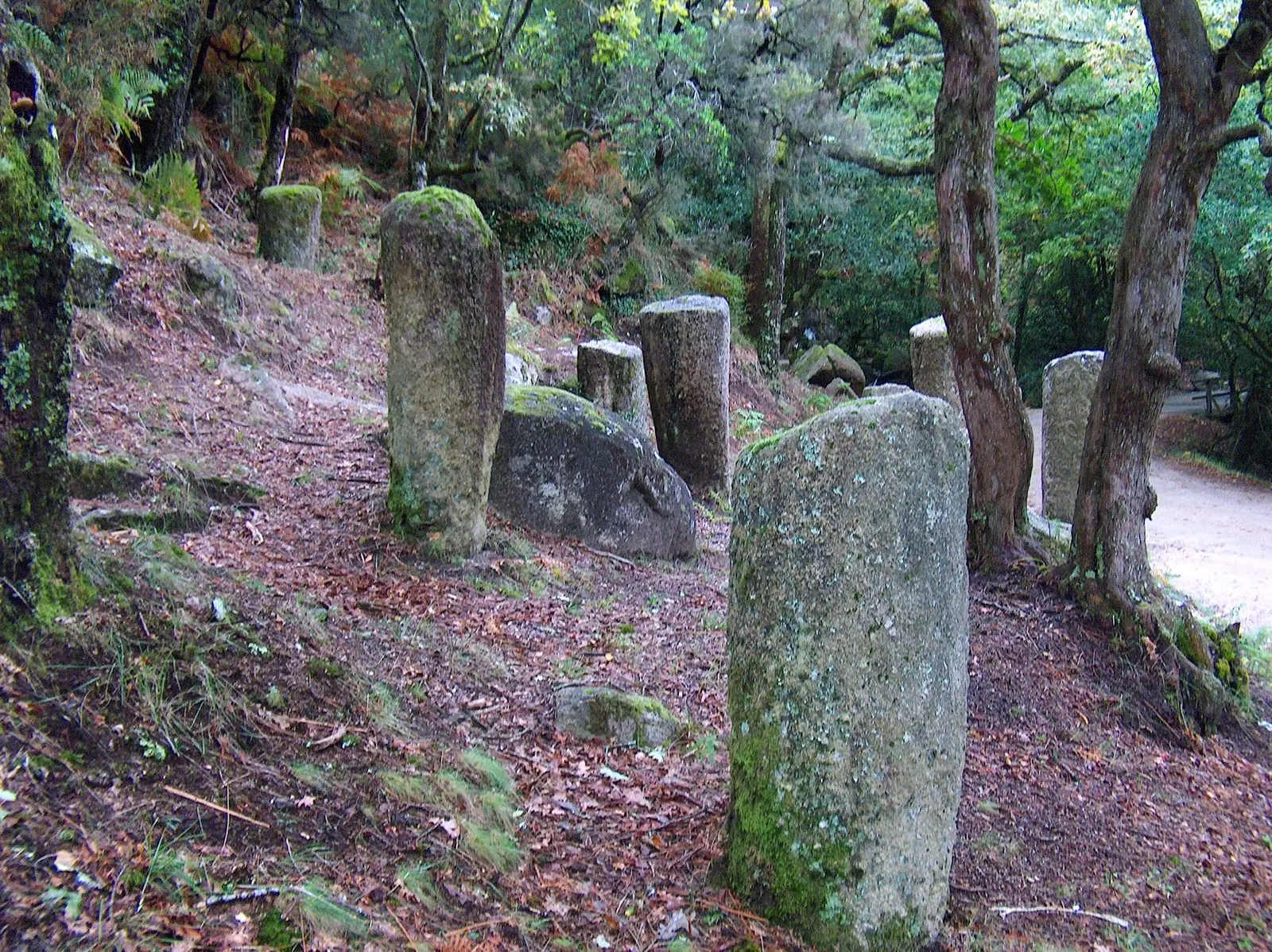
The Roman road network of the Northwest left its most legible record in stone: the milestones, granite columns that counted miles from a city and bore the name of the emperor who ordered the road built or repaired. The State classified them at different moments. This page gathers the National Monument entries that refer to them: the Roman Road XVIII (Geira) in Terras de Bouro, the milestones of the roads from Braga to Porto and from Braga to Tui, and the two milestones of the road from Lisbon to Mérida, in Évora. The general framework of the network is in Roman roads and Roman Portugal.
What the Capela Series is
Several of the entries below carry the expression «Série Capela» in their name. It refers to the inventory of the milestones of the conventus of Braga made by Martins Capela, published in 1895 under the title Miliários do Conventus Bracaraugustano em Portugal, and used by the State when, at the beginning of the twentieth century, it classified groups of milestones. The base classification is the decree of 16 June 1910 (Diário do Governo No. 136, of 23 June 1910), according to the Atlas do Património Cultural. In almost every case, the register groups the milestones under a single entry, without a decree for each stone.
The Geira in Terras de Bouro (Via XVIII)
Road XVIII, called Geira or Via Nova, linked Bracara Augusta (Braga) with Asturica Augusta (Astorga) and appears in the Antonine Itinerary. The construction is attributed to the Flavian period, at the end of the first century; the general text on this network is in Roman roads, which also describes the crossing of the Gerês mountains by the Portela do Homem.
What this page adds is the current protection. Decree No. 5/2013, of 6 May 2013 (Diário da República, 1st series, No. 86), classified as a National Monument the route through Terras de Bouro, from milestone XIV (Santa Cruz) to milestone XXXIV (Albergaria), including all associated archaeological structures. The Atlas lists the parishes covered: Balança, Campo do Gerês, Carvalheira, Chamoin e Vilar, Chorense e Monte, Covide e Ribeira. The summary of the diploma in the Diário da República indicates that the new classification extends the protection of the 35 milestones of the Geira’s Capela Series, already classified in 1910; the file for the photograph illustrating this page, on Wikimedia Commons, also uses the description «35 marcos miliários, série Capela». The route covered twenty Roman miles, an extension that popular sources give as about 30 km.
Braga to Porto: eight milestones at Trofa
The entry Roman road from Braga to Porto (8 milestones, Capela Series) has the NINV 3635 and the municipality of Trofa. Two locations are named in the Atlas: the milestone of the Quinta do Paiço, in Alvarelhos, and the milestone at the former Trofa station, in Bougado (São Martinho and Santiago). The latter is therefore not an independent monument: it is one of the eight. The remaining locations are not identified in the Atlas. Trofa also has a classified hillfort, in Alvarelhos, where there is an interpretive trail; see classified hillforts of the North.
Braga to Tui: fourteen milestones in two municipalities
The entry Roman road from Braga to Tui (14 milestones, Capela Series) (NINV 4196 in Ponte de Lima and 4147 in Paredes de Coura) is the most dispersed. In the Atlas, the milestones appear by location:
- in Ponte de Lima: three records at Faldejães (parish of Arcozelo), one at Arcozelo and one at Bertiandos;
- in Paredes de Coura: six at the Chapel of São Bartolomeu das Antas, one at the Church of São Pedro de Rubiães (designated «Marco de Caracala»), and those of Barreiros, Fonte de Olho and Quinta do Crasto.
The Atlas represents fifteen milestone locations, more than the fourteen in the title; we could not reconcile the numbers, and a single stone or fragment may be counted in different ways. The Faldejães milestone, which is sometimes treated as an independent monument, is, in this register, part of the Braga–Tui series. On Ponte de Lima, see the town and, on the city of departure, Braga.
Lisbon to Mérida: two milestones in Évora
The entry Roman road from Lisbon to Mérida (2 milestones) (NINV 2753) is located in Évora, in the parishes of Malagueira and Horta das Figueiras, with the alternative designation Milestone of the Quinta da Manizola. It was classified by the same decree of 1910. Mérida (Emerita Augusta) was the capital of the province of Lusitania; for the south of the country, see the city of Évora and Roman archaeology.
Outside this group
The Atlas records other classified milestones in the North, such as those of Montalegre (Cantina de Leiranque and Ponte do Arco) and of Virandelo, in Valpaços. They are not part of this page.
Seeing the milestones
Some stand in churchyards, beside chapels, along roads or on private property. When consulted on 5 November 2026, we found no official publication of opening hours or a single itinerary for these entries. For the Geira, the Terras de Bouro municipality page is the starting point; in the other municipalities, ask the council before going. The inscriptions are fragile: do not clean or move the stones.
Photograph by Sqjaques. Original on Wikimedia Commons, under CC BY-SA 4.0; resized and compressed for the web, without altering the composition.

Frequently asked questions
- What is the Capela Series?
- It is the designation given to a group of milestones of the former conventus of Braga inventoried by Martins Capela, whose work on the milestones of the Conventus Bracaraugustano in Portugal dates from 1895. Official records use the term for several groups classified in 1910.
- Which section of the Geira is classified in Terras de Bouro?
- Decree No. 5/2013, of 6 May 2013, classified as a National Monument the route of Roman Road XVIII through Terras de Bouro, from milestone XIV (Santa Cruz) to milestone XXXIV (Albergaria), including all associated archaeological structures.
- Are the Faldejães and Trofa station milestones separate monuments?
- In the national register, no. The Faldejães milestone is part of the entry Roman road from Braga to Tui (14 milestones, Capela Series), and the milestone at the former Trofa station is part of the entry Roman road from Braga to Porto (8 milestones, Capela Series).
- Can I see these milestones?
- Many stand outdoors, beside roads, churchyards and paths, but we found no official information on access or opening times. Confirm with the relevant municipality and do not remove or move the stones.
Sources
- Património Cultural, I.P. — Atlas do Património Imóvel, camada PatrimonioImovel (NINV 11248, 3635, 4196, 4147, 2753)
- Diário da República — Decreto n.º 5/2013, de 6 de maio (Via Romana XVIII, Terras de Bouro)
- Diário da República — Decreto de 16 de junho de 1910 (DG n.º 136, de 23-06-1910)
- Wikimedia Commons — Geira Romana, Gerês (descrição do ficheiro: 35 marcos miliários, série Capela)
- Wikipédia — Via XVIII (ponteiro para Itinerário de Antonino, Lemos 1995 e 2002)
- Wikipédia — Roman Milestones of Braga (ponteiro para Capela, Miliários do Conventus Bracaraugustanos em Portugal, Porto, 1895)
- Município de Terras de Bouro — Via XVIII / Geira