Archaeology
Classified Castros of the North and Centre
Nine castros classified as National Monuments: Sacóias, Alvarelhos, Ázere, São Caetano, Arados, Bom Sucesso, Tintinolho, Aldeia Nova and Monte Redondo.
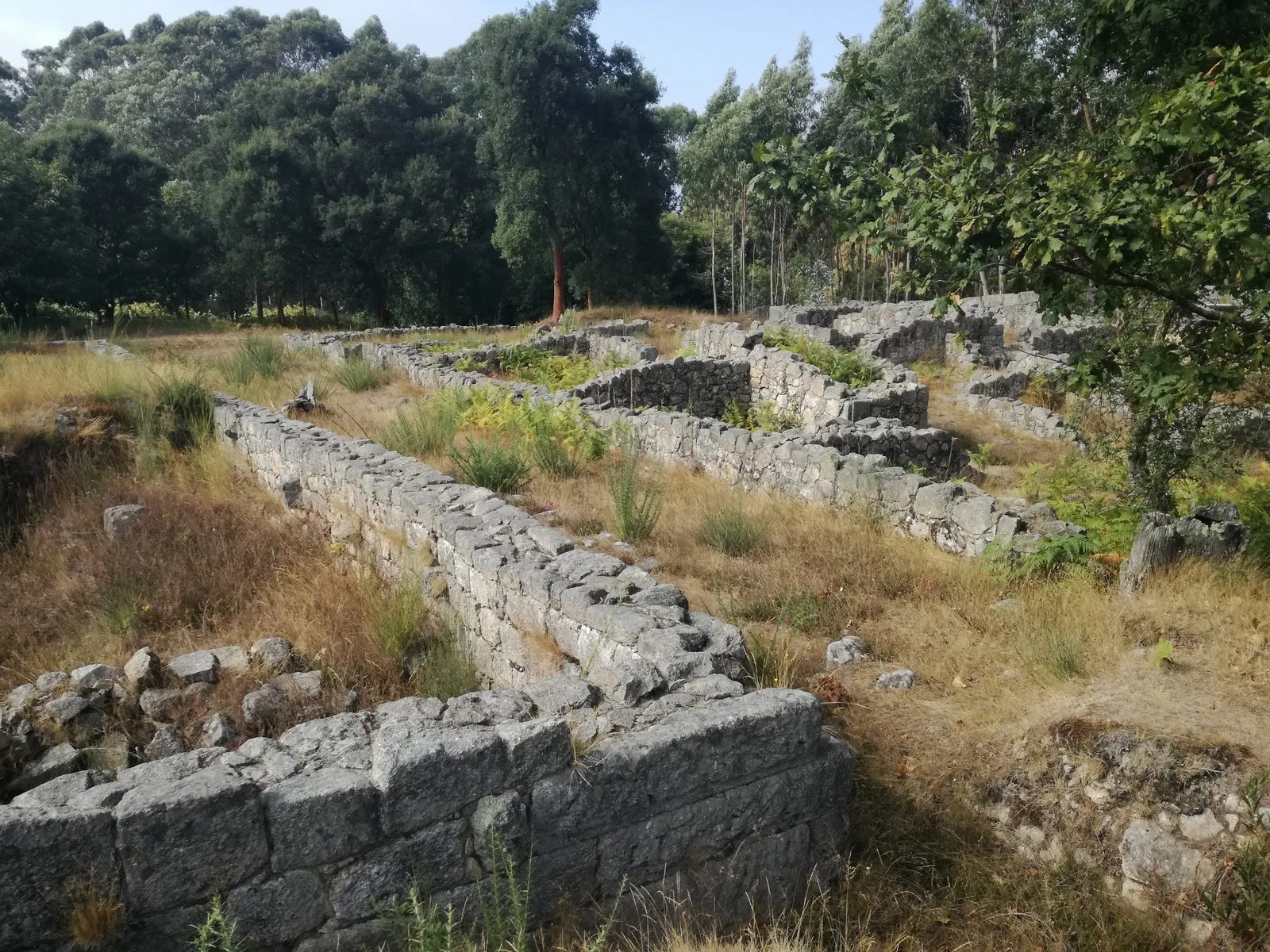
Nine of the castros classified as National Monuments in mainland Portugal lie in municipalities as different as Bragança, Monção, Trofa, Guarda and Mangualde. They share a form (fortified settlements on hilltops, with walls and stone houses) and the fact that the publicly accessible documentation is, for most, very brief. This page brings them together, states what the consulted sources allow us to affirm, and notes what remains to be confirmed. For general context, read the castro culture and the Iron Age; for a excavated castro that can be visited, with more detail, see the Citânia de Sabroso.
The classification data come from the Atlas do Património Cultural, consulted on 5 November 2026. The descriptive text of the inventory (SIPA) was not legible on that date; therefore, where the site is described, the source is indicated.
Castro de Alvarelhos (Trofa)
At Alvarelhos, on the Serra de Santa Eufémia, is the castro with the most complete information. The Atlas gives the NINV 3782 and the alternative designation Castro de São Marçal; it has been classified since 1910. The municipality describes a site with traces of several occupations, from the Late Bronze Age to the Middle Ages. According to the consulted summary, the Iron Age phase is known by the name castellvm madiae, the castro of the madequisenses, a people documented from the 2nd century BC; the Roman period, along the Cale–Bracara road, was the most decisive for the organisation of the settlement; and, from the mid-5th century, the urban core was apparently abandoned. On Monte de São Marçal there are also traces of a small fortification (9th–12th centuries) and of a church with a cemetery (from the mid-12th to the 16th century).
It is also the only one in the group for which the municipality publishes an interpretive trail with free visiting and free entry. The same parish preserves Roman milestones: see the Roman Road XVIII and the classified milestones.
Castro de Sacóias (Bragança)
In the parish of Baçal (NINV 2351), on an isolated hilltop above the chapel of Nossa Senhora da Assunção. The inventory summary, reproduced on Wikipedia, describes a fortified settlement with small walls of rubble stone, probably from the Iron Age, reoccupied in the Roman period, with fragments of tile, brick and millstones. The same summary records its poor state of conservation and that the material collected by the Sociedade Martins Sarmento is held in the Museu do Abade de Baçal. We found no accessible excavation report. For context, see Bragança.
Castro de São Caetano (Monção)
In the locality of Outeiro, parish of Longos Vales (NINV 4134). It is one of the few whose official designation already describes the structure: “covering the perimeters of the three walls”. It was classified by Decree no. 735/74 of 21 December 1974, not in 1910. The inventory places it in the Iron Age, with occupation continuing into the period of the Roman conquest and abandonment at the end of the 1st century. An archaeological project in Longos Vales, begun in 2014, reportedly included excavations at this castro, which indicates recent work, but we did not obtain the report.
Castro de Monte Redondo (Braga)
Also known as Castro Monte Cossourado or Castro de São Mamede, in Guisande and Oliveira (São Pedro), NINV 2209. It is the one in the group with the clearest research history: the inventory refers to a partial excavation in 1899 and 1900, led by Albano Belino, with three lines of walls (the first with a perimeter of 1050 m), circular and some rectangular houses, brooches, amber beads, a small stone axe, Roman coins, fragments of tile and a votive altar, now in the Sociedade Martins Sarmento, in Guimarães. The works stopped for lack of agreement with the landowners. The inventory tentatively proposes an origin between the 10th and 9th centuries BC and records the state of abandonment.
Castro dos Arados (Marco de Canaveses)
Also called Alto de Santiago or Monte do Ladário, in the parish of Alpendorada, Várzea e Torrão (NINV 3641). The municipality’s heritage record mentions an acropolis, a second platform and a stretch of wall, at about 480 m altitude. The Rota do Românico describes the viewpoint of Alto de Santiago, about 500 m from the Estrada Nacional 210, with traces of walls and houses from the castro period. We did not obtain a chronology or a history of excavations.
Castro do Bom Sucesso (Mangualde)
In Tavares (Chãs, Várzea e Travanca), NINV 4072. It is the only one classified later, by Decree no. 67/97 of 31 December 1997. According to the consulted summary, the inventory describes it as a settlement spanning the Bronze and Iron Ages. We found no further reliable public information.
Castro de Tintinolho (Guarda)
In the parishes of Alvendre, Cavadoude and Faia (NINV 2957). The Atlas confirms the 1910 classification, but the field for the decree is empty in this record. Popular descriptions speak of an Iron Age settlement on a hilltop, with no reference to excavations. It is the weakest case in the group: for regional context, see Guarda.
Castro de Ázere (Arcos de Valdevez)
In Ázere (NINV 4084), classified in 1910. We only confirmed the official record; popular sources suggest occupation from the 8th century BC, but without support from a study we could read. It is therefore left undated on this page.
Castro de Aldeia Nova (Miranda do Douro)
In Miranda do Douro (NINV 2396), classified in 1910. Wikipedia describes it only as an Iron Age castro. There is an identification uncertainty: the photographs and the Mirandese-language link associated with the article refer to the Castro de São João das Arribas, without explaining whether this is the same site. We do not assert it. See Miranda do Douro.
How to read the group
Four of these castros (Sacóias, Ázere, Tintinolho and Aldeia Nova) have, in the sources we could read, nothing more than the classification record. The 1910 classification covered sites excavated in the late 19th and early 20th centuries, but this does not mean that structures are visible today or that organised visits exist. By comparison, Briteiros and Santa Luzia have trails and interpretation, and the Citânia de Sabroso has modern excavations. The general typology is covered in Portuguese archaeology.
If you intend to visit, always confirm with the municipality the access, the ownership of the land and the condition of the route. When consulted on 5 November 2026, Trofa was the only municipality with a published interpretive trail for its castro.
Photograph by Cyberlima785, dated 24 August 2017. Original on Wikimedia Commons, under CC BY-SA 4.0; resized and compressed for the web, without altering the composition.

Frequently asked questions
- Which castros are covered on this page, and where are they?
- Sacóias (Bragança), Alvarelhos (Trofa), Ázere (Arcos de Valdevez), São Caetano (Monção), Arados (Marco de Canaveses), Bom Sucesso (Mangualde), Tintinolho (Guarda), Aldeia Nova (Miranda do Douro) and Monte Redondo (Braga). All are listed in the Atlas do Património Cultural as National Monuments.
- When were they classified?
- Seven of them by decree of 16 June 1910 (Diário do Governo no. 136, 23 June 1910). The Castro de São Caetano was classified by Decree no. 735/74 of 21 December 1974, and the Castro do Bom Sucesso by Decree no. 67/97 of 31 December 1997.
- Can I visit all of them?
- There is no single rule. When consulted on 5 November 2026, only Alvarelhos had a published free-access interpretive trail, issued by the Trofa municipality. For the others we found no official access information; confirm with the municipality and respect private property.
- Are they all from the Iron Age?
- Not necessarily. Alvarelhos was occupied from the Late Bronze Age to the Middle Ages, and Bom Sucesso is described as a settlement spanning the Bronze and Iron Ages. For several of the others, the sources consulted only allow us to say that they are protohistoric fortified settlements.
Sources
- Património Cultural, I.P. — Atlas do Património Imóvel, camada PatrimonioImovel (NINV 2351, 3782, 4084, 4134, 3641, 4072, 2957, 2396, 2209)
- Município da Trofa / iPorto — Castro de Alvarelhos
- Rota do Românico — Miradouro do Alto de Santiago
- Município de Marco de Canaveses — Fichas de património 2015, Alpendorada, Várzea e Torrão
- Wikipédia — Castro de Sacóias (ponteiro para o SIPA IPA.00000552)
- Wikipédia — Castro de Monte Redondo (ponteiro para o SIPA 1923 e para O Arqueólogo Português, 1909)
- Wikipédia — Castro de São Caetano (ponteiro para o SIPA 3610)
- Wikipédia — Castro do Bom Sucesso (ponteiro para o SIPA 4797)
- Wikipédia — Castro de Aldeia Nova (ponteiro para o SIPA 545)
- Wikipédia — Castro de Alvarelhos (ponteiro para o SIPA 3811)
- Wikidata — Castro de Alvarelhos (Q17390115)