Places
Schist Villages of Serra do Açor
Guide to the five Schist Villages of Serra do Açor: Aldeia das Dez, Benfeita, Fajão, Sobral de São Miguel and Vila Cova de Alva, plus history and tips.
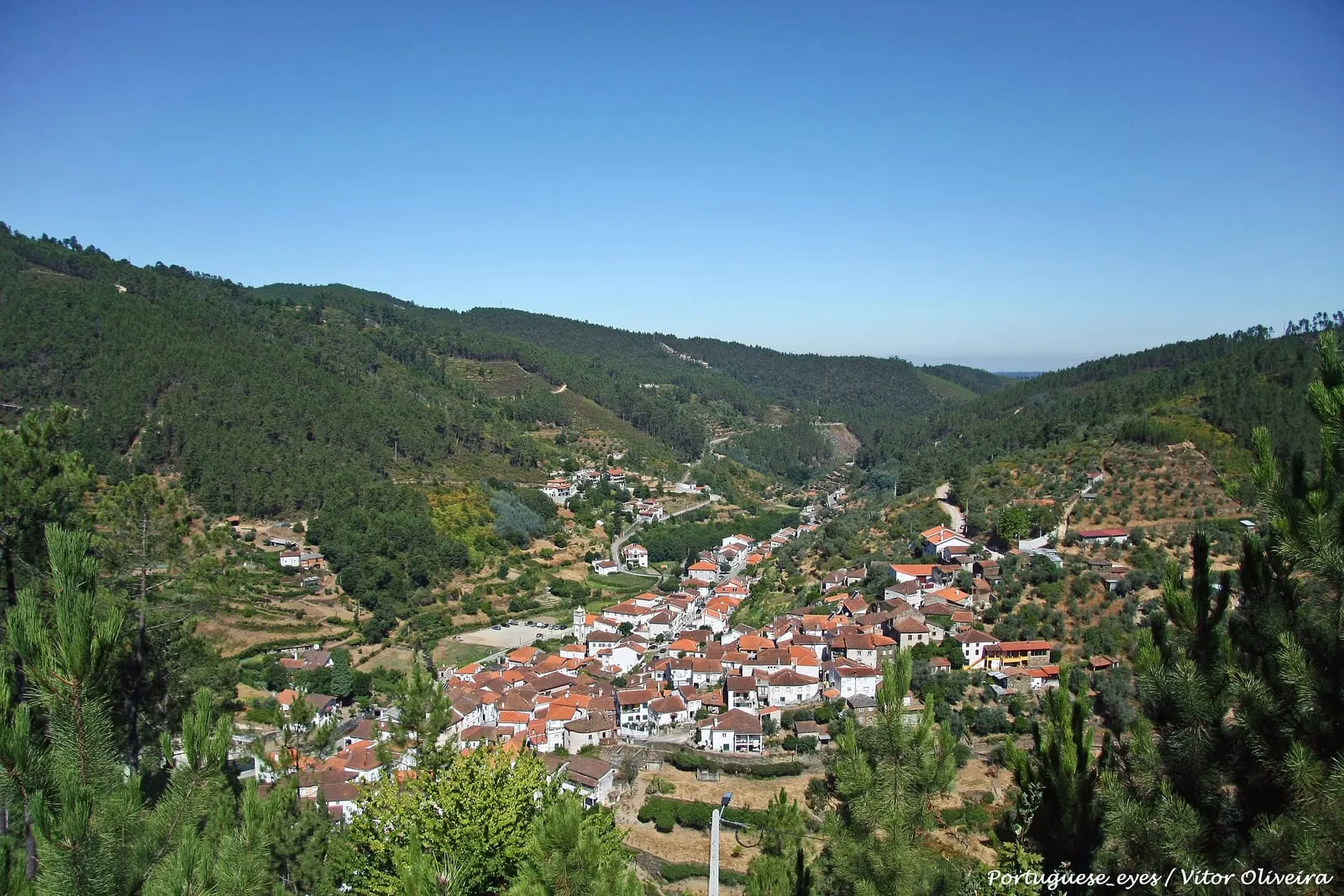
The Serra do Açor territory is one of the four units into which the network of Schist Villages is organised. According to the official portal consulted on 5 November 2026, it comprised five villages spread across four municipalities: Aldeia das Dez (Oliveira do Hospital), Benfeita and Vila Cova de Alva (Arganil), Fajão (Pampilhosa da Serra) and Sobral de São Miguel (Covilhã). They are linked to the valleys of the Alva, the Alvôco, the Ceira and streams flowing down to the Zêzere, and they differ greatly in stone, scale and history.
This guide presents each village based on the official network records and the national register of classified heritage. Membership of the network is a tourism development choice, not a heritage classification: legal protection applies to specific buildings, indicated below where they exist.
Aldeia das Dez: a granite village facing the schist
Aldeia das Dez, in the municipality of Oliveira do Hospital, lies on the northern slope of the Colcurinho, at about 500 metres altitude, above the Alvôco river. The official record itself sums up the paradox: it is a village built predominantly of granite, from which the schist ranges can be seen. Traces of a castro and a stretch of Roman paving about 3 km away, on the road to Avô, attest to the antiquity of the settlement.
The bishop of Coimbra made it independent of Avô in 1543; it was again annexed in 1594 and regained its autonomy in 1602/1603. In the 19th century the village had two or three match factories (about 50 workers in 1890), an activity that ended with the monopoly granted in 1895 to the Companhia Portuguesa de Fósforos. Rua dos Entalhadores and Rua dos Douradores recall another craft: that of gilded woodcarving, visible in the 18th-century Igreja Matriz. Also noteworthy are the Casa do S (or Casa da Voluta), from the 17th century, the Solar Pina Ferraz, the Church of Santa Maria Madalena (1758), the Cruzeiro do Largo da Fonte (1661) and the Santuário de Nossa Senhora das Preces.
Benfeita: the Torre da Paz between two streams
Benfeita, in the municipality of Arganil, arose at the point where the Carcavão stream meets the Mata stream. A document of October 1196, held at the Torre do Tombo, records the sale of half of the villa Bienfecta; a foral charter of 17 May 1300 set the rules for its settlers. The 1527 land register recorded 18 residents here. The road to Côja, begun in 1931, reduced a journey that had previously been made on foot, and taking more than two and a half hours, to 15 minutes.
It is one of the network’s villages where the houses are mostly white. Its most distinctive feature is the Torre da Paz, built of schist masonry, whose bell marks the end of the Second World War with 1620 strokes every year on 7 May. The tower was classified as a Monument of Municipal Interest by Edital no. 1294/2026/2, published in the Diário da República on 13 October 2026. Also worth attention are the Ponte Fundeira, rebuilt in stone in 1880, the walkways beneath the houses in the lower part, the Capela de Santa Rita (octagonal plan, 18th century), the Figueiral mill and the Casa Simões Dias, where the teacher and poet José Simões Dias was born in 1844.
The official record places Benfeita next to the Serra do Açor Protected Landscape, close to the Mata da Margaraça — which it describes as a Natural Reserve and a Council of Europe Biogenetic Reserve, with cork oaks, chestnuts, hazels, wild cherries and walnuts — and the Fraga da Pena, with its waterfalls. The Caminho do Xisto da Benfeita links the village to these places.
Fajão: an old town among quartzite boulders
Fajão, in the municipality of Pampilhosa da Serra, lies on the left bank of the Ceira river, near its source, beside the Penedos de Fajão rock formations. In 1233, the prior of the monastery of São Pedro de Folques granted a foral to its settlers; the municipality was demarcated in 1602, with parishes such as Janeiro de Baixo, and abolished on 24 October 1855.
The schist houses, sometimes dark and sometimes ochre, with some quartzite, descend through alleys with ramps and steps to the forecourt of the Igreja Matriz de Nossa Senhora da Assunção, built in 1788–1789. The former Casa da Câmara, Tribunal e Cadeia keeps its layout but has been heavily altered and now operates as accommodation. Three houses on Rua da Liga de Melhoramentos bear dates carved into them (1825, 1869 and 1881). The Museu Monsenhor Nunes Pereira holds woodcuts by the priest who collected and published the 24 Contos de Fajão in 1989. The requalification of the village began in September 2003. Fajão also hosts the Geoscope, with a dome and kiosk for stargazing.
Sobral de São Miguel: the “heart of the schist”
Sobral de São Miguel, in the municipality of Covilhã, occupies the northeastern flank of the range, mainly on the left bank of the Porsim stream, which flows into the Zêzere. It is mentioned for the first time in the Inquirições of D. Dinis, in a document of 1284. The parish separated from Casegas in 1888, under the name Sobral de Casegas, and adopted its current name in 1970. In the 1930s and 1940s, demand for wolfram linked to the Panasqueira Mines shaped the local economy; the Capela de Santa Bárbara was raised by the miners.
Inhabitants call it the “heart of the schist”, and the official record considers it one of the largest clusters of schist buildings in the country, although most are rendered and painted white. In the old core, the houses climb the slope in a staircase pattern, with streets running parallel to the stream linked by narrow lanes. Places to see include the Ponte do Caratão, the Fonte do Caratão (1900), the Casa Museu João dos Santos, the olive press, the mill, the communal ovens, the threshing floor cut into schist outcrop and the horse-shoeing trunk. There are two schist quarries in the vicinity.
Vila Cova de Alva: convent, manor houses and a sixteenth-century street
Vila Cova de Alva, also in Arganil, stretches along the left bank of the Alva river, at the northern edge of the range. The official record presents it as the Schist Village with the largest monumental ensemble. Here schist is the dominant material, but granite marks doors and windows, and one street preserves sixteenth-century Manueline mouldings. It received a foral from the bishop of Coimbra, D. Estêvão Anes Brochardo (1304–1318), confirmed in 1471; the municipality was abolished in 1836. Until 1924 it was called Vila Cova de Sub-Avô.
The Convento de Santo António, from the early 18th century, was built with timber from the Mata da Margaraça donated in 1713 by the bishop of Coimbra. French troops looted it in 1811. The national register classifies it as a Monument of Public Interest (Portaria no. 885/2013, of 11 December). The Igreja Matriz holds the same category (Portaria no. 257/2011, of 27 January), and the pillory has been a Property of Public Interest since Decree no. 23 122, of 11 October 1933 (see pillories). Beside the square there are also the Solar dos Condes da Guarda, the Solar Abreu Mesquita, the Casa da Praça (former Casa da Câmara, early 17th century) and the Ermida de São João de Alqueidão.
Piódão and the other networks
The Piódão also lies in Serra do Açor, in the municipality of Arganil, but it does not belong to the Schist Villages: it is one of the twelve Historic Villages of Portugal. The two networks are distinct projects, with their own selection and management. In practice, Piódão can be combined with Benfeita or Fajão: the official record for Fajão itself indicates, on the EN344, the junction for Piódão. The thirteen villages of Serra da Lousã are described in Schist Villages of Serra da Lousã, and those of the Zêzere valley in Schist Villages of the Zêzere. To place the materials and building techniques in context, see schist houses.
Planning the visit
The five villages are far apart from one another and linked by mountain roads. Vila Cova de Alva, Benfeita and Aldeia das Dez lie on the northern side, close to the Alva and Alvôco valleys; Fajão and Sobral de São Miguel, more isolated, deserve a day of their own. As of the consultation on 5 November 2026, the official records listed signposted walking routes: the Caminhos do Xisto of Benfeita, of Aldeia das Dez (PR1, PR2 and PR3 OHP), of Fajão (PR1 PPS, climb to the Penedos) and of Sobral de São Miguel (PR1 CVL).
In the same consultation, the network’s agenda announced for Sobral de São Miguel the Xisfungos (28 November 2026) and the «Sobral Aldeia Presépio», with a date given as 15 December 2026. Confirm dates, opening hours for the Fajão museum and the Geoscope, and trail conditions on the official village records or with the municipalities. Several of the buildings mentioned are private homes, with no access to the interior.
Photograph by Vitor Oliveira, 24 August 2016. Original on Wikimedia Commons, under CC BY-SA 2.0; resized and compressed for the web, without altering the composition.

Frequently asked questions
- What are the Schist Villages of Serra do Açor?
- According to the official portal consulted on 5 November 2026, the Serra do Açor territory comprised five villages: Aldeia das Dez (Oliveira do Hospital), Benfeita and Vila Cova de Alva (Arganil), Fajão (Pampilhosa da Serra) and Sobral de São Miguel (Covilhã).
- Is Piódão part of the Schist Villages?
- No. Piódão, also in Serra do Açor and in the municipality of Arganil, belongs to the network of Historic Villages of Portugal. It is not on the list of the 28 Schist Villages, although it can be combined with them on the same trip.
- Are all of these villages built of schist?
- No. According to the official records, Aldeia das Dez is predominantly built of granite; Vila Cova de Alva uses schist with granite dressed stonework; and in Benfeita and Sobral de São Miguel many façades are rendered and painted white.
- Are there classified heritage sites in these villages?
- Yes, in Vila Cova de Alva and Benfeita. The national register includes the Convento de Santo António and the Igreja Matriz of Vila Cova de Alva (MIP), the pillory of the same village (IIP), and the Torre da Paz of Benfeita (MIM, 2026).
Sources
- Aldeias do Xisto — Território e unidades territoriais
- Aldeias do Xisto — Aldeia das Dez
- Aldeias do Xisto — Benfeita
- Aldeias do Xisto — Fajão
- Aldeias do Xisto — Sobral de São Miguel
- Aldeias do Xisto — Vila Cova de Alva
- Património Cultural, I.P. — Atlas do Património Classificado (consulta por freguesia)
- Aldeias Históricas de Portugal — Piódão
- Wikidata — povoações de Aldeia das Dez, Benfeita, Fajão, Sobral de São Miguel e Vila Cova de Alva