Places
Schist Villages of the Serra da Lousã
The 13 Schist Villages of the Serra da Lousã by municipality, from Talasnal and Candal to Gondramaz and Coentral Grande, with trails and visiting tips.
- Location
- Lousã, Coimbra
The Serra da Lousã is the largest of the four territories of the Aldeias do Xisto (Villages of Schist): it brings together 13 of the network’s 28 villages. When consulted on 5 November 2026, the official portal placed in this territory Talasnal, Candal, Cerdeira, Casal Novo, Chiqueiro, Aigra Nova, Aigra Velha, Comareira, Pena, Casal de São Simão, Ferraria de São João, Gondramaz and Coentral Grande. Each village has its own entry, which also indicates the municipality. In this way it is confirmed that the thirteen villages are divided among six municipalities: Lousã, Góis, Penela, Figueiró dos Vinhos, Miranda do Corvo and Castanheira de Pera.
It is worth understanding from the outset what this designation means. The Villages of Schist are a rural development and tourism network. The programme began in 2001, with European Union funding and applications prepared by the municipal councils. ADXTUR, the agency that now coordinates the network, was created at the end of 2007. Belonging to the network is not a classification of cultural heritage. Ten of the thirteen entries for the Serra da Lousã refer to the village’s inclusion in the Sítio de Importância Comunitária Serra da Lousã, part of the Natura 2000 Network. This is a nature conservation designation and likewise does not protect the houses as built heritage.
Where they are: six municipalities on one range
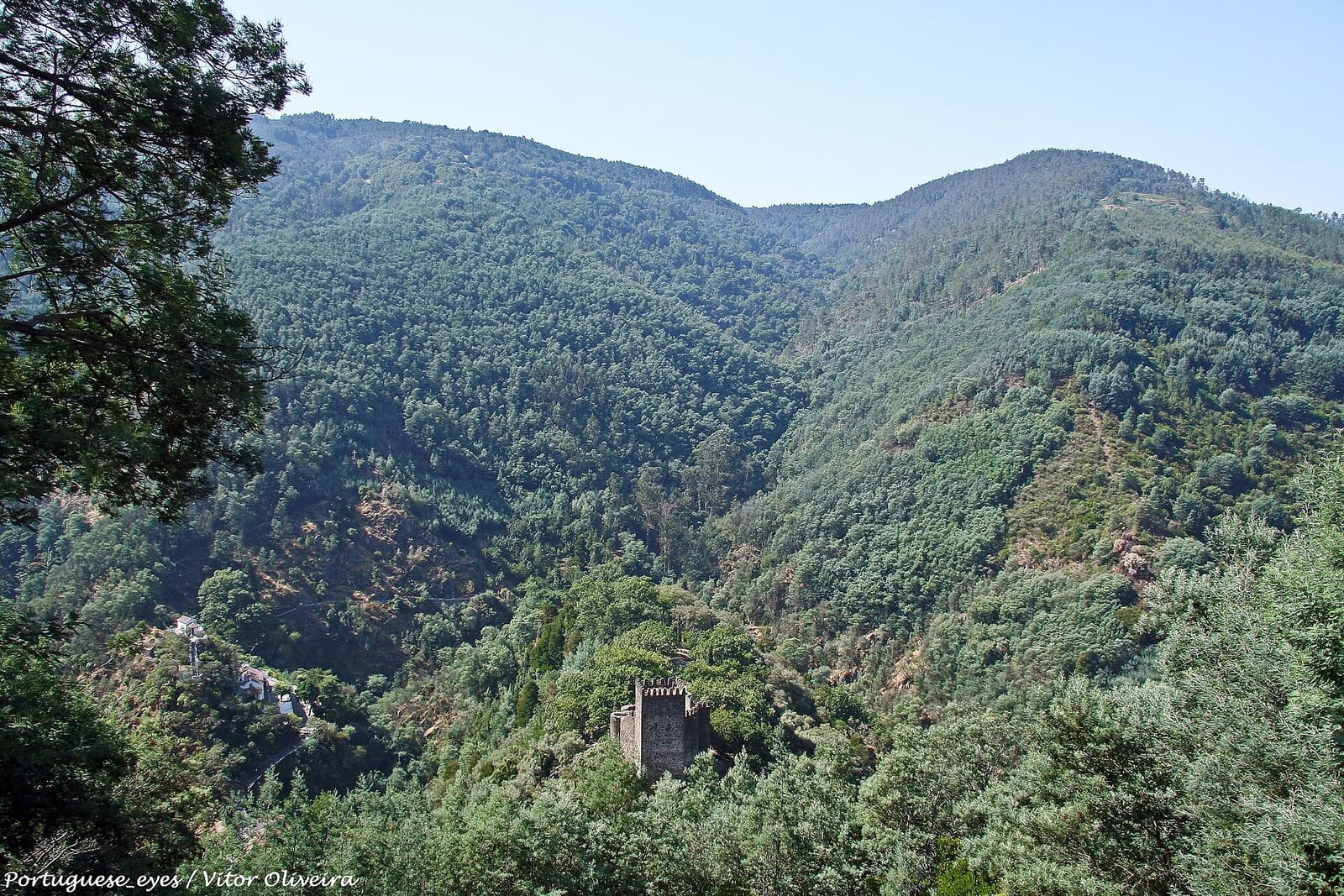
The territory follows the massif of the Serra da Lousã, whose highest point is the Trevim (1204 m). The villages occupy different slopes and do not form a single route:
- Lousã: Talasnal, Candal, Cerdeira, Casal Novo and Chiqueiro, on the western slope, all in the basin of the Ribeira de São João.
- Góis: Aigra Nova, Aigra Velha, Comareira and Pena, on the northern slope, near the Penedos de Góis.
- Miranda do Corvo: Gondramaz, on the western edges of the massif.
- Castanheira de Pera: Coentral Grande, at high elevations near Santo António da Neve.
- Penela: Ferraria de São João, at the southern end of the range.
- Figueiró dos Vinhos: Casal de São Simão, in the civil parish of Aguda, at the south-western extremity.
The two southern villages belong to different municipalities. Penela has Ferraria de São João and Figueiró dos Vinhos has Casal de São Simão. The two are linked by the Ribeira de Alge, which passes close to Casal de São Simão on its way to the Zêzere.
The five villages of Lousã
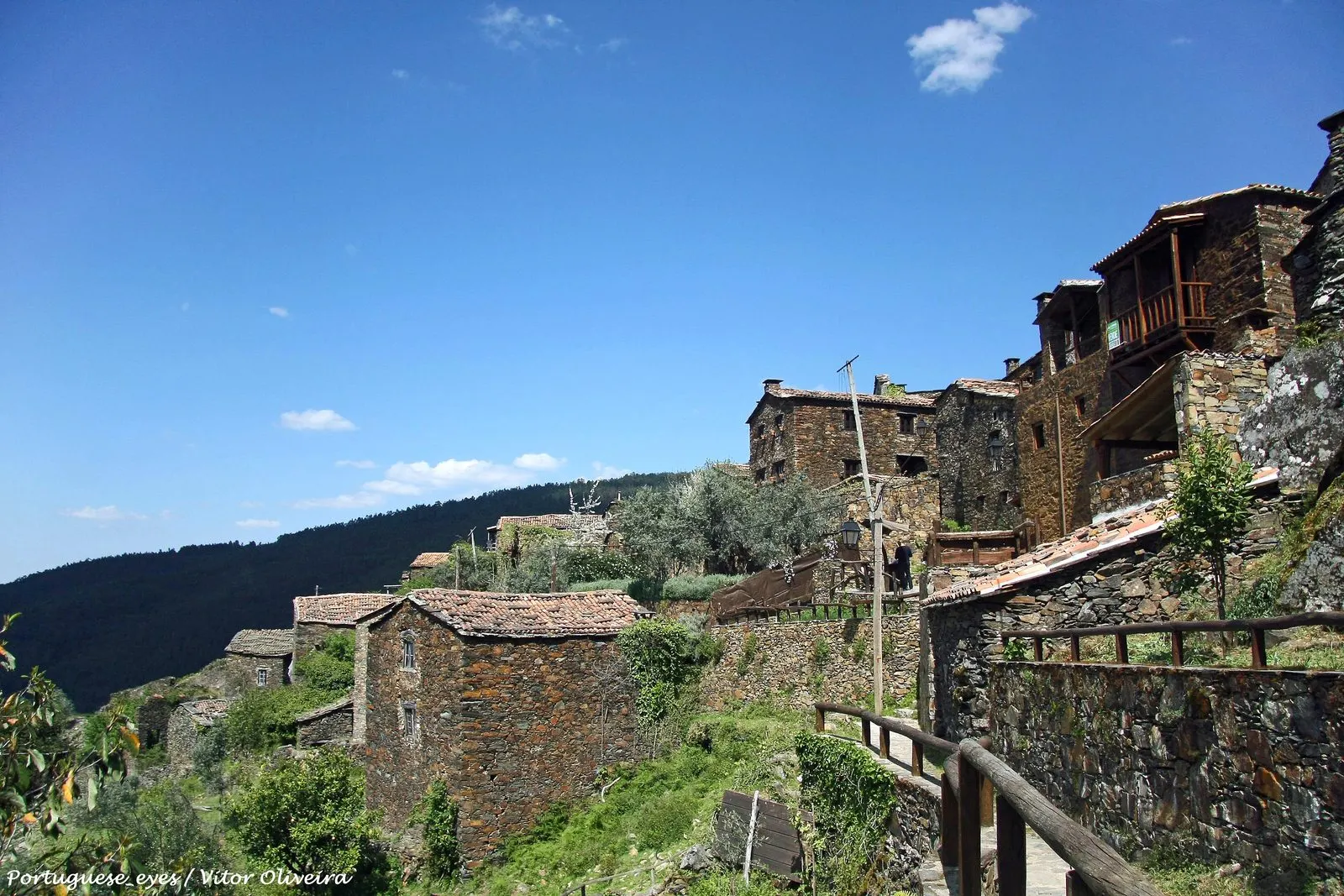
Talasnal is the village that, according to the network itself, has given the group the most visibility. It lies 12 km from Lousã, reached via Cacilhas. The settlement stretches along a ridge facing the valley floor. A steep main lane gives access to alleys and cul-de-sacs. The houses are of dark schist, and almost no façades are rendered. The entry records two former olive presses: one is in ruins and the other, privately owned, has been restored. Talasnal reached its peak population in 1911, with 129 inhabitants. The school closed in 1975, when it had only two pupils. Today the houses are second homes, accommodation or shops.
Candal lies beside the EN236, the road linking Lousã with Castanheira de Pera. The entry mentions this «privileged accessibility» and describes it as one of the most visited villages. Most of the buildings are on a slope facing east, in an amphitheatre above the Ribeira do Candal. By the road there is a row of rendered and painted houses. It is worth climbing to the viewpoint above the village and looking for the fountain dated 1941. By the stream, the entry notes five water mills from the 1920s and an olive press dated 1919, restored with its mechanism working.
Cerdeira develops almost vertically down a hillside, along a single lane that descends to the stream. The houses are of dark schist and no façade is rendered. According to the entry, the village was refounded as a place for artistic creation, with residencies, workshops and a School of Arts and Crafts. The House of Arts and Crafts was rebuilt under the ECO-ARQ programme, using local materials. Every year, in July, the village hosts the festival Elementos à Solta.
Casal Novo is easily overlooked by those arriving on the unpaved track, because the vegetation hides its profile. The village is organised along the path that descends to the Sanctuary of Our Lady of Piety. The former threshing floor now serves as a viewpoint over Lousã and its castle. According to the entry, Casal Novo has had no permanent inhabitants since 1981.
Chiqueiro is higher up, between two small watercourses. It is laid out in two steep lanes of dark schist, and only the chapel is rendered. The Chapel of Our Lady of the Guide was shared with Casal Novo and Talasnal. The village once had a resident priest. The festival of Nossa Senhora da Guia takes place on the second Saturday of September.
According to the network, the permanent occupation of these five villages began in the second half of the 17th century or in the early 18th century. Until then, the range was used mainly by shepherds, in spring and summer. The oldest documents cited are a fine imposed by the Lousã Municipal Council in 1679 and a register of emphyteutic properties from 1687.
The four villages of Góis
The four villages of Góis are close to one another and are presented by the network as a group. Access is from the N342 or the N2, with signposting to all four villages.
Aigra Nova has three small streets and low houses of schist, some of them rendered. The door lintels are generally of oak or chestnut. The Ecomuseu Tradições do Xisto (Schist Traditions Ecomuseum) operates here, with several sites. There is also a network shop and a tree-planting project for maternity. The Cadastro da População do Reino (Census of the Kingdom’s Population) of 1527 already records, within the term of Góis, a settlement with four households, which the entry identifies with Aigra Nova.
Aigra Velha occupies a ridge at 770 m above sea level according to the official entry. The houses are single-storey and form a closed group, designed against bad weather, intruders and wolves, with internal passages between the dwellings. The oven and still of the Claro family were restored under the ECO-ARQ project. On the approach from the EN2, via Pena, about 2 km are unpaved.
Comareira is a small settlement, sunny all day, surrounded by cômoros, the earthen terraces that probably gave it its name. It is built of schist and quartzite, and some façades have the traditional coarse render. The network presents it as its smallest village.
Pena sits on a spur of quartzite, on the left bank of the Ribeira da Pena, facing the Penedos de Góis. It has a single main street and several alleys, built of schist and quartzite. Beside the bridge stands a monumental chestnut tree. Along the stream there are a levada (irrigation channel), a privately owned water mill and natural pools.
Gondramaz, Coentral Grande and the southern villages
Gondramaz (Miranda do Corvo) stretches along a ridge line, with a main street from which narrow lanes branch off. Schist covers façades and paving. The entry highlights the paved route accessible to people with reduced mobility and the figures carved in stone by local craftsmen. At the entrance, a plaque reproduces a poem by Miguel Torga. Points of interest include the Chapel of Nossa Senhora da Conceição, a alminha (roadside shrine to souls), the wash-house and the fountain.
Coentral Grande (Castanheira de Pera) is the network’s 28th village and the geological exception of the territory. It sits on an outcrop of granite in the midst of schist, and its architecture is granitic. It was the home of the neveiros (snow-gatherers), who in winter collected and compacted snow on the heights of Santo António da Neve to send it to Lisbon. The Casa do Neveiro, a museum centre set up in 2002 in the former parish council building, tells this story. The entry also highlights the Ribeira das Quelhas footbridges and the snow pits (poços neveiros), at about 1100 m altitude.
Ferraria de São João (Penela) lies on a quartzite ridge at the southern end of the range. It is built mainly of quartzite, with some façades rendered and painted white. What sets it apart is the group of communal sheepfolds (currais comunitários) beside an oak woodland. The entry describes them as among the most numerous still preserved in the country. The village also has a mountain biking centre with several signposted routes. The unpaved road only reached it in 1961.
Casal de São Simão (Figueiró dos Vinhos) has practically a single street, running along a ridge above the Ribeira de Alge. It is built mainly of quartzite. At the entrance stands the Ermida de São Simão (Chapel of São Simão), with a Gothic inscription dating its completion to 1458. There is also a house with the date 1701 carved on its lintel and a fountain from 1939. A path descends to the Fragas de São Simão (Crags of São Simão), where there is a river beach. The crags appear in the setting of O Baptismo de Cristo (The Baptism of Christ) by José Malhoa, which the painter gave in 1904 to the Mother Church of Figueiró dos Vinhos.
How the houses are built
The entries for these villages describe construction adapted to the slope and to the materials available. In Aigra Nova, Comareira and Pena, the typical house has two floors. The ground floor sheltered livestock. The upper floor served as living quarters and storage for grain, olive oil, salted meat and tools. In Talasnal, Casal Novo and Chiqueiro there are two types of building: the currais (sheepfolds), with only a ground floor and a thatched roof, and two-storey houses, with the upper floor reached by a schist staircase. In these, the schist walls were laid with a mortar of clay and straw, and the structure was of chestnut or pine.
Variations also matter. Many façades in Lousã were left unrendered. In Comareira and Pena there are traditional renders, and in Ferraria de São João the living floor was rendered while the sheepfolds were left as bare stone. The guide to schist houses and the one on vernacular architecture develop these themes outside the context of the network.
Preparing the visit
When consulted on 5 November 2026, the official entries listed these routes:
- Villages of Lousã: the «Caminho do Xisto da Lousã» routes, such as the PR2 Rota das Aldeias do Xisto da Lousã, the PR3 Rota da Levada and the PR4 Rota do Trevim.
- Villages of Góis: the PR1 GOI, Rota das Tradições do Xisto, and the PR9 GOI, Trilho do Baile.
- Gondramaz: the PR1 MCV, Caminho do Xisto Acessível.
- Ferraria de São João: the PR1 PNL, Trilho do Rebanho, and the routes of the mountain biking centre.
- Casal de São Simão: the PR1 FVN, Descida às Fragas.
Before setting out, check the entry for each village and the network’s route platform for the condition of the trails, their length and their level of difficulty.
Plan the journey village by village. Candal lies on the EN236. Coentral Grande has a paved approach from the EN236-1. By contrast, the entries for Talasnal, Chiqueiro and Casal Novo indicate access by an unpaved forest track from Cacilhas; for Casal Novo, the network considers these tracks passable by light vehicles driven with care. In several of these villages there are few or no permanent residents. Many houses are private homes: respect properties, yards and sheepfolds. For accommodation, dining and events, use the contacts in each village’s entry and the municipal tourist offices.
To continue along the network, see the Aldeias do Xisto da Serra do Açor and the Aldeias do Xisto do Zêzere. To place the territory in context, consult the page on the Centro region and the one on Penela.
Photograph by Vitor Oliveira, 9 April 2017. Original on Wikimedia Commons, under CC BY-SA 2.0; resized and compressed for the web, without altering the composition.
Frequently asked questions
- How many Villages of Schist are there in the Serra da Lousã?
- Thirteen, according to the official portal consulted on 5 November 2026. They are spread across six municipalities: Lousã (5), Góis (4), Penela, Figueiró dos Vinhos, Miranda do Corvo and Castanheira de Pera (one each).
- Which villages are in the municipality of Lousã?
- Talasnal, Candal, Cerdeira, Casal Novo and Chiqueiro. They lie on the western slope of the range, in the basin of the Ribeira de São João, and are linked to one another by several walking routes.
- Are all the villages built of schist?
- No. Schist predominates in most of them, but Casal de São Simão and Ferraria de São João are mainly built of quartzite, and Coentral Grande sits on an outcrop of granite, with granite architecture.
- Is being a Village of Schist a heritage classification?
- No. The network is a development and tourism project coordinated by ADXTUR. A village's inclusion in the network is not equivalent to the legal classification of buildings or groups of buildings.
Sources
- Aldeias do Xisto — Território: Serra da Lousã
- Aldeias do Xisto — Talasnal
- Aldeias do Xisto — Candal
- Aldeias do Xisto — Cerdeira
- Aldeias do Xisto — Casal Novo
- Aldeias do Xisto — Chiqueiro
- Aldeias do Xisto — Aigra Nova
- Aldeias do Xisto — Aigra Velha
- Aldeias do Xisto — Comareira
- Aldeias do Xisto — Pena
- Aldeias do Xisto — Casal de São Simão
- Aldeias do Xisto — Ferraria de São João
- Aldeias do Xisto — Gondramaz
- Aldeias do Xisto — Coentral Grande
- ADXTUR — A rede: história e desenvolvimento
- Wikidata — Talasnal (Q15060263), coordenadas
Keep exploring
Heritage nearby
More places to discover from here. Approximate straight-line distances, within 50 km.