Monuments
Royal Basilica of Castro Verde
Royal Basilica of Castro Verde, classified in 2023: c. 1573 mother church honouring Ourique, with 18th-century battle azulejos, gilded woodwork and treasury.
- Location
- Castro Verde, Beja
- Built
- obra iniciada c. 1573; fachada e interior renovados na segunda metade do séc. XVIII; título de Basílica Real em 1735
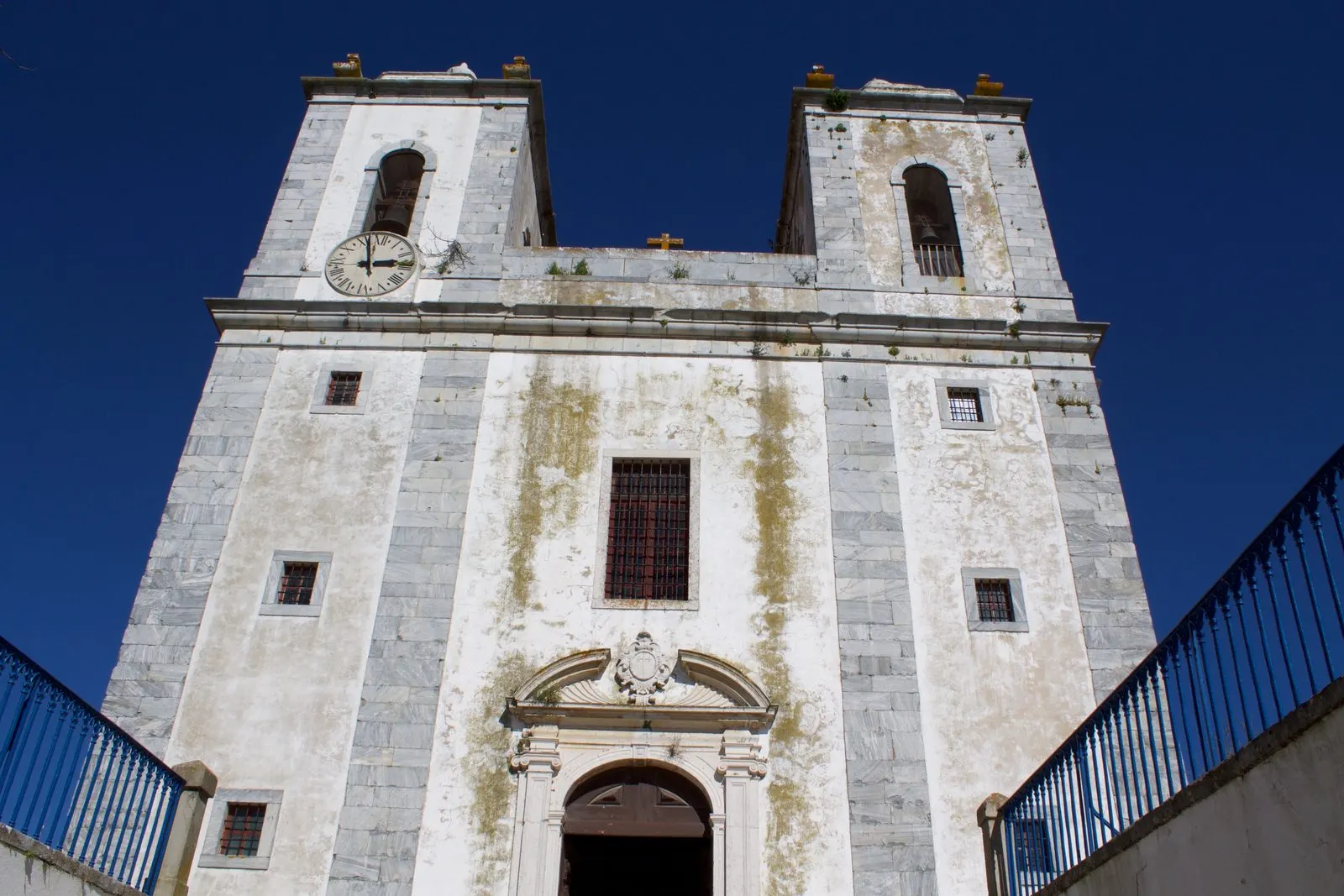
The Royal Basilica of Castro Verde, also called the Church of Our Lady of the Conception, is the parish church of the town of Castro Verde, in the Lower Alentejo. Overlooking the square, the whitewashed façade and the two bell towers stand out. What distinguishes it is its decorative programme: the interior is lined with eighteenth-century azulejos that narrate, panel by panel, the Battle of Ourique, the victory of D. Afonso Henriques that tradition associates with the origins of the kingdom. In 2023 it became a National Monument.
From Order of Santiago church to Basilica
Castro Verde was a commandery of the Order of Santiago in the early sixteenth century, and the order had a church built in the settlement, erected from the late Middle Ages onwards. A visitation by the friars of Santiago in 1510 already mentions a church on the site of the present one, described as a smaller building and structurally different.
According to André de Resende, cited in the record of the Património Cultural, I.P., it was King D. Sebastião who, around 1573, ordered the old church to be demolished and a church built in its place that would commemorate «worthily» the «memorable victory» of Ourique. The work, called a basilica at the time, is thought to have continued into the following century. The record points to similarities with buildings by João Antunes, in particular the church of Santiago in Alcácer do Sal, and notes that some authors attribute the design to him; the classification decree speaks only of similarities.
After the Restoration, the House of Bragança sought to legitimise itself also through the symbolism of Ourique. It was in this context that D. João V granted the church, in 1735, the designation of Royal Basilica.
The building
The structure is plain, in keeping with religious architecture of the last quarter of the sixteenth century. The plan is longitudinal, with a single nave of rectangular section, followed by the chancel, also rectangular but smaller, flanked by two annexes of equal size. The façade is sober and divided into three registers: in the first, the portal opens, preceded by a staircase and forecourt, flanked by Ionic pilasters and topped by a broken pediment bearing the arms of the Order of Santiago; above it, a rectangular window; the whole ends in a gable. Two bell towers of square section, with pinnacles and cupolas, frame the façade. The façade was probably altered in the second half of the eighteenth century, as was the interior.
The Ourique azulejos
This second phase of works gave the present interior. The walls of the nave are covered with eighteenth-century azulejo panels, divided into two registers: below, compositions of albarradas; above, figurative panels that tell the story of the Battle of Ourique. The 2023 decree attributes the iconographic programme to Master PMP.
The chancel is covered by a barrel vault painted with polychrome baroque motifs and lined with azulejos made in Lisbon and dated 1713, depicting episodes from the life of Christ. The decree also highlights the interior’s gilded woodwork.
In one of the sacristies is kept the treasury of the Royal Basilica, which the decree describes as a collection of pieces of great quality and rarity. The decree does not inventory it, and neither does this page: what it contains and the conditions of access should be confirmed on site.
Classification
The parish church of Castro Verde was classified as a property of public interest by Decree No. 45/93, of 30 November 1993. Decree No. 18/2023, published in the Diário da República, 1st series, No. 136, of 14 July 2023, reclassified it as a National Monument and renamed it «Royal Basilica of Castro Verde, also known as the Church of Our Lady of the Conception, parish church of Castro Verde». The decree invokes the property’s matrix character, its symbolic and historical value and its aesthetic value. The plan annexed to the diploma defines a general protection zone around the building. The property is not on the World Heritage List.
Visiting
The basilica is on Largo Dr. João Guerreiro Mestre, in Castro Verde, in the civil parish union of Castro Verde and Casével. When consulted on 5 November 2026, it was not possible to confirm, from an accessible official source, the opening hours or the visiting conditions of the church and treasury. Contact the Municipality of Castro Verde or the parish before travelling, especially outside service times.
Castro Verde is also the centre of a cereal-growing plain landscape, covered on the page for the Castro Verde Biosphere Reserve; the municipality belongs to the district of Beja. Among the church types to which it belongs, see the index of parish churches.
Photograph by Patrick Nouhailler from Genève, Suisse, of 9 March 2017. Original on Wikimedia Commons, under CC BY-SA 2.0; resized and compressed for the web, without altering the composition.
Frequently asked questions
- Why is it called the Royal Basilica?
- According to the 2023 classification decree, King D. João V granted the church the designation of Royal Basilica in 1735, by virtue of its connection with the founding symbolism of D. Afonso Henriques's victory at Ourique, within the context of the legitimation of the House of Bragança.
- Do the azulejos depict the Battle of Ourique?
- Yes. The walls of the nave are covered with eighteenth-century azulejo panels in two registers: the first with albarradas, the second with figurative panels narrating the Battle of Ourique. The iconographic programme is attributed to Master PMP. The chancel has azulejos made in Lisbon in 1713 depicting episodes from the life of Christ.
- What is the basilica's classification?
- National Monument, through reclassification by Decree No. 18/2023, published in the Diário da República, 1st series, No. 136, of 14 July 2023. Previously, the church had been classified as a property of public interest by Decree No. 45/93, of 30 November 1993.
- Where did the Battle of Ourique take place?
- The national record states only that Castro Verde lies near the place of São Pedro das Cabeças, where the battle is said to have taken place.
Sources
- Património Cultural, I.P. — Basílica Real de Castro Verde, também designada Igreja de Nossa Senhora da Conceição, matriz de Castro Verde (73679)
- Património Cultural, I.P. — Atlas do Património Classificado e em Vias de Classificação (NINV 4623)
- Diário da República — Decreto n.º 18/2023, de 14 de julho
- Wikidata — Basílica Real de Castro Verde (Q66813121)
Keep exploring
Heritage nearby
More places to discover from here. Approximate straight-line distances, within 50 km.