Monuments
Manor houses and palaces of Viana do Castelo
Four National Monuments of Viana do Castelo: Casa dos Arcos, Casa de Miguel de Vasconcelos, the Paços municipais and the Palácio dos Viscondes da Carreira.
- Location
- Viana do Castelo, Viana do Castelo
Among the buildings that the State has classified in Viana do Castelo are four examples of civil architecture: two urban houses, the municipal palaces and a palace. This guide groups them together because their classification brings them close: all are National Monuments. The official record does not treat them as a single entity, and it is worth saying so from the outset: only one of the records, that of the Casa dos Arcos, has an accessible detailed description; for the other three, what can be confirmed is the designation, the location and the classification decree.
House known as João Velho or dos Arcos
This is the best documented. The record (NINV 4208, code 70309) places it on the Largo do Instituto Histórico do Minho, at the Rua do Poço, and describes it as one of the few surviving examples of Gothic civil architecture of its type in Portugal, built at a time of strong economic development in the town, linked to the importance of the port in the overseas expansion.
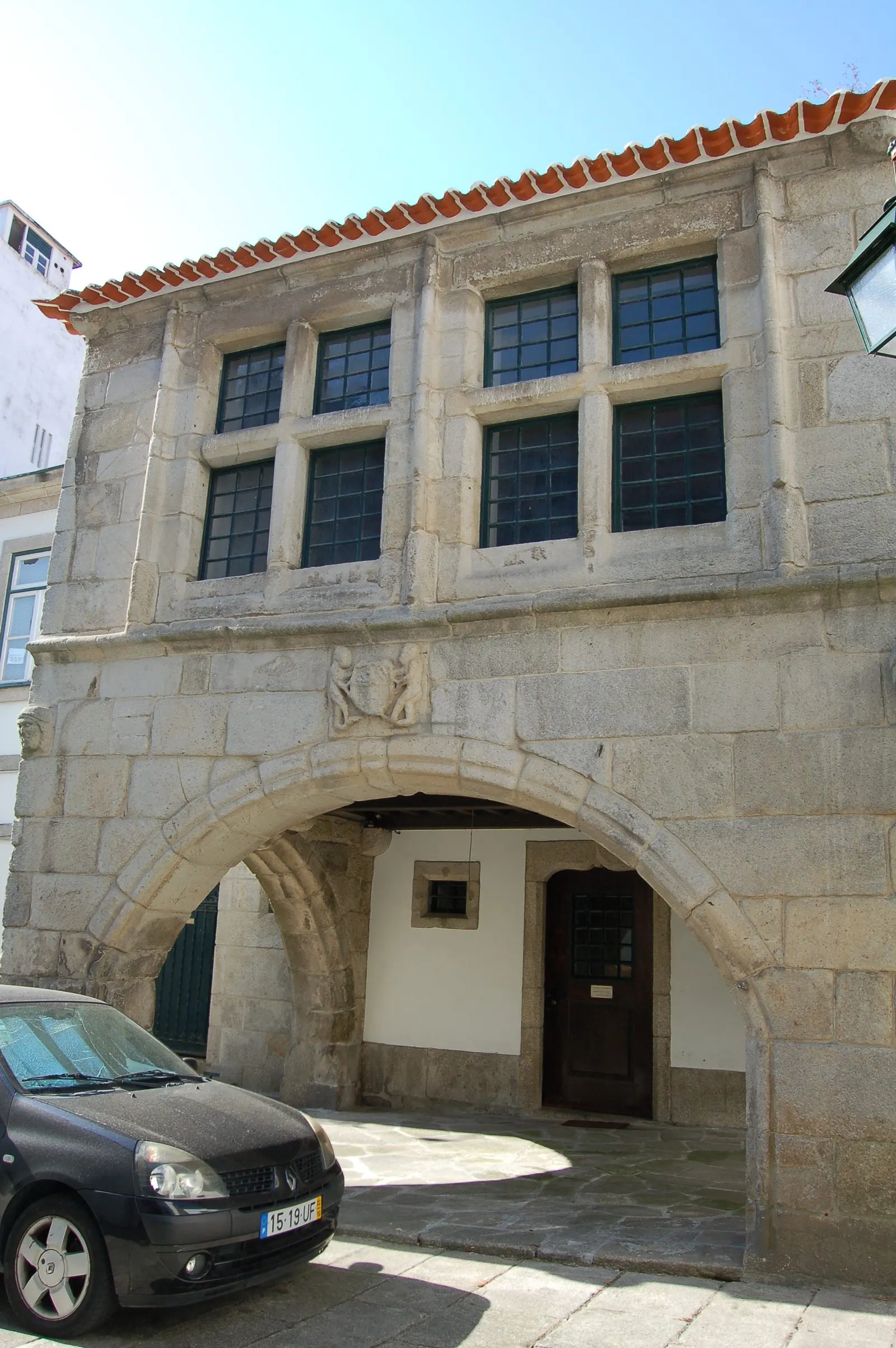
The plan is rectangular, in two levels: below, an open loggia and storeroom; above, the residence. The façade has a basket-handled arch over the loggia, surmounted by a stone coat of arms of the Velho family, and at the corners, level with the arms, two corbel heads. The noble floor, resting on a timber framework, has two cross-mullioned windows separated by small colonnettes, and the stone staircase leans against the side façade. The record adds that the house formed part of a group of houses on the largo of the matriz with the same structure, a noble floor over an open arcaded loggia, and that this typology recalls examples of Galician civil architecture of the same period.
The name comes from tradition, which holds that the navigator João Velho lived there and that D. Manuel stayed in the house in 1502, on his pilgrimage to Santiago. The record itself corrects this: it is known that João Velho lived near the Porta do Postigo, further down, close to the river, and the house was possibly that of his son, who bore the same name. The interior has been heavily altered; the most significant intervention was the work of 1914 by the Instituto Histórico do Minho, which was housed there until 1918.
Casa de Miguel de Vasconcelos
The national record (NINV 4209) also gives it the names Casa dos Medalhões and Casa dos Lunas. It was classified in the same decree as the Casa dos Arcos, Decree no. 11 454, of 19 February 1926, which lists it as «Casa de Miguel de Vasconcelos, Viana do Castelo». I was unable to read the descriptive record for this house; I therefore do not describe its architecture or history, and I do not give dates that I could not confirm.
Paços municipais de Viana do Castelo
The Paços municipais (NINV 4231) are a National Monument by the decree of 16 June 1910, published in the Diário do Governo no. 136, of 23 June 1910. They appear, alongside the Palácio dos Viscondes da Carreira and the two houses above, in the list of properties covered by the special protection zone set by the Portaria of 12 June 1973, which shows that the instrument groups them within the same urban core. I have not read an official source on the construction and works of the building; this is the weakest point of this guide.
Palácio dos Viscondes da Carreira
The Atlas (NINV 4230) records it under the alternative names Palácio dos Viscondes de Carreira, Palácio dos Távoras and Câmara Municipal de Viana do Castelo. It is a National Monument by the same 1910 decree. As with the previous record, I was unable to read the official description; the reference to the Câmara Municipal is an alternative designation in the record, and I have not confirmed whether the palace still houses municipal services today.
Taken together
The Casa dos Arcos, the only one described in the record, shows a model of urban house with an open loggia and a granite noble floor, which the record itself compares with Galician civil architecture; the Casa de Miguel de Vasconcelos was classified alongside it in 1926, and the other two buildings, with civic and seigneurial functions, sixteen years earlier, in the 1910 decree. For context, see Renaissance architecture, the language of the Manueline style and the typology of manor houses and seigneurial residences. A comparable house in the Alentejo is the Casa de Garcia de Resende, in Évora.
How to visit
When I consulted the sources on 5 November 2026, I found no visiting hours from an official source for any of the four buildings. All can be appreciated from the street, in the historic centre; for the interiors, please confirm with the Viana do Castelo municipality.
Photograph by MTeresaSoares, dated 29 September 2011. Original on Wikimedia Commons, under CC BY-SA 3.0; resized and compressed for the web, without altering the composition.

Frequently asked questions
- Are these four houses listed?
- Yes, all as National Monuments. The Casa de João Velho or dos Arcos and the Casa de Miguel de Vasconcelos by Decree no. 11 454, of 19 February 1926; the Paços municipais and the Palácio dos Viscondes da Carreira by the decree of 16 June 1910, according to the Atlas do Património Classificado.
- Did João Velho live in the Casa dos Arcos?
- That is what popular tradition says. The official record notes that João Velho in fact lived near the Porta do Postigo, and that the house was probably the residence of his son of the same name.
- Can I visit the interiors of these buildings?
- When I consulted the sources on 5 November 2026, I found no visiting hours published by an official source for any of the four. They can be seen well from the street; for the interiors, please confirm with the Viana do Castelo municipality.
- Is the Palácio dos Viscondes da Carreira the town hall?
- The Atlas do Património Classificado records «Câmara Municipal de Viana do Castelo» among the alternative designations of the palace, which is also known as the Palácio dos Távoras. I have not confirmed its current use with the municipality.
Sources
- Património Cultural, I.P. — Atlas do Património Classificado e em Vias de Classificação (NINV 4208, 4209, 4230 e 4231)
- Património Cultural, I.P. — Casa chamada de João Velho ou dos Arcos (70309)
- Diário do Governo, I série, n.º 35, de 19-02-1926 — Decreto n.º 11 454
- Diário do Governo, I série, n.º 136, de 23-06-1910 — Decreto de 16 de junho de 1910