Monuments
Celorico da Beira Castle
Visit Celorico da Beira Castle in Beira Alta: oval walls and a tower, besieged by León in 1198, rebuilt by D. Dinis, restored since 1936. National Monument.
- Location
- Celorico da Beira, Guarda
- Built
- Séc. XII–XIV (reforma de D. Dinis); restauro de 1936 aos anos 1940
The Castelo de Celorico da Beira crowns the hill above the town of Celorico da Beira, in the district of Guarda. The oval curtain wall and the square tower dominate the rooftops and the valley fields. The site has a documented military history dating from the late 12th century. The image it presents today, however, owes nearly as much to the 20th-century restoration as to the Middle Ages, and the national register states this frankly.
Uncertain origins
The national register of the Património Cultural, I.P. begins by setting aside the legends. No material trace links the hill to the foundations attributed to Brigo and the Turduli. A connection with the Roman Celióbriga is also unproven. A Latin inscription reported in 1635 later disappeared, and it is not known where it was found. The municipality of Celorico, for its part, notes that some authors admit a Romanised proto-historic hillfort on the site and cites a Roman votive inscription dedicated to a pre-Roman deity. Occupation before the Middle Ages thus remains to be demonstrated.
The transfer of Celorico to the Portuguese crown and the works of the first kings are also poorly documented. The register cites Adriano Vasco Rodrigues, who accepts that the site was already fortified in the 12th century and that D. Afonso Henriques conquered it and granted a charter (foral) to its inhabitants.
Sieges and charters
The first concrete reference to the castle dates from 1198. That year, Leonese troops besieged the fortress, and the alcaide (castellan), D. Rodrigo Mendes, asked his brother, D. Gonçalo Mendes, alcaide of the neighbouring Castelo de Linhares, for help. In 1217, D. Afonso II granted a charter to Celorico. In 1246, the future D. Afonso III besieged the fortress, during the civil war against his brother, D. Sancho II.
The reform of D. Dinis
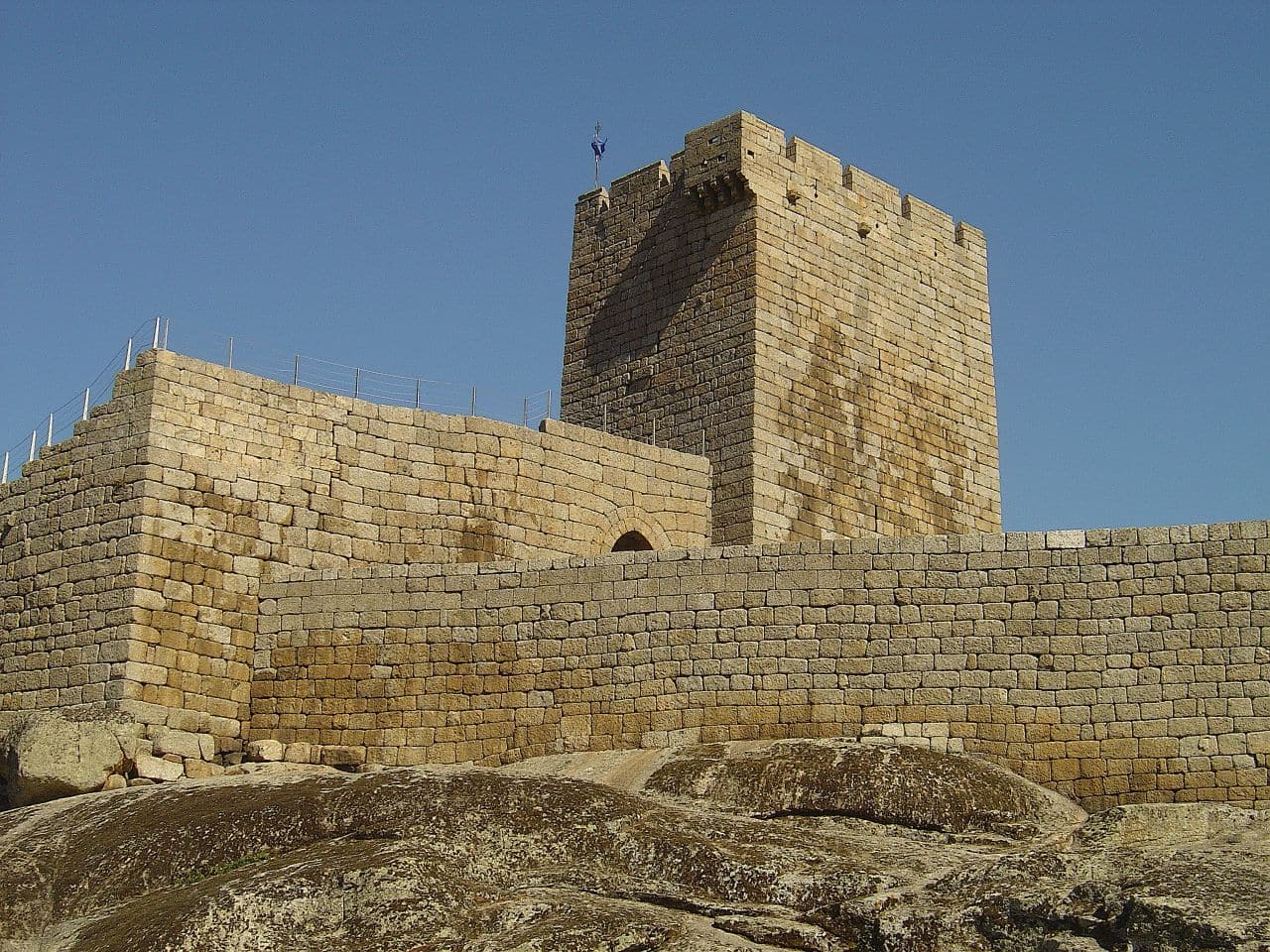
The national register attributes the castle’s general appearance to a extensive reform under D. Dinis, in the 14th century. The plan follows the Gothic model: the curtain wall is clearly oval and adapted to the terrain. The works are thought to have continued through the reigns of D. Afonso IV, D. Pedro and D. Fernando.
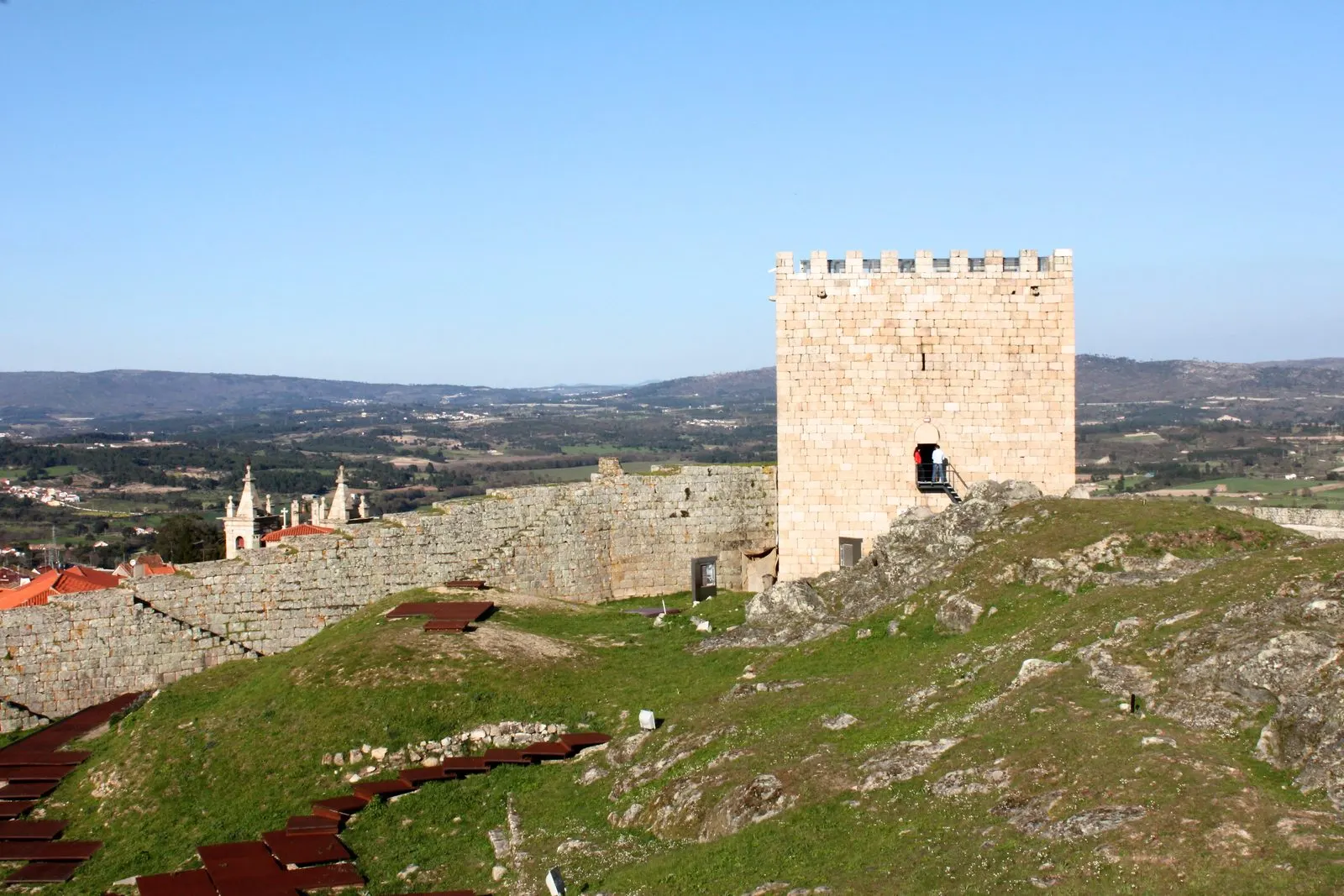
The tower is rectangular, of two storeys, and is built against the curtain wall in the northeast sector, a position typical of the active defence of the Gothic period. Entry is through a raised doorway with a pointed arch. Originally it was reached by a movable ladder; today one climbs a metal staircase. The enclosure has two gates, to the south and west, in an arrangement that the register considers may still be of Romanesque origin.
The municipality offers a different reading of the tower. It describes the castle as Romanesque-Gothic, with two entrances and two bastions built against the south side. According to the same page, the original keep would have stood at the centre of the redoubt, and no traces of it survive; the present tower would be later. Both sources agree on the Dionysian date of the curtain wall and on the position of the tower against the wall.
Ruin and restoration
In the 16th century, there are records of several improvements and, in 1640, shortly after the Restoration, works were carried out. A century later, however, Jerónimo Contador de Argote described the castle as badly ruined, with sections of wall destroyed and the cistern filled with rubble. In the 19th century, the dismantling accelerated. In 1817, the circuit magistrate (corregedor da comarca) requested stone for paving work. In 1835, the municipal council itself gave up stone for the municipal market, and further demolitions followed.
The restoration began in 1936 and continued into the early 1940s. The national register classifies it as an inventive “reintegration”. Walls were rebuilt, earth in the interior was turned over, and floors, roofs and parapet heights were altered. Much of what is seen today results from this idealised vision of the Middle Ages.
In this century, the municipality has carried out a requalification of the castle and the tower. An archaeological excavation between January and March 2007 recovered thousands of ceramic fragments, from the medieval to the contemporary period. In 2008, lighting and the requalification of the tower followed. In May 2022, the municipality inaugurated the Casas do Castelo, two rehabilitated buildings that link to the castle.
Classification
The castle is a National Monument. The Decree of 16 June 1910, published in the Diário do Governo no. 136 of 23 June 1910, classified the Castelo de Celorico. The Decree no. 8 176, published in the Diário do Governo, Series I, no. 110, of 3 June 1922, classified the castle together with its curtain wall. The castle is not part of any UNESCO inscription. The municipality of Celorico da Beira is part of the Serra da Estrela Biosphere Reserve.
Planning the visit
When consulted on 5 November 2026, the municipal page on the castle indicated opening every day, 9:00 to 13:00 and 14:00 to 17:00. That page had last been updated in November 2020. Please confirm the hours with the Tourist Office of Celorico da Beira or the municipal council, at Rua Sacadura Cabral, before you go.
Celorico is not one of the Aldeias Históricas de Portugal, but the municipality includes one of them: Linhares da Beira, whose castle shares with Celorico the episode of 1198. To complete the route, see the itinerary of Centro de Portugal and the network of castles of Portugal.
Photograph by Nmmacedo, dated 21 March 2011. Original on Wikimedia Commons, under CC BY-SA 3.0; resized and compressed for the web, without altering the composition.
Frequently asked questions
- When was the Castelo de Celorico da Beira built?
- The earliest secure reference dates from 1198, when the castle was besieged by Leonese troops. Its present appearance results mainly from a reform carried out under King Dinis in the 14th century, and from a heavily interventionist restoration begun in 1936.
- Is the castle classified?
- Yes. It is a National Monument. The Decree of 16 June 1910 classified the Castelo de Celorico; Decree no. 8 176, published in the Diário do Governo of 3 June 1922, extended the classification to the castle together with its curtain wall.
- What is the connection with Linhares da Beira?
- The two castles are in the same municipality. In 1198, during the Leonese siege, the alcaide (castellan) of Celorico, D. Rodrigo Mendes, asked his brother, D. Gonçalo Mendes, alcaide of Linhares, for help. Linhares da Beira is one of the Aldeias Históricas de Portugal (Historic Villages of Portugal); Celorico is not part of that network.
- When can it be visited?
- When consulted on 5 November 2026, a municipal web page last updated in November 2020 indicated opening hours every day, 9:00 to 13:00 and 14:00 to 17:00. Please confirm the schedule with the municipality or the tourist office before going.
Sources
- Património Cultural, I.P. — Castelo de Celorico da Beira, com a respectiva muralha (70710)
- Património Cultural, I.P. — Atlas do Património Classificado, Castelo de Celorico da Beira (NINV 2910)
- Diário do Governo — Decreto n.º 8 176 (I Série, n.º 110, 3-06-1922)
- Diário do Governo — Decreto de 16 de junho de 1910 (n.º 136, 23-06-1910)
- Município de Celorico da Beira — Castelo de Celorico da Beira
- Município de Celorico da Beira — Obras de requalificação do Castelo de Celorico da Beira e Torre de Menagem
- Município de Celorico da Beira — Inauguração das Casas do Castelo
- Município de Celorico da Beira — Castelo de Celorico da Beira (informações e horário)
- Wikidata — Castelo de Celorico da Beira (Q5049769)
- Aldeias Históricas de Portugal — Página inicial (lista das 12 aldeias)
Keep exploring
Heritage nearby
More places to discover from here. Approximate straight-line distances, within 50 km.